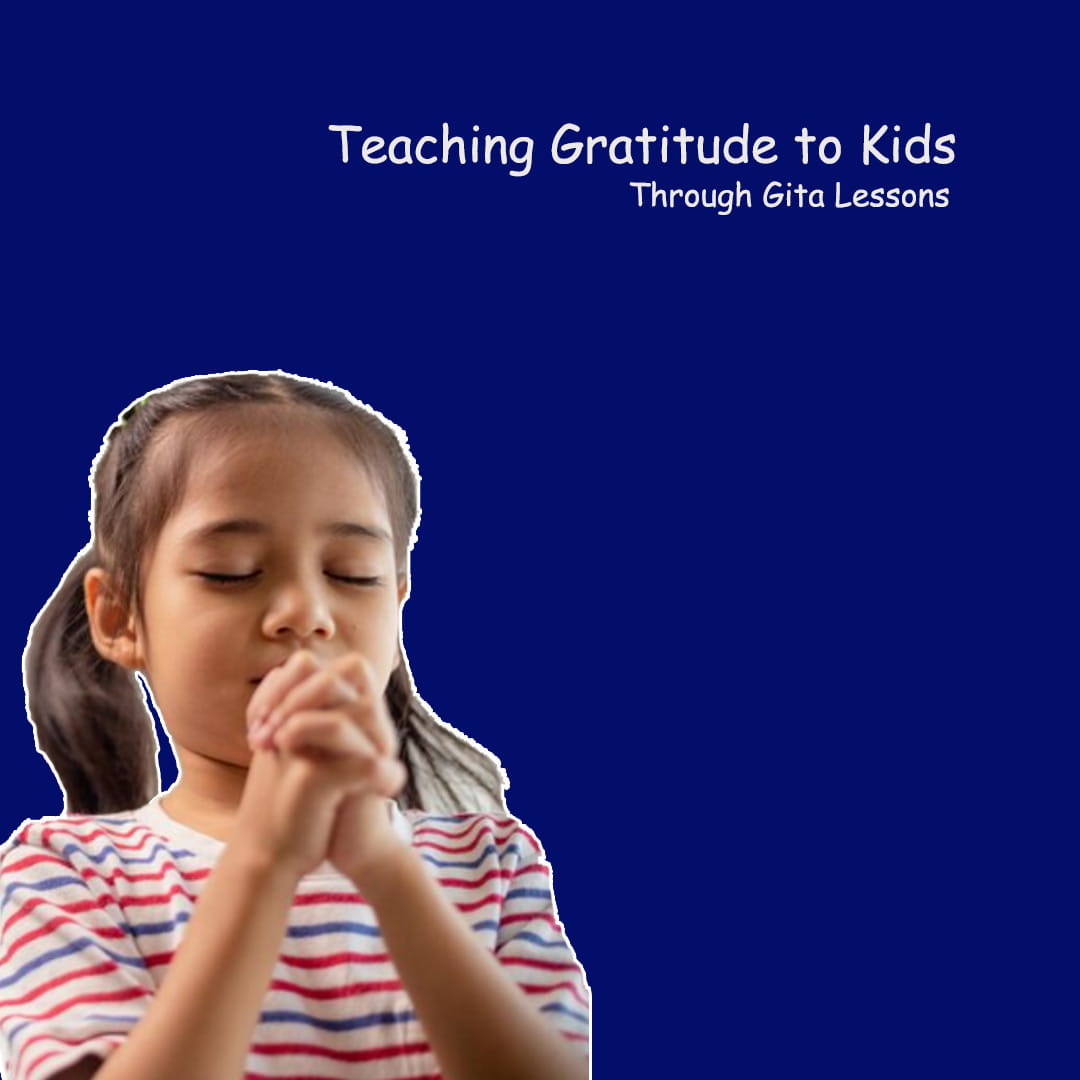
To have a fulfilling, healthy and content life, some virtues should be instilled deep in the psyche of our children and gratitude can undoubtedly be considered the most important among these. Simply put, gratitude means thankfulness, appreciating whatever you have got from life. One might be intrigued that why gratitude is put in front row. So, when today’s world is turning more materialistic everyday and there is a plethora of things available around us to desire for, being grateful for what we already have, and being content with whatever we already have, is absolute necessity for mental peace and a stress-free life. It builds a foundation for a life full with strong moral values. Gratitude is necessary to cope in today’s fast-paced world, where children are surrounded by comforts, choices, and constant stimulation. Teaching gratitude to children has therefore become more important than ever. The Bhagavad Gita, an Indian spiritual masterpiece can serve as a resource to help kids understand gratitude and apply it in the real life.
Though the Bhagavad Gita is an ancient scripture, its teachings are deeply relevant for modern families. Kids can learn a lot from Bhagavad Gita, when explained in simple, age-appropriate ways. These Bhagavad Gita lessons can beautifully nurture gratitude, humility, and respect in young minds. The Bhagavad Gita works as a gentle moral guide for kids. The Bhagavad Gita is often seen as a philosophical text for adults, but at its heart, it teaches simple life values: thankfulness, self-control, duty, humility, and inner peace. For kids, these ideas can be shared through short stories, examples from daily life, and reflective questions. Here, in this blog we will provide you with some examples that can help parents educate how and why Bhagavad Gita can be used as a resource for teaching gratitude to kids, and for raising thankful, grounded children.
One of the most well-known teachings of the Gita is karma yoga which motivates us to perform our duty sincerely without being overly attached to the results. The Bhagavad Gita teaches us to be thankful for effort, not just results. To explain this to children we can tell them, “Do your best, and be grateful that you got the chance to try.” Kids also have to face competition in exams, sports etc and they seek approval of their parents, other elders and peers through their results. They aim for higher marks to prove themselves. And as a result, they often feel unhappy when they don’t win or score high marks. Here, if they are well acquainted with the karma yoga taught in the Bhagavad Gita, they can be grateful for: the ability to learn, the support of parents and teachers and ultimately the effort they put in. Kids learn to appreciate the process, not just the reward. It is an important gratitude lesson which children can learn through Gita lessons.
To reinforce the idea in children’s mind, we can do a simple activity alongside just verbally telling them. This activity can be performed after all exams or competitions either as a group discussion at school, or individually at home where the kids can be asked: “What did you learn from this?” or “Who helped you along the way?”
Asking questions like this shifts the focus of kids from disappointment on what they did not get, to appreciation for what they got.
Another thing that can be learnt from the Bhavad Gita is the yajna. The Bhagavad Gita focuses on Yajna, the cycle of giving. It helps kids understand that they are not actually at the centre of the universe and instead are a miniscule but important part of a beautiful, interconnected web. We all are a part of an eternal cycle of giving and receiving. It immensely helps the kids in learning gratitude as they come to understand that they are not The One and Only most important thing in the world.
Another way of instilling gratitude in kids can be through letting them understand yajna. The Bhagavad Gita mentions the concept of Yajna (sacrifice or selfless offering). It explains that the world operates in a cycle not in a straight line, anyone who is at the giving end, is also at the receiving end for one or the other thing. For instance, the rains bring food, the food sustains life, and in return, we must give back to the source.
Now, to explain this concept to our kids we must simplify it and for that we can use the example of a potluck dinner where everyone contributes in the dinner. Earth acts as a giant "potluck dinner" where everyone brings something to the table. The sun brings light, the trees bring oxygen, and the farmers bring vegetables. If we just eat and never bring a dish, the party eventually stops. Kids must understand that gratitude cannot only be felt, it must be acted upon.
The Bhagavad Gita helps kids understand that whatever we consume or need cannot be directly consumed from a shop or market. The nature is provider for us and the Bhagavad Gita tells us to respect what nature provides. The food that we eat is produced in fields after a rigorous process. The Bhagavad Gita speaks of nature (prakriti) as a divine force that sustains life. Everything we eat, wear, and use comes from nature in some form. When kids understand this, they start to appreciate the farmers and others who provide us with food and services, they start appreciating plants and animals for the services they provide. Like plants provide us with oxygen and are the source of energy for all living beings directly or indirectly. Small insects like butterfly and honeybee that otherwise may seem insignificant help in continuation of plant life on earth. Invisible microbes clean up the environment by decomposing dead bodies and the list goes on. The Bhagavad Gita makes kids understand that even the non-living components of nature like air, sunlight and water are very important and should always be appreciated and we should remain grateful for them as they are imperative for our survival on earth. So, through Bhagavad Gita lessons kids learn to have gratitude towards Earth’s natural resources. This lesson naturally builds gratitude and also a sense of responsibility towards the nature.
We can strengthen this learning in kids simply by asking them to say a short thank-you before meals, or by encouraging them to talk about how rain, soil, and sunlight help food grow. They should be taught not to waste food, water, or electricity as these habits quietly reinforce moral values for kids rooted in gratitude.
Another instance of how kids can be taught about gratitude through Gita lessons is that the Gita reminds us that we are not able to achieve something alone. This teaches humility over ego. The Bhagavad Gita tells us that many forces work together for any success we achieve. For example, when a kid scores good marks in exams, this is not a result of his efforts alone. His efforts are obviously very important, but along with that the teacher who taught him, the parents who provided with right environment for studies and provided him with proper books, stationery, nutrition etc, as well as the friends who were there to encourage and support him in studies: also played their part in his success. For kids, this can be translated as: “You are special, but you are not alone.” In this way, children learn to thank teammates instead of taking all the credit, and respect teachers, helpers, and elders. They value themselves and remain confident but also acknowledge that success comes with support. Gratitude and humility grow together when children realize how many people contribute to their lives.
We can root this feeling deeper in kids by sharing simple stories where a character succeeds but learns to thank others and then connecting it gently to Gita values without being preachy.
The Bhagavad Gita emphasizes selfless actions which means doing good without expecting praise or rewards. Kids can be taught to help others in simple house chores, to share their belongings with siblings or classmates and to be kind without waiting for appreciation. Being able to serve someone helps children recognize how fortunate they are and develops empathy. It also makes them thankful for their own abilities—the ability to help is itself a blessing.
So, by now, you might have got a good idea about how Bhagavad Gita can be used to teach kids gratitude. There are so many pearls of wisdom in Bhagavad Gita which can help our kids to bedazzle their lives and shine bright. Now, another concern is making Gita Gratitude Lessons Child-Friendly. In order to ensure that children connect with these teachings, we should use simple language, not heavy philosophy and focus on stories and real-life examples. The goal is not to make children memorize verses, but to help them feel thankful in everyday moments. We can also add some daily Gita inspired gratitude ritual sin their lives. For example, we can start saying a short prayer before meals to thank nature and farmers and/or start expressing gratitude at bedtime for family, friends, and teachers. The Bhagavad Gita teaches that performing one’s duty sincerely is a form of worship. Children can be guided to see chores, homework, or helping siblings as opportunities to serve. Gradually, they start feeling gratitude for being a part of something bigger. Lastly and most importantly, lead by example—children imitate adults. Parents and teachers who express gratitude openly—whether thanking a shopkeeper or appreciating a child’s effort—demonstrate the Gita’s teachings in action. This leaves a deeper impact on a kid’s psyche than a lecture. All in all, teaching gratitude to kids is one of the greatest gifts parents and educators can offer. In a world that constantly asks for “more,” the Gita softly reminds children to pause and say, “I am thankful.” And that simple feeling can transform their lives forever.
Kids who are grateful are emotionally resilient, have stronger relationships, are humble not arrogant and have a mindful living.
We understand, that in today’s busy lives where mostly both the parents are working or in cases where kids are more engaged with devices than parents, you might feel overwhelmed and get confused about the tactics you should follow to teach the kids gratitude through Gita lessons. Bambinos comes to your rescue in such scenario. The foundation of virtues like gratitude, when built at the tender age has a lasting and deeper impact. Kids need to comprehend the Bhagavad Gita in order to follow it and this cannot be achieved by lectures or readings. They need specially curated curriculum and specially trained mentors, which helps them to understand deeper meaning of the sayings or shlokas of the Bhagavad Gita without overburdening their mind with complex words. Bambinos Bhagavad Gita classes are designed keeping all these points in sight, and are available in one to one and group classes format. For more details, about the same, please contact through the website or the other contact channels. You will never be disappointed if you choose Bambinos Bhagavad Gita classes for your kids.
Shape Your Kid's Future with Bambinos Classes | World’s first Bhagavad Gita course for Kids | Click here to Book a Free Class Limited time offer.
About the Author

Srijita Banerjee
AuthorSrijita Banerjee is a freelance writer and an enthusiastic educator who loves connecting with children and helps them out to Groom Well. Srijita imbibes profound love for English and is a torch bearer. Strong believer and highly optimistic. Hardwork and dedication drives Srijita to work relentlessly towards best.
LinkedIn Profile ↗