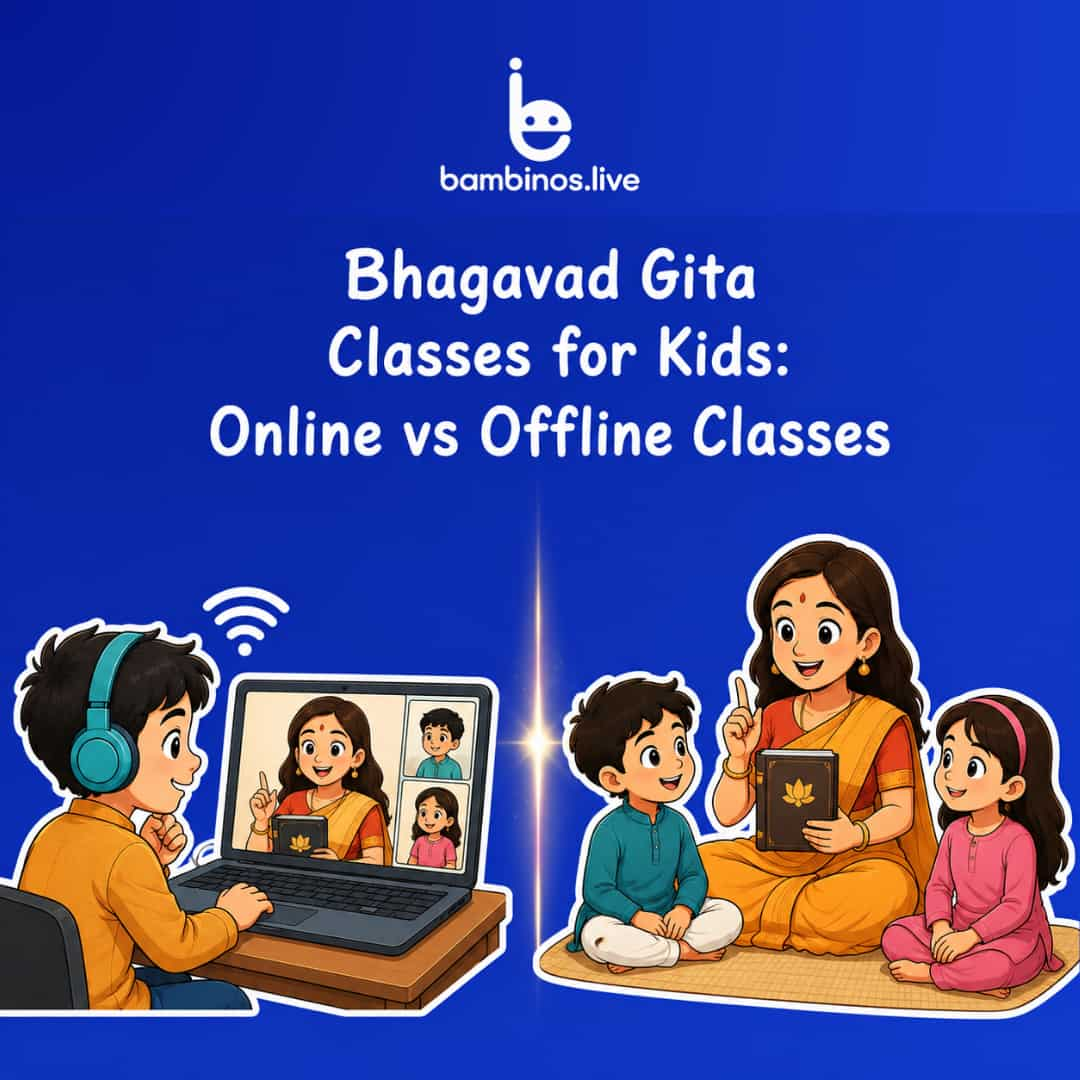
Online and offline Bhagavad Gita classes for kids can both work well. The better choice depends on your child's age, your family's schedule and whether a good teacher is close to home.
Most parents reach this choice after one simple thought: "I want my child to learn the Gita, but I can't teach the Sanskrit myself." A temple class down the road and a live online class with a teacher in another city can look equally good on paper. In daily life, they feel very different.
This guide compares the two formats honestly, lists the questions worth asking any class, and explains what to expect from an online class.
Online vs Offline at a Glance
Here is a quick side-by-side comparison before the details.
| Point to compare | Online classes | Offline classes |
|---|---|---|
| Travel | None, joins from home | Travel to a venue |
| Choice of teacher | Teachers from any city | Teachers nearby only |
| Group size | Often small | Varies by venue |
| Community feel | Through the screen | In person |
| Families abroad | Easy to join | Only where a class exists |
| Screen time | Adds some | None |
The Key Difference Between Online and Offline Classes
The key difference between online and offline Gita classes lies in the setting. The subject itself can stay exactly the same.
In an offline class: Your child travels to a temple, cultural centre or teacher's home, and learns alongside other children in the same room.
In an online class: Your child joins a live session from home on a laptop or tablet, with the teacher and classmates on screen.
What stays the same: A good class in either format explains each shloka in simple words, sets it inside a Mahabharata story and links it to your child's own life. Judge the teaching first and the format second.
Strengths of Online Gita Classes
Online Gita classes work best when travel time, distance or a busy timetable stands in the way.
- No travel: Children join from home, which saves time on school days.
- Teachers from anywhere: Families outside India, or in cities without a Gita class nearby, can still find a good teacher.
- Small groups: Many live online classes keep groups small, so each child is seen and heard.
- Parents can listen in: A parent in the next room can hear how the class is going.
One family's experience is shared in a US parent's review of Little Yogi.
Strengths of Offline Gita Classes
Offline Gita classes work best when a child needs face-to-face company and a community setting.
- Being in the room: Some young children focus better when the teacher is sitting right beside them.
- Group recitation: Chanting together in one room has a special feel.
- Festivals and events: Temple classes often take part in Janmashtami and Gita Jayanti celebrations.
- A break from screens: For children who already use screens for school, an offline class adds variety.
How Much Screen Time Is Sensible?
A sensible amount of screen time for an online class is a short, live session with breaks in between.
India's Ministry of Education gave guidance on this in its PRAGYATA guidelines for digital education in 2020. For Classes 1 to 8, it suggested not more than two live online sessions of 30 to 45 minutes each on days when schools held online classes, as this press note from the Ministry of Education on PRAGYATA explains. The guidance was written for schools, but it is a useful yardstick for any online class your child joins.
Keep a Gita class to one short session on the days it runs. Between classes, a little offline practice at home keeps the learning going, and this 8-week plan to learn Gita teachings at home gives a simple routine to follow.
6 Questions to Ask Before Choosing a Gita Class
Ask these questions before choosing any Gita class, online or offline:
- 1. Is the class grouped by age? A four-year-old and a twelve-year-old need very different lessons.
- 2. Are shlokas taught with their meanings? Recitation without meaning is easily forgotten.
- 3. How is pronunciation corrected? The teacher should listen to each child, not only the group.
- 4. Are stories part of every class? Stories from the Mahabharata give verses their context.
- 5. How many children are in a group? Smaller groups usually give each child more chances to speak.
- 6. Can you watch a class first? A trial or demo class shows you how your child responds.
A class that gives every child a turn to speak can also help with shyness. This post on how the Bhagavad Gita helps kids build confidence explains why.
What a Little Yogi Class Includes
Little Yogi is a live Gita course from Bambinos.live, offering online Bhagavad Gita classes for kids. Here is what a class includes:
- Live teaching: Every class is taught live by a teacher, so children can ask questions as they go.
- Small groups: Children learn in small groups, which gives each child more chances to speak and chant.
- Ages 4 to 15: The course is open to children from age 4 up to 15.
- Shlokas with meanings: Each verse is taught along with its meaning in simple words.
- Mahabharata stories: Stories from the Mahabharata set the scene for the verses children learn.
- Learning from home: Children join from home, so there is no travel on class days.
Pick the Class Your Child Will Keep Going To
The right Gita class is the one your child attends regularly and looks forward to, whatever the format. Check your weekly timetable, see what is available near you, and run the six questions above past any class before you commit.
If an online class seems worth a look, book a free Little Yogi demo and sit through one session with your child before deciding.
FAQs
Are online Gita classes good for young children?
Online Gita classes can be good for young children when sessions are short, live and in small groups. A parent nearby helps younger children settle in.
Are offline Gita classes better than online ones?
Offline Gita classes are not better or worse than online ones by default. The teacher, the group size and your child's comfort matter more than the format.
Can NRI families find Gita classes for kids?
Yes, NRI families can find Gita classes for kids online, which removes the need for a class nearby.
About the Author

Rita Gupta
AuthorRita is an experienced educator specializing in Gita, and English, known for her engaging teaching style and supportive classroom environment. Along with her passion for teaching, she actively writes articles and stories that reflect her creativity and love for learning. Rita focuses on understanding every student’s individual needs, helping them gain confidence, stay motivated, and build a strong academic foundation. Through her guidance, learners develop essential skills and unlock their highest potential. For her, every student is a unique story waiting to be written, and she feels grateful to play even a small part in helping them discover their brightest chapter.
LinkedIn Profile ↗