Yes, chess is good for a 7-year-old. At this age, kids can understand the basic rules, follow the movement of each piece, solve beginner puzzles, and play short games. Chess also gives them regular opportunities to focus, think through a position, and plan their next move.
For parents, the main question is often how to get started without making chess feel like another school lesson. The right starting point is simple: introduce the board and pieces first, then add rules, puzzles, tactics, and full games as the kid becomes comfortable with them.
In this blog, we’ll look at the benefits of chess for 7-year-olds, how to introduce the game, and ways to make chess part of their routine.
Is chess good for a 7-year-old?
Yes. Seven is a good age to start chess.
A 7-year-old can usually follow a set of rules and understand that one move can affect what happens next. That makes chess a good fit for this age group.
A beginner can start with:
- Setting up the chessboard
- Learning how the pieces move
- Understanding captures
- Learning check and checkmate
- Solving easy chess puzzles
- Playing short games
There is no need to begin with openings or complicated chess strategy. First, the kid needs to know the board, understand the pieces, and enjoy playing.
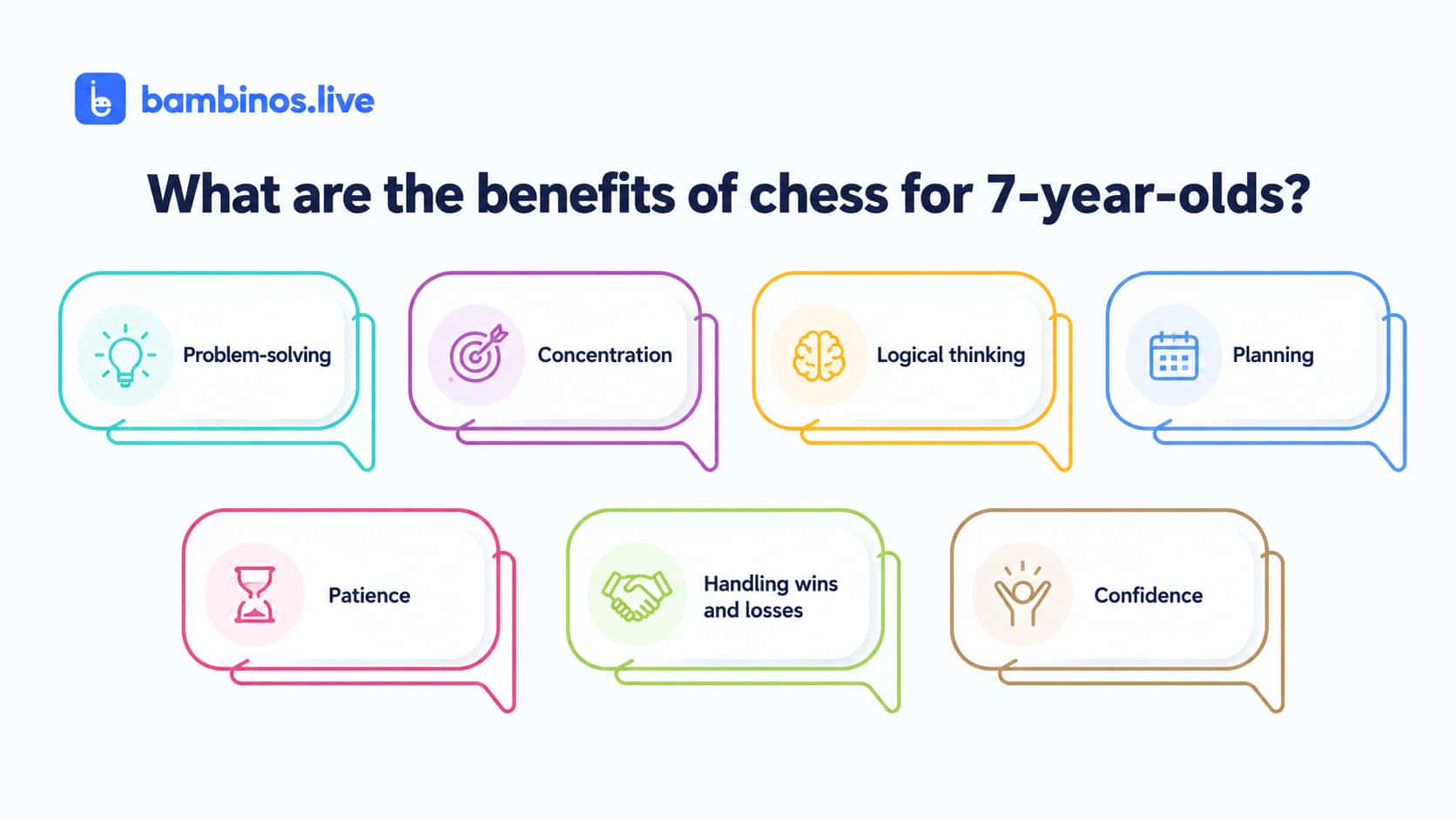
What are the benefits of chess for 7-year-olds?
Chess makes kids stop and think before they move. During a game, they need to look at the position, consider what the other player might do, and choose their next move.
1. Problem-solving
A chess position gives a kid a problem to solve.
Should they capture a piece? Is their king safe? Can they protect their queen? Is there a checkmate?
Chess puzzles work in much the same way. The kid looks at the board and tries to find the move that works.
A study published in the journal New Approaches in Educational Research found that chess instruction was associated with improvements in problem-solving skills among primary school students. The findings support the use of chess as an activity that involves problem-solving and reasoning.
2. Concentration
A chess game requires attention from the first move to the last.
Kids need to notice where their pieces are, watch the opponent's moves, and avoid missing threats on the board. Even a short game gives them a reason to stay focused on one activity.
3. Logical thinking
Chess follows a clear set of rules.
A bishop moves diagonally. A rook moves along ranks and files. A knight moves in an L shape and can jump over pieces.
Once kids know these rules, they can start asking what each move means for the position. This gives them a natural way to think about cause and effect.
4. Planning
Chess is not only about the move in front of you.
A kid may move a piece because they want to attack another piece on the next move. Later, they may start looking at how the opponent could respond.
As their chess skills improve, openings, tactics, and endgames introduce more planning.
5. Patience
Chess rewards a player who takes time to look at the board.
A move may look good at first but lose a piece after the opponent responds. Checking the position before moving gives kids a reason to slow down and think.
6. Handling wins and losses
Not every chess game ends with a win.
A kid may lose a queen, miss checkmate, or make a move that changes the game. Reviewing what happened can be more useful than focusing only on the result.
Over time, kids get used to making mistakes, looking at the position again, and trying a different move in the next game.
7. Confidence
Finding checkmate or solving a chess puzzle gives kids something they worked out on their own.
The same applies when they remember a tactic or successfully use an idea from an earlier game. These moments make the game more interesting and give kids a reason to keep playing.
How to teach chess to a 7-year-old?
Start with the chessboard rather than trying to teach the whole game at once.
A 7-year-old can learn the pieces first and then gradually move into captures, check, checkmate, puzzles, and complete games.
Start with the chess pieces
Introduce the pawn, rook, knight, bishop, queen, and king one at a time.
Let the kid move each piece around the board. The knight is often interesting for beginners because it can jump over other pieces, while the queen has a wide range of movement.
Once the movements are familiar, introduce captures.
Play mini-games
A full chess game has many things happening at once.
Mini-games allow kids to focus on one part of the board. You could play a game using only pawns or practise moving rooks and kings across the board.
These activities make it easier to explain one rule at a time.
Introduce check and checkmate
Once the basic movements are clear, explain what happens when the king is attacked.
Start with easy positions. Show the kid how to escape check and then introduce basic checkmate patterns.
The goal is to make the idea clear before moving into more complicated positions.
Use chess puzzles
Puzzles are a good way to introduce tactics without starting another full game.
A beginner can work on positions involving:
- A useful capture
- A check
- Protecting a piece
- A simple threat
- Checkmate in one
A few puzzles can also fit into a short practice session.
Keep sessions short
A 7-year-old does not need a long chess lesson every day.
A 15-20 minute session can include a quick explanation, a few puzzles, or a short game. The length can change depending on the kid's interest and experience.
Follow the kid's pace
Some kids remember the pieces quickly. Others need more time before they are ready for tactics.
There is no need to rush into openings or competitive play. A basic progression works well:
- Set up the chessboard.
- Learn the pieces.
- Learn movement and captures.
- Play mini-games.
- Learn check and checkmate.
- Solve beginner puzzles.
- Play complete games.
- Add basic tactics and strategy.
Why is online live chess more flexible for 7-year-olds?
For families with school, homework, and other activities, travelling to a chess centre every week may not always fit the schedule. Online live classes remove the travel part while keeping the interaction with an instructor.
1. No travel
The kid can join the class from home instead of travelling to a coaching centre.
That saves the time spent going to and coming back from class.
2. Flexible class timings
Online chess programs may offer different class timings.
Parents can choose a slot that fits around school and other activities.
3. Live interaction
A live instructor can respond to the kid during the class.
The kid can ask about a move, solve a position, play against another student, or discuss a mistake from a game.
4. 1:1 and small-group options
Some kids prefer individual attention, while others enjoy playing with other students.
A 1:1 class gives the instructor more time to focus on one kid. A small group gives kids a chance to play and interact with other players.
Little Grandmasters in the Making with Unbox Chess
Knowing that chess is suitable for a 7-year-old is one part of the process. The harder part for many parents is finding the time to teach the pieces, rules, puzzles, tactics, and games at home.
This is where Unbox Chess by Bambinos.live can fit in.
Unbox Chess offers live online chess classes for kids, with 1:1 and small-group options. Classes introduce kids to chess through lessons, puzzles, games, and different stages of play.
For a 7-year-old, the program can cover:
- Chessboard and piece movements
- Basic chess rules
- Puzzles and tactics
- Chess games
- Openings and endgames
- Progression towards advanced play
Why parents choose Unbox Chess by Bambinos.live
- Featured on Shark Tank India
- 4.7/5 Google rating from 8,000+ reviews
- 4.7/5 Trustpilot rating from 1,900+ reviews
- 1:1 and small-group class options
If your 7-year-old is ready to start the journey as a Little Grandmaster in the Making, you can book a free demo with Unbox Chess by Bambinos.live.
FAQs
1. What should a 7-year-old learn first in chess?
Start with the chessboard and the movement of each piece. Next, introduce captures, check, and checkmate. Beginner puzzles and short games can follow.
2. Is 7 a good age to start chess?
Yes, 7 is a good age to start chess. Kids can understand the basic rules, remember how the pieces move, and play short games. They can also start solving beginner chess puzzles.
3. Are online chess classes good for 7-year-olds?
Yes, online chess classes can work well for 7-year-olds. Kids can attend from home, interact with a live instructor, and play games or solve puzzles during class. 1:1 and small-group classes are also available.
4. What is Unbox Chess by Bambinos.live?
Unbox Chess by Bambinos.live offers live online chess classes for kids aged 4 to 15. Kids can attend 1:1 or small-group classes with a live instructor. The classes cover chess basics, puzzles, tactics, games, and more advanced concepts.
5. How can I teach chess to my 7-year-old at home?
Start with one piece at a time and let your kid practise its movement on the board. Use mini-games and easy puzzles before playing a full game. Keep the sessions short and let the kid progress at their own pace.
6. How often should a 7-year-old play chess?
A 7-year-old can play chess a few times a week. Short sessions are enough for a beginner. Regular practice helps the kid remember the rules and become familiar with the board.
7. How can Unbox Chess help a 7-year-old start chess?
Unbox Chess by Bambinos.live gives kids live online chess classes with 1:1 and small-group options. A beginner can start with the board, pieces, basic rules, and puzzles before moving into tactics and complete games. Parents can also book a free demo to see how the classes work.
About the Author

Bambinos Learning Solutions
AuthorBambinos is India’s #1 online learning platform for kids built by a team of IIM & IIT graduates.
LinkedIn Profile ↗