STEM is the new buzzword in education, but what does it really mean for our children? STEM, which stands for Science, Technology, Engineering and Mathematics, is much more than just an educational term. It is a way of learning that encourages children to ask questions, explore ideas, solve problems, experiment, and create.
Through hands-on STEM activities, children learn to look at everyday challenges with curiosity and think of creative solutions. STEM learning doesn’t have to stop when kids leave the classroom. In fact, meaningful learning can happen anywhere. The best part is that many STEM activities at home require nothing more than a few simple household materials.
We must try to choose activities based on a child’s age and interests. Choosing age-appropriate easy STEM projects allows children to learn at their own pace while keeping the experience enjoyable. This approach also matches India’s National Education Policy 2020, which recommends experiential learning, including hands-on learning, as standard teaching practice at all school stages.
Whether we are planning STEM activities for students to supplement classroom learning or simple projects to keep children engaged at home, there are plenty of possibilities using materials you already have. These fun STEM activities for kids can turn ordinary playtime into opportunities to learn and understand how things work. For even more ideas, try these fun science activities for kids. Most importantly, STEM learning activities do not need to have a perfect result. The process of experimenting, making mistakes, and trying again is an important part of STEM education.
In this blog, let’s explore some simple and fun STEM activities for kids that can turn everyday moments into exciting learning experiences for children. These activities can be easily enjoyed by Kindergarten kids and young students.
STEM Activities for Kindergarten
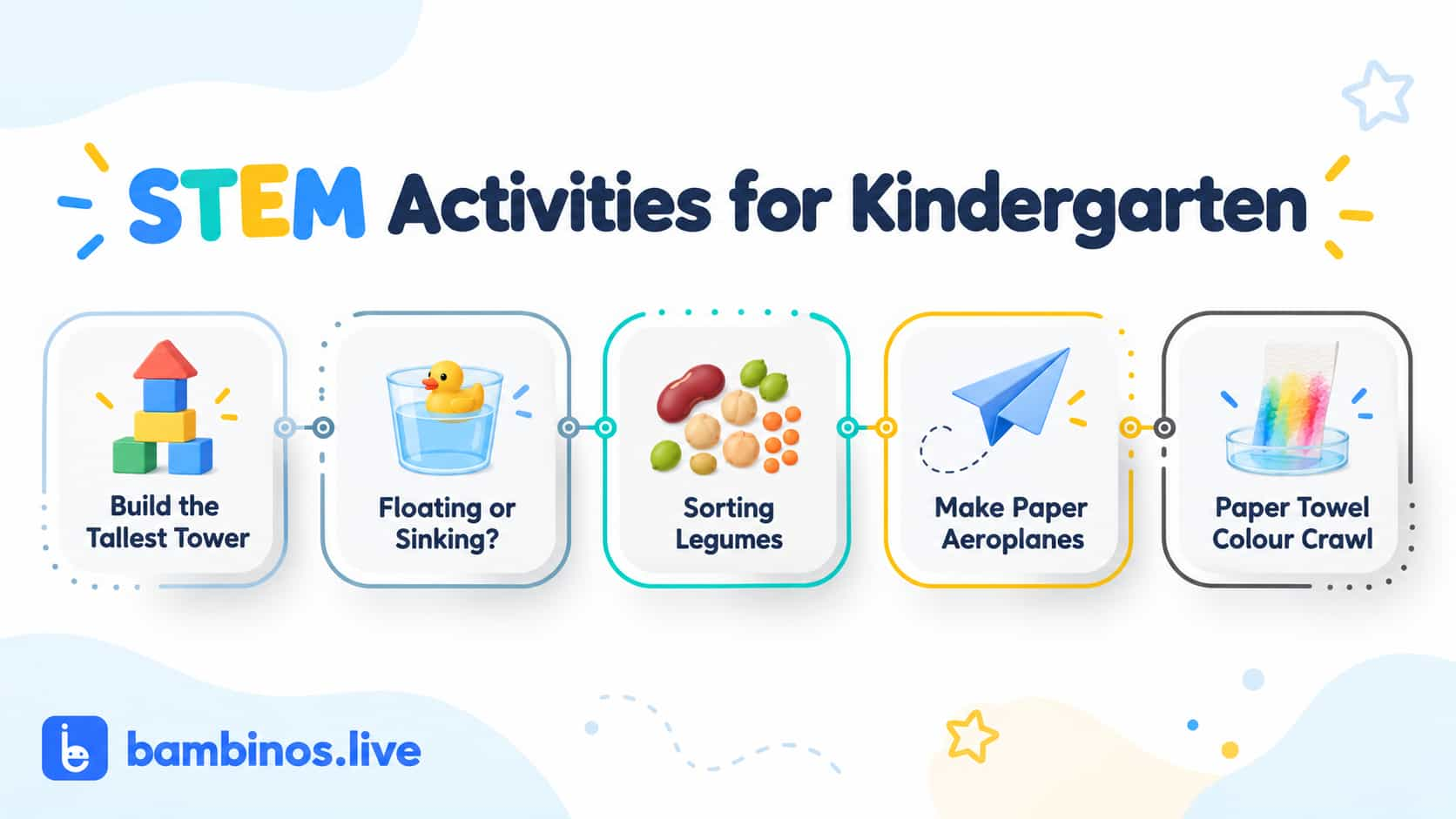
1. Build the Tallest Tower Children can design this using paper cups. This will help them to learn about design, balance, stability and engineering.
2. Floating or Sinking? Ask the child to get different objects like pencil, eraser, spoon, rubber toy. Before putting each object into the water, ask your child to predict whether it will sink or float. Discuss why some objects float while others sink. This will help them to learn about density and weight.
3. Sorting Legumes Mix chickpea and kidney beans and ask the child to sort them. They can also count and separate them. This activity not only helps them to learn counting but also develops their recognition power.
4. Make Paper Aeroplanes Let children make different aeroplane designs. Test and measure how far each flies. This will develop the concept of aerodynamics, design and measurement.
5. Paper Towel Colour Crawl Place colored water in glasses and dip rolled up paper towels in them. Your child will be so excited to see the colors crawl up and down the rolls magically. You can gently introduce the concept of capillary action at home with this activity. Children can explore concepts like this through live experiments in online science classes for kids.
STEM Projects for Middle Schoolers
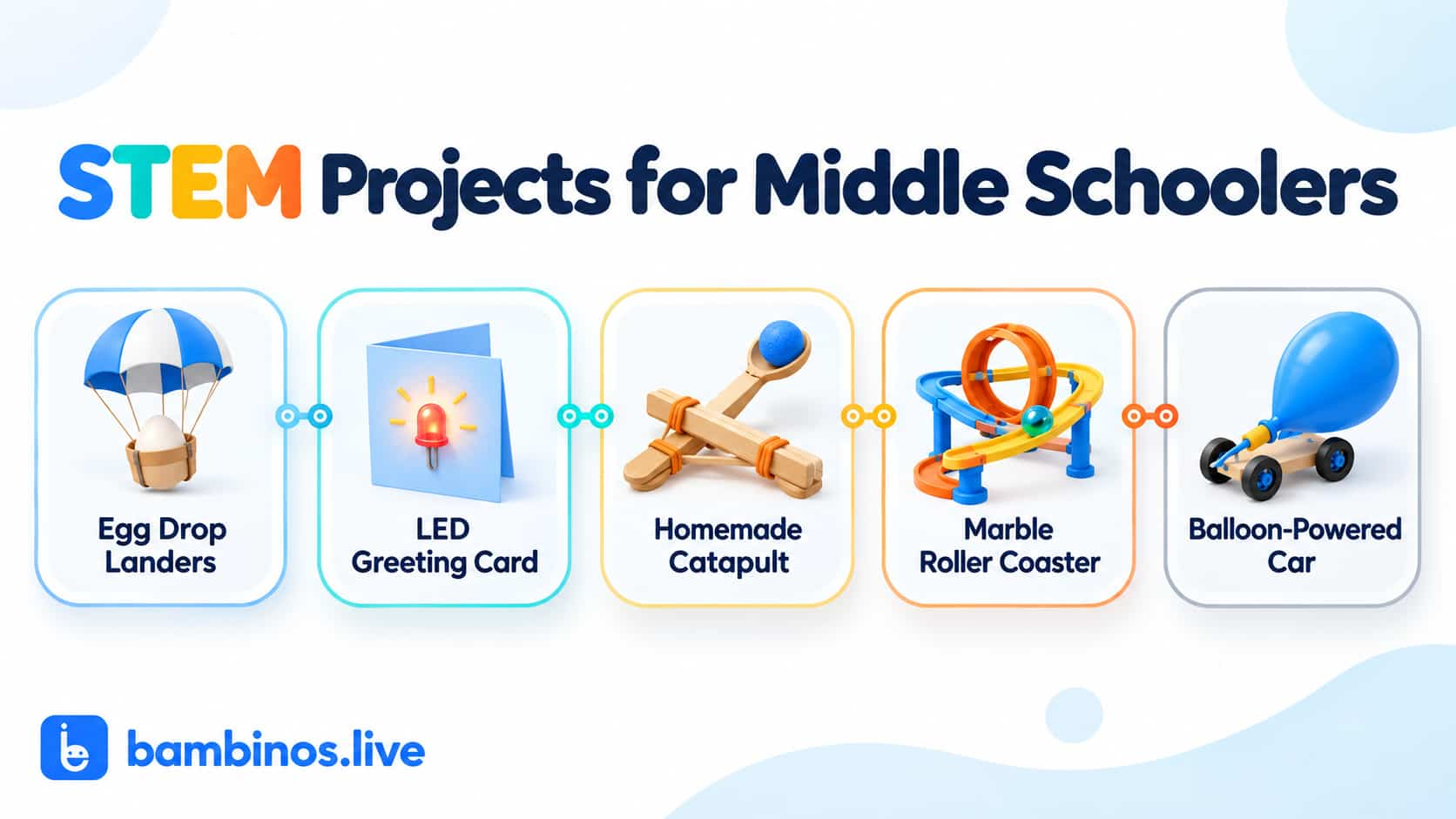
6. Egg Drop Landers This science activity for middle schoolers requires students to combine their knowledge of gravity and engineering. Students must build a structure to keep an egg from cracking when dropped from high heights.
7. LED Greeting Card Use copper tape, an LED, and a coin-cell battery to turn a simple greeting card into a fun light-up card. Create a basic circuit inside the card by connecting the copper tape to the battery and LED. Add a small flap or spot that completes the circuit when pressed. When children press it, the LED lights up, helping them understand how a simple circuit works in a fun and exciting way.
8. Homemade Catapult Use ice cream sticks, straws, rubber bands to create a simple catapult. Then, they’ll see how effective their catapults are at launching different objects, such as cotton balls, erasers, and paper balls. This activity will give them lesson on Newton’s laws of motion.
9. Marble Roller Coaster Use simple materials like cardboard strips, paper, tape, and a marble to build a small roller coaster track. Make a starting point high enough for the marble to roll down, and add a loop using a curved strip of cardboard. This is a simple way to learn how potential energy changes into kinetic energy, or energy of motion.
10. Balloon-Powered Car Let children build a simple car using cardboard or a plastic bottle, straws, skewers, bottle caps, tape, and a balloon. Once the car is ready, attach a balloon to a straw and release the air to make the car move forward. This fun activity helps children understand force, motion, friction, and Newton’s laws. Looking for more build-and-test projects? Explore these STEM-based adventure learning activities.
More Easy STEM Projects to Try at Home
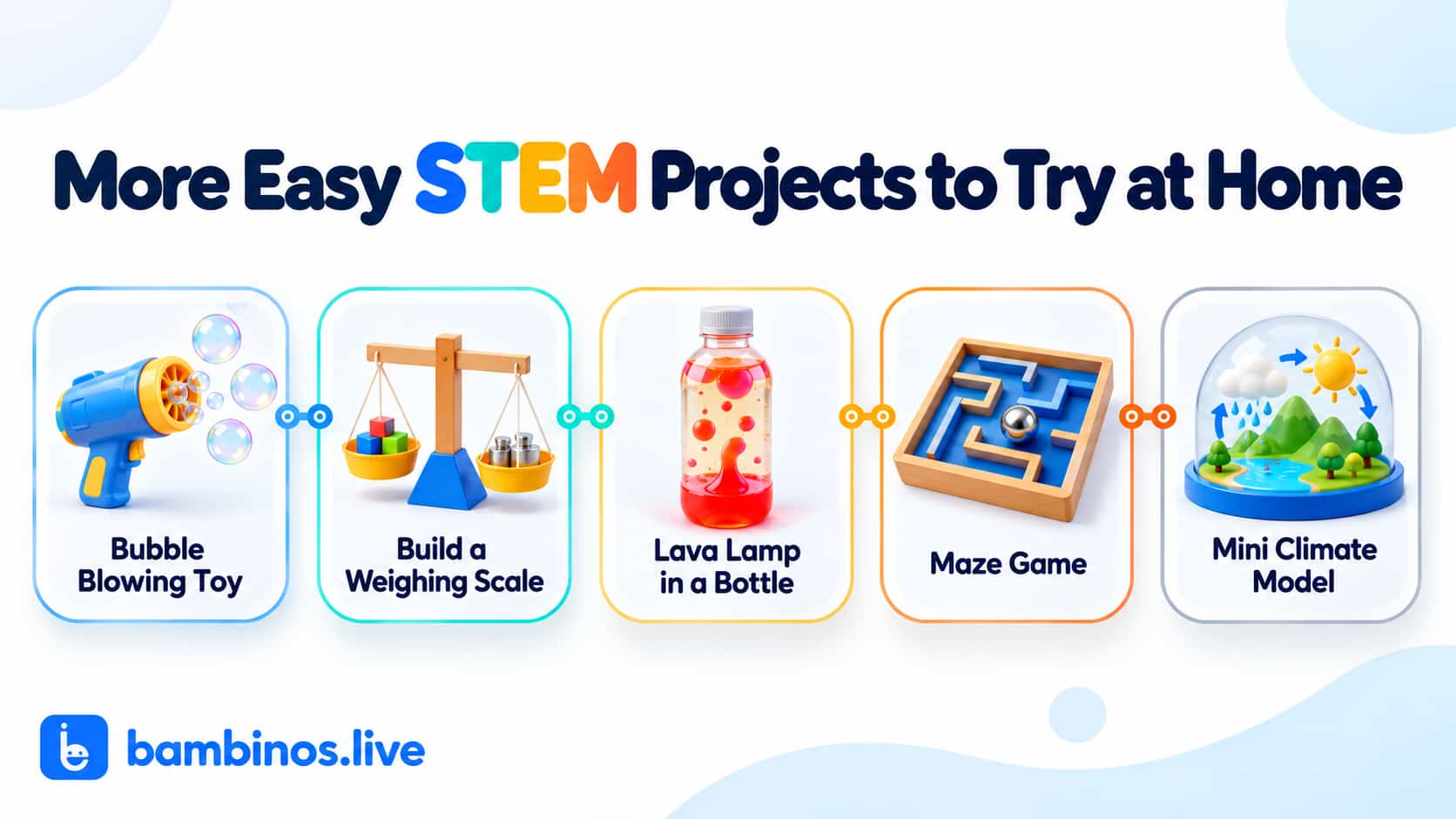
Apart from these, there are some more easy STEM projects that can be tried easily at home by children.
11. Bubble Blowing Toy All you need is a straw, wire that will be bent in a loop, washing liquid. You can dip the loop in liquid soap and blow through the straw and have endless hours of fun in making bubbles.
12. Build a Weighing Scale Use a clothes hanger, string and paper cups to make a simple weighing scale. Children can weigh different household objects in this.
13. Lava Lamp in a Bottle Fill the bottle with oil, leaving some space. Add water and food color. Pour in Eno. Now watch the bubbles rise and fall.
14. Maze Game Draw a maze on paper. Attach a paper clip to a small piece of paper. Move the magnet underneath the page to guide the paper clip through the maze.
15. Mini Climate Model Fill a jar with hot water. Place a plate with ice on top of the jar. Add a few drops of food coloring. Watch condensation form and fall like rain. Home projects like these work even better alongside structured online programs for kids that build curiosity and confidence.
STEM learning does not need a lab, costly kits or perfect results. A few paper cups, a balloon or a jar of water can teach children about balance, force, energy and the water cycle. What matters most is the habit of asking “why”, predicting, testing and trying again. Start with one activity this week, let your child lead, and talk about what happened. Small experiments at home can grow into a lifelong love for science.
Want your child to explore science through live, hands-on experiments with expert teachers? Book a free demo class with Bambinos.live today.
.jpg)
About the Author

Preeti Kapur
AuthorPreeti Kapur is an educator and writer with a deep love for children and learning. An avid reader and art enthusiast, she enjoys experimenting with colours and canvas in her free time. Armed with a master's degree in Political Science, she chose to become an educator because of her passion for nurturing young minds. She strives to make learning innovative, fun, and engaging. She has also co-authored Ruffled Feathers, a book that draws inspiration from the world around her to craft strong, soulful characters.
LinkedIn Profile ↗