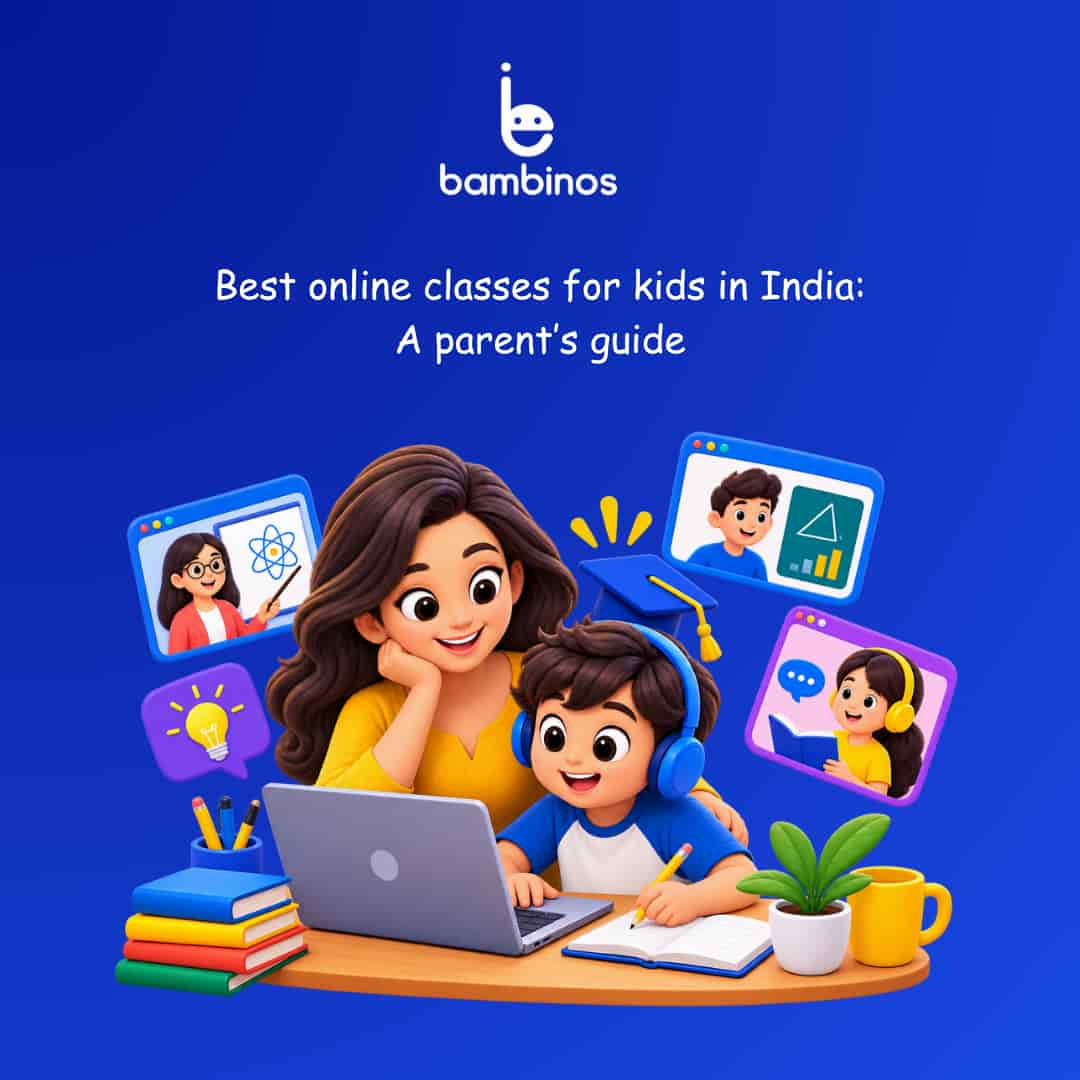
To choose online classes for kids in India, start with one clear goal, pick a live class with a small group and a fixed teacher, keep each session short for your kid's age, and judge the class by a free demo before you pay.
Take a Class 4 kid in Lucknow whose parents sign him up for three apps in one summer. By August he has a login for each, a half-finished certificate from one, and no clear memory of what he learnt.
The problem was never the internet. Nobody decided what the classes were for.
What kinds of online classes can kids take in India?
Kids in India can take four broad kinds of online classes: school subjects, language and speaking skills, thinking games, and culture or values.
| Kind of class | Common examples | What a good class gives |
|---|---|---|
| School subjects | Maths, science, coding | Clear concepts, not just faster homework |
| Language and speaking | Spoken English, phonics, creative writing, regional languages | Regular turns to speak, read or write |
| Thinking games | Chess, puzzles, olympiad practice | Problems to solve and mistakes to review |
| Culture and values | Stories from the Gita, Panchatantra, music | Stories a kid can connect to daily life |
Most parents start with one class that fixes a real gap, such as a kid who knows English but goes quiet when asked to speak. A second class can wait until the first one becomes a habit.
Are live classes better than recorded videos for kids?
Live classes are better than recorded videos for most kids under 12, because a teacher can notice confusion, ask questions and keep a young kid involved.
Recorded videos are useful for revision or for an older kid who already likes a subject. A seven-year-old, however, rarely stays with a video once it gets hard. In a live class, the teacher stops, asks the kid to explain, and changes the example.
Group size matters as much as the format. In a class of 40 on a video call, most kids only listen. In a small group, each kid gets several turns to answer in every session. That speaking time is often what parents are really paying for.
How long should an online class be for each age?
An online class should be about 30 to 45 minutes for primary school kids, with only one or two such sessions a day, and much shorter screen time for under-fives.
The Ministry of Education's PRAGYATA guidelines on digital education suggest not more than two online sessions of 30 to 45 minutes a day for Classes 1 to 8, and up to four for Classes 9 to 12.
For pre-primary kids, they suggest about 30 minutes a day, mainly for guiding parents.
For the youngest kids, the World Health Organization's screen time advice for under-fives says sitting screen time for two to four-year-olds should be no more than an hour a day, and less is better.
A simple rule follows from both: count school screen time and class screen time together, and leave the rest of the evening for play, reading and sleep.
What should parents check in a demo class?
Parents should check how often their kid speaks, how the teacher handles a wrong answer, and whether the kid can explain one new idea after the class.
During the class
- Count how many times your kid answers or speaks. In a good class, it should be several times.
- Watch what happens after a wrong answer. A good teacher asks the kid to think again instead of simply giving the right one.
- Notice whether the teacher uses the kids' names and remembers what they said earlier.
After the class
- Ask your kid to teach you one thing from the session.
- Ask what was the hardest part. A kid who says "nothing" may not have been stretched.
- Check what happens if a class is missed: a recording, a make-up class or nothing.
These checks apply to any subject. Our guide to the benefits of chess classes for kids shows the same idea in action, with a list of what to look for in a chess demo.
How can parents keep online classes safe?
Parents can keep online classes safe by setting up the device themselves, sitting nearby for younger kids and teaching their kid a few clear rules.
- Device set-up: Use a laptop or tablet in a shared room, not behind a closed door.
- Joining links: Save the class link yourself, so your kid does not search for it or click links from chats.
- Personal details: Teach your kid never to share the home address, school name or phone number in class chat.
- Camera and mic: Show your kid how to mute and switch off the camera, and when to do it.
- Payments: Keep payment details away from your kid's account.
UNICEF India's note for parents on keeping children safe online makes a useful point: the aim is to guide kids online, not to cut them off from it.
How do you know an online class is working?
You know an online class is working when your kid uses the skill outside class, asks to attend, and makes fewer of the same mistakes after a few weeks.
Give a new class about eight weeks before you judge it. Then look for small, real changes.
A kid in a speaking class may introduce herself to a guest without being pushed. A kid in a maths class may check the bill at a shop. A kid in a chess class may stop and think before every move instead of every fifth one.
If nothing has changed by then, talk to the teacher before you quit. Often the level is wrong, and a move to a different batch fixes it.
What does Bambinos.live offer in online classes?
Bambinos.live offers live, small-group online classes for kids in English, maths, science, chess and Gita-based values.
| Course | Who it is for | What kids do in class |
|---|---|---|
| Unbox English | Kids aged 4 to 14 | Speak, read, write and practise grammar through stories |
| Unbox Math | Class 1 to 9 | Learn concepts through games and visual models |
| Unbox Science | Class 1 to 9 | Do hands-on activities and explain the science behind them |
| Unbox Chess | Kids aged 6 to 15 | Solve puzzles, review games and play in leagues |
| Little Yogi | Kids who want to learn from the Gita | Hear stories and talk about everyday choices |
Bambinos.live appeared on Shark Tank India in Season 4. Parents can see the full course plan for Unbox English online classes or ask about any other course during a demo.
Choose one class and test it with a demo this week
At this point, you have a clear picture of the kinds of online classes kids in India can take, how long sessions should be, what to check in a demo, how to keep classes safe and how to tell whether a class is working.
This week, write down the one skill you want your kid to build. Then book one demo, use the checklist above, and ask your kid to teach you one thing afterwards. That single conversation will tell you more than any brochure.
If your kid would enjoy learning live with a teacher and a small group, Bambinos.live runs classes in English, maths, science, chess and the Gita. Book a free demo class and see how a session works.
Frequently asked questions
How do you choose online classes for kids in India?
You choose online classes for kids in India by setting one clear goal, picking a live small-group class with a fixed teacher, keeping sessions short for your kid's age and judging the class through a free demo first.
What is the right age to start online classes?
The right age to start online classes is usually around five or six, when a kid can sit through a short live session. Before that, most learning works better through play and reading at home.
How many online classes should a kid take at a time?
A kid should usually take one or two online classes at a time. More than that leaves little time for homework, play and rest, and makes it hard to see which class is helping.
Are online classes safe for young kids?
Online classes are safe for young kids when parents set up the device, keep it in a shared room, save the class link themselves and teach their kid not to share personal details.
About the Author
Bambinos Learning Solutions Pvt. Ltd.
AuthorThe Bambinos.live editorial team writes practical guides for parents and kids aged 4 to 15. The team works alongside the educators who teach our live classes in English, maths, science, chess, Kannada and Little Yogi, which covers Indian culture, shlokas, stories and mindfulness. Each article draws on what kids find easy, what they find tricky and what helps at home. Bambinos.live was founded in 2020 and was featured on Shark Tank India.
LinkedIn Profile ↗