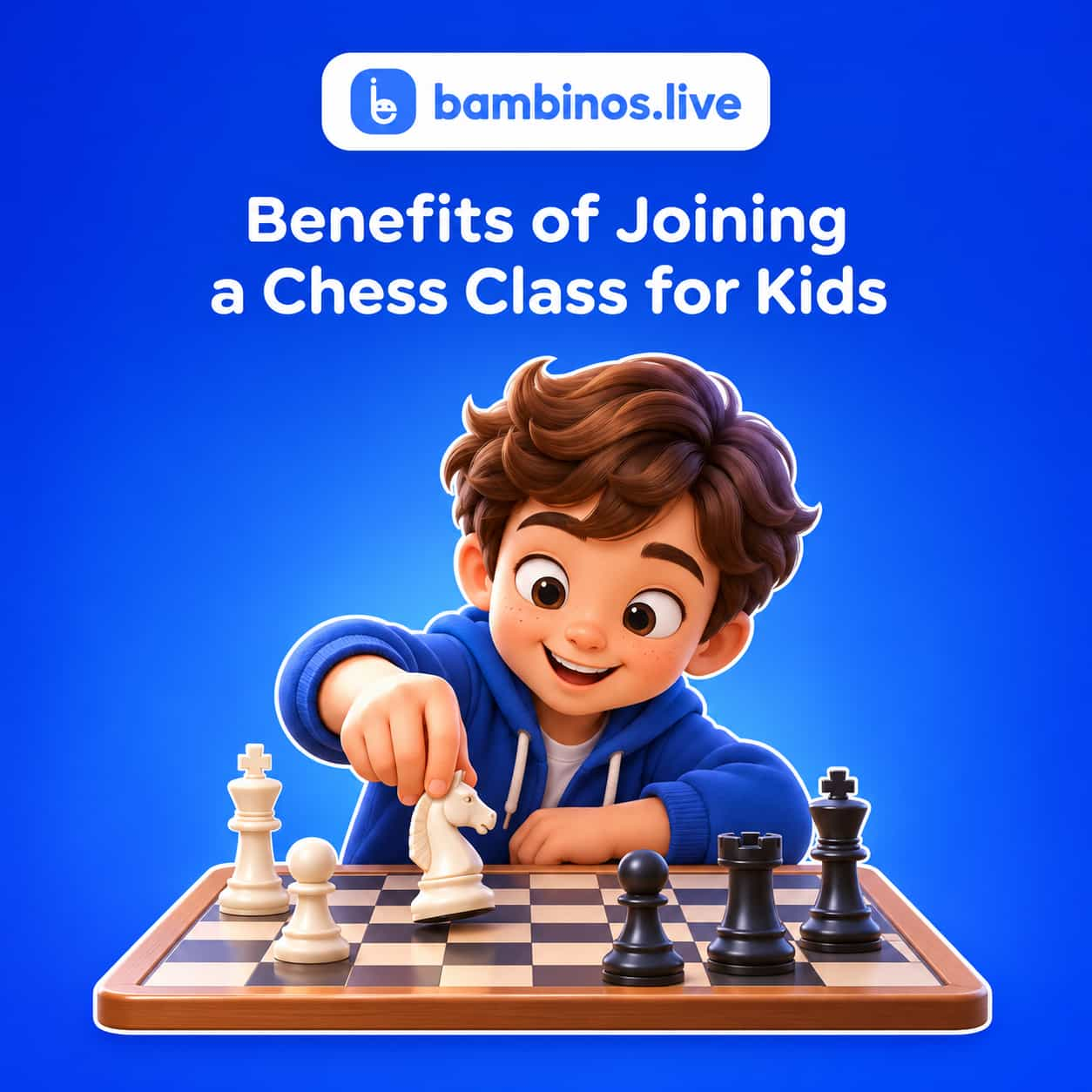
The benefits of joining a chess class for kids are better focus, sharper problem-solving, patience during games and the ability to accept a loss without giving up.
Many kids pick up the rules from a cousin or an app and then get stuck. They lose game after game, nobody tells them why, and the board goes back in the cupboard.
A good class fixes exactly that. One good option is Unbox Chess by Bambinos.live, backed by Shark Tank India, where kids learn live in a small group with the same coach every week.
This guide explains what a chess class really gives your kid, what it does not do, and how to pick the right one.
Why do many kids quit chess when they learn alone?
Many kids quit chess when they learn alone because they keep losing without knowing what went wrong. Over time, they may lose interest in playing.
It usually starts well. A kid learns the moves from a family member or a video, downloads an app and enjoys the first few weeks.
Then the app opponents get stronger. The kid starts losing to simple tricks, like a knight left unprotected or an attack they did not see coming. Each loss feels random, so they play faster and think less.
A coach changes this. They go through the game, point to the one move that went wrong and show how to avoid it next time. Playing kids at the same level helps too, because winning sometimes keeps the game fun.
Here is how Unbox Chess runs its classes:
- Two live classes every week
- The same coach and the same small group each time
- Five puzzles after every class, checked by the coach
- A monthly league, played with clocks
Parents can explore these online chess classes for kids to see the full plan.
How do chess classes help a child's thinking skills?
Chess classes help a child's thinking skills through regular games and guided lessons. Kids learn to focus on the board, spot patterns and think before making a move. However, these skills do not automatically lead to higher school marks.
In England, the Education Endowment Foundation studied chess lessons in primary schools with around 4,000 Year 5 pupils. After 30 hours of lessons, their maths, English and science results were no different from pupils who did not attend.
So join a chess class for the habits it builds, not for marks. These are the four you will notice first.
Focus
Kids learn to study the board before they touch a piece. A beginner who moved in two seconds will, after a few weeks, sit and think for a minute or more.
Pattern memory
The more games kids play, the faster they spot familiar traps and checkmates. A position that once looked confusing starts to look like one they have seen before.
Checking before acting
Coaches teach one simple question before every move: "What can my opponent do next?" It is the same check a kid needs before handing in a test paper.
Thinking in steps
Chess teaches kids to plan in order. First they bring out their pieces, then they castle to keep the king safe. With practice, these plans grow to three or four moves.
Is a live chess class better than chess apps for kids?
Yes, a live chess class is better for most kids because a coach can explain why a move was wrong. A chess app can show another move, but kids may not understand why it is a better choice.
|
Chess app |
Live chess class
|
|
|---|---|---|
|
Mistakes |
Shows a better move |
Explains why |
|
Frustration |
No one to help |
Coach encourages |
|
Opponents |
Bots or strangers |
Kids at the same level |
|
What to learn next |
Kid decides |
Coach follows a plan |
|
Best for |
Daily puzzles |
Real learning |
Apps still have a place. The best mix for most kids is two live classes a week and a few app puzzles on the days in between.
Do online chess coaching programs really work for kids?
Yes, online chess coaching programs work for kids when the classes are live, the groups are small and coaches review their games.
They do not work when the "class" is a recorded video, or when the group is so large that the coach cannot watch each kid's board. Kids then end up watching instead of playing.
A good live online class lets kids:
- Learn from a skilled coach, even one in another city
- Join from home, with no travel
- Play the same group every week
- Ask questions during class
- Go through their mistakes with the coach
For families with no good chess academy nearby, this is often the easiest way to start.
What should parents look for before a child joins an online chess class?
Parents should look for an experienced coach, small batches, a clear learning plan and regular game practice before choosing an online chess class.
Use the demo class to check these seven things:
- The coach explains in simple words. A strong player who cannot explain to a 7-year-old is the wrong fit.
- Every kid gets to speak. If kids sit muted for most of the class, the batch is too big.
- There is a clear plan. Rules first, then tactics, then strategy.
- Kids play real games in class. Watching a screen alone does not build skill.
- The coach reviews mistakes. Ask how often each kid's games are checked.
- Coaches are background-checked. Ask how the academy picks its coaches.
- Parents get progress updates. You should know what your kid learnt this month.
The simplest test: after a good demo, your kid asks to play again.
Which suits your child: a chess club, an academy or an online class?
An online class suits most kids who are starting to learn chess. A chess club suits kids who already know the game and want more playing time. A chess academy suits kids who want to take part in serious tournaments.
|
Option |
Best for |
Keep in mind
|
|---|---|---|
|
Online class |
Beginners who need a coach |
Pick live, small groups |
|
Chess club |
Kids who know the game |
Mostly playing, little teaching |
|
Academy |
Serious tournament players |
More hours, may need travel |
Most families start online. Once the kid is hooked, they add a local club or a tournament.
What are the social benefits of learning chess with peers?
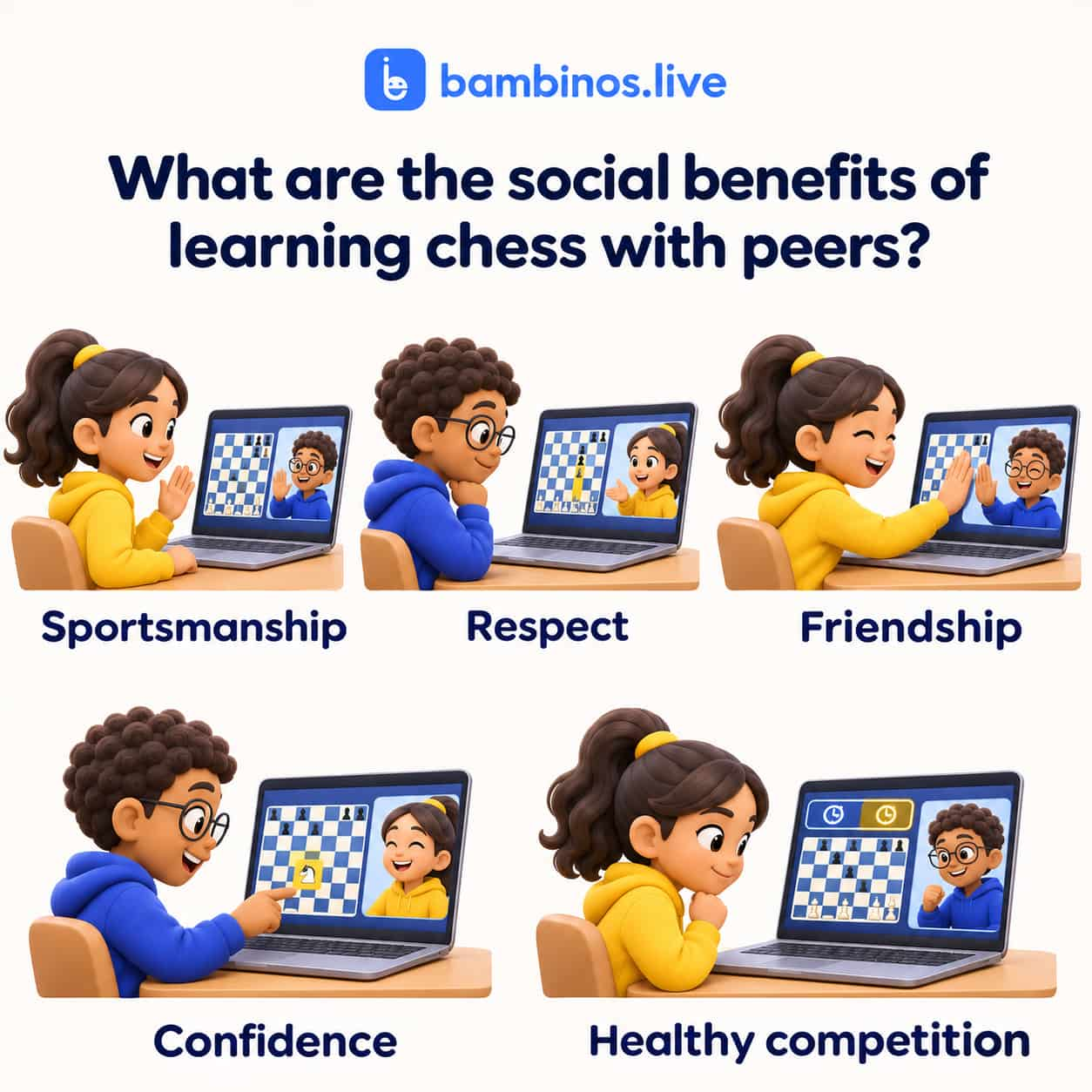
The social benefits of learning chess with peers are better sportsmanship, confidence during games and respect for other players.
Chess with a group is very different from chess against an app:
- Sportsmanship: greeting opponents before a match and saying "good game" after, win or lose
- Respect: accepting a loss and saying "well played" to the winner
- Friendship: seeing the same faces every week
- Confidence: explaining a move out loud to the class
- Healthy competition: wanting to climb the league table
Game reviews add the most. A kid explains why they made a move, and a classmate points out a move they missed. Both learn something.
What age should a child join a chess class?
A child should join a chess class around the age of 6 or 7, when most kids can follow simple rules and sit through a game.
What kids can usually handle at each age:
- 4 to 5: how a few pieces move, through short games with a parent
- 6 to 7: full games and simple checkmates
- 8 to 10: puzzles, basic plans and class leagues
- 11 and above: openings and rated tournaments
Starting later is fine. A curious 9-year-old often catches up quickly with regular games.
Parents of younger kids can read this guide on whether chess is good for a 7-year-old to learn more.
Want your kid to enjoy chess and stick with it? Start with one live class
By now, you have an understanding of what a chess class gives kids that an app cannot: a coach who explains mistakes, opponents at the same level and a steady weekly routine.
The next step is one demo class. While it runs, watch your kid:
- Do they stop and think before moving?
- Does the coach explain mistakes clearly?
- How do they handle a loss?
If they come away asking for another game, the class is working.
Unbox Chess by Bambinos.live, backed by Shark Tank India, runs live small-group classes for kids aged 6 to 15, with checked puzzles, game reviews and monthly leagues. Book a free demo class to see how your kid enjoys learning chess.
Frequently asked questions
What are the benefits of joining a chess class for kids?
The benefits of joining a chess class for kids are better focus, problem-solving, planning, patience and sportsmanship. A class also gives kids guidance from a coach and a chance to play against others at a similar level.
How many chess classes a week are enough for a kid?
Two chess classes a week are enough for most kids who are learning the game. They can also solve a few short puzzles on other days to practise what they have learned.
Can a child learn chess online without a parent who plays?
Yes, a child can learn chess online without a parent who plays. A good coach teaches the rules and explains the moves from the beginning. Parents just need to make sure their kid attends classes and completes the assigned puzzles.
Does chess help children in school?
Chess helps kids practise focus, planning and checking their work. However, learning chess does not automatically lead to higher school marks. A large study in England found no difference in maths, English or science results after chess lessons.
Are chess tournaments good for kids?
Yes, chess tournaments are good for kids who enjoy playing and have some experience with the game. Parents can start with friendly in-class leagues before encouraging their kids to take part in outside tournaments.
About the Author
Bambinos Learning Solutions
AuthorBambinos is India’s #1 online learning platform for kids built by a team of IIM & IIT graduates.
LinkedIn Profile ↗