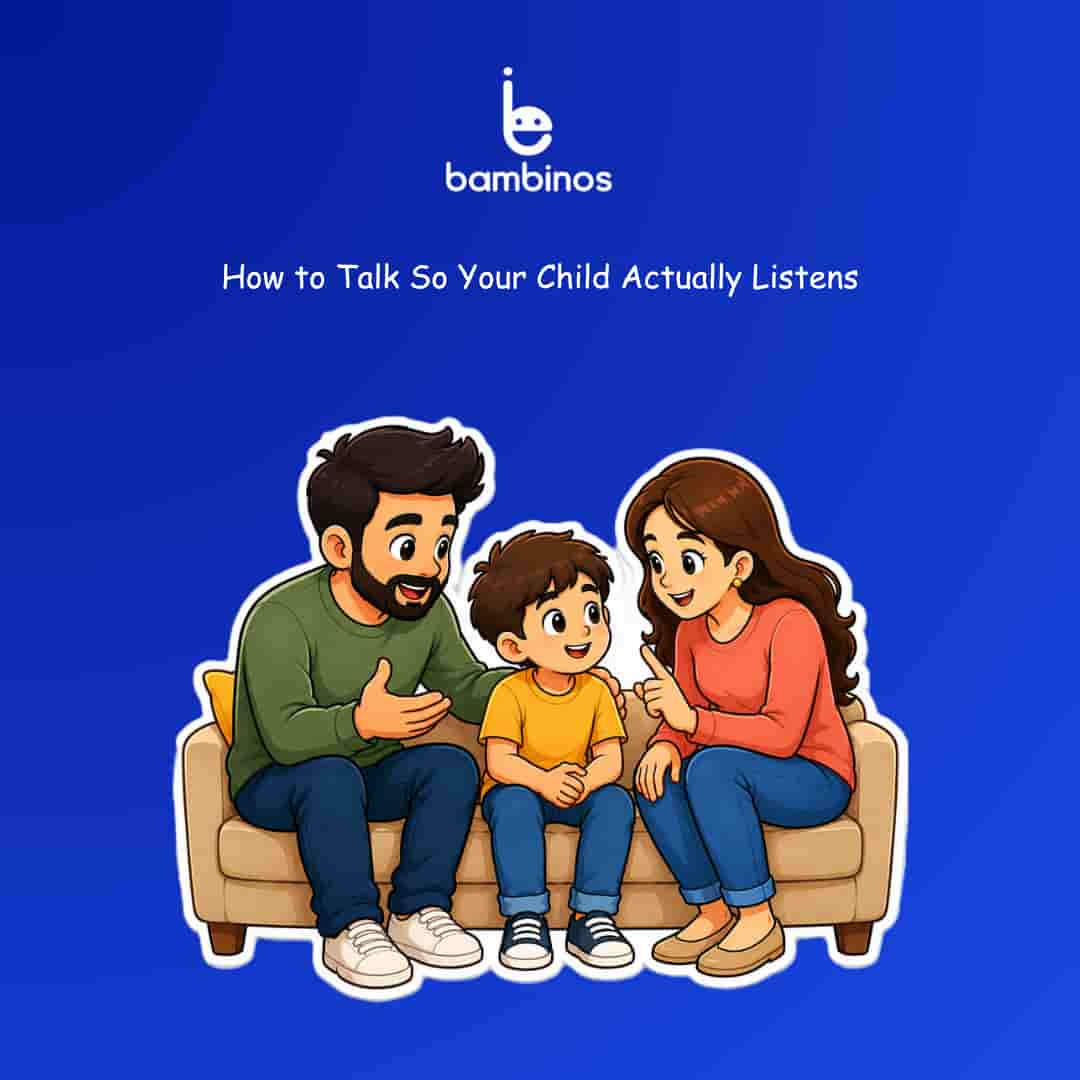
Picture this: you have asked your child three times to put away their toys. The first time, there is no response. The second time, you raise your voice slightly. By the third time, you are frustrated, your child is upset, and a simple request has turned into an argument.
Sound familiar?
Many parents experience moments like this. It can feel as though children suddenly stop listening, especially when they are busy playing, watching something, or dealing with strong emotions. But often, the problem is not that a child refuses to listen. It is that the way adults communicate does not always match how children process instructions and emotions.
Good child communication is not about controlling every response. It is about creating connection, giving clear guidance, and helping children feel respected enough to cooperate.
Why children seem to “stop listening”
Children do not always ignore parents intentionally. Sometimes they are deeply focused on an activity. At other times, they may be tired or confused by what is being asked. According to the American Academy of Sleep Medicine, whose recommendations are endorsed by the American Academy of Pediatrics, children aged 6 to 12 need 9 to 12 hours of sleep per 24 hours, and regularly sleeping less than the recommended amount is associated with problems in attention, behaviour and learning.
Imagine hearing this:
"Clean your room, put your clothes away, finish your homework, and don't forget your water bottle for tomorrow."
For an adult, this may sound simple. For a young child, it can feel like too much information at once. According to the CDC, following two-step instructions such as "put the toy down and close the door" is a milestone that 75% or more of children reach by 30 months, so a four-part instruction asks far more than a young child can hold and act on.
There is research behind this. According to a study published in Applied Cognitive Psychology, the accuracy with which 5- and 6-year-olds carry out spoken instructions is strongly associated with their working memory, not with how willing they are to cooperate.
One of the most useful parenting tips is to keep instructions short and specific. Instead of giving four directions together, begin with one clear request: "Please put your clothes in the cupboard."
Connection comes before correction
When children feel disconnected, they are less likely to cooperate.
Before giving an instruction, move closer. Say your child’s name. Make gentle eye contact and ensure you have their attention.
Instead of calling from another room:
“Turn off the tablet right now!”
Try walking over and saying:
“You’re enjoying your game. In five minutes, it will be time to switch it off and get ready for dinner.”
This does not mean children should control every situation. It simply means that positive parenting combines boundaries with respect.
Say what you want them to do
Parents often tell children what not to do:
“Don’t run.” “Stop shouting.” “Don’t make a mess.”
The problem is that these statements identify the unwanted behaviour without always explaining the expected behaviour.
Try replacing them with:
“Please walk inside.” “Use a quieter voice.” “Keep the blocks on the mat.”
Clear language gives children something specific to follow. This simple shift can improve child behaviour because expectations become easier to understand.
Keep your words short and clear
Long lectures rarely improve listening.
When parents are frustrated, they may explain the same point repeatedly. But after a while, children stop processing the message.
Instead of saying:
“How many times have I told you that every evening you need to keep your school things ready because then in the morning everyone gets late?”
Try:
“Please pack your school bag before dinner.”
Effective parenting often depends less on saying more and more on saying the right thing clearly.
Acknowledge feelings without removing boundaries
Suppose your child wants to continue playing, but it is bedtime. They become angry and say, “I’m not going!”
A common response is:
“Stop arguing and go to bed.”
A gentler but still firm response could be:
“I know you want to keep playing. It’s hard to stop when you’re having fun. It is bedtime now.”
The boundary remains. Bedtime is still bedtime. But the child’s feelings are acknowledged.
This is an important part of gentle parenting. Understanding an emotion does not mean agreeing to every demand.
Give choices when choices are possible
Children naturally want some independence. Constant commands can sometimes create unnecessary power struggles.
Small choices can help:
“Would you like to do your homework before or after your snack?”
“Do you want to wear the blue shirt or the green one?”
“Would you like to brush your teeth now or in five minutes?”
Both options should be acceptable to the parent. The goal is not to negotiate every rule but to give children appropriate control where possible.
Listen the way you want your child to listen
Children learn communication by observing adults.
If a child begins telling a story and the parent continues scrolling through a phone, the child notices. If they are interrupted constantly, they learn that listening is optional.
Strong parent-child relationships are built through everyday moments of attention, including simple listening activities for kids that encourage them to express themselves and listen to others.
You do not need to stop everything for every conversation. But when something matters to your child, try to listen fully. Ask a question. Let them finish. Show them that their words matter.
When children feel heard, they are often more willing to hear others.
Avoid labels during difficult moments
Words can stay with children longer than parents realize.
Statements like:
“You never listen.” “You are so lazy.” “You are always difficult.”
may describe a frustrating moment, but children can begin to see these labels as part of their identity.
Focus on the behaviour instead.
Instead of “You are irresponsible,” try:
“Your homework was not completed today. Let’s work out what needs to change tomorrow.”
This is one of the most practical discipline strategies because it corrects the problem without attacking the child’s character.
Stay calm enough to be heard
No parent remains calm all the time. Frustration is normal.
However, shouting often shifts a child’s attention away from the message and toward the fear, anger, or tension of the moment. A child may obey immediately, but that does not always mean they understood the lesson.
When possible, lower your voice rather than raising it. Pause before responding. Use fewer words.
Calm communication skills for kids are often learned from calm communication at home, supported by simple communication games and activities for kids that make learning to express themselves easier and more enjoyable.
Notice cooperation, not just problems
Parents naturally notice what needs correcting. But children also need to know when they are doing something well.
Try saying:
“Thank you for coming when I called.”
“I noticed you packed your bag without a reminder.”
“You were upset, but you still explained what happened.”
Specific appreciation helps children understand which behaviours are useful. It also supports a healthier parent-child relationship because communication is not limited to correction.
What children really need from us
Getting children to listen is not about finding one perfect sentence or parenting trick. It is about building a pattern of communication based on clarity, consistency, and connection.
Children need boundaries. They also need respect. They need guidance, but they also need opportunities to express themselves.
The most effective parenting advice is often surprisingly simple: speak clearly, listen carefully, correct behaviour without attacking character, and remember that cooperation grows more easily in a connected relationship.
Give your child the right communication skills
While parents shape communication every day at home, structured learning can also help children become more confident speakers and thoughtful listeners.
Bambinos.live, the best online classes for kids, offers engaging online programs designed to help children strengthen communication, confidence, and essential life skills. Through interactive learning, guided conversations, and age-appropriate activities, children get opportunities to express their ideas, listen to others, and communicate more effectively.
With consistent support at home and the right learning environment, children can develop communication habits that strengthen relationships and support them for years to come.
Give your child more opportunities to speak, listen, and express themselves. Book a demo with Bambinos.live
FAQs
1. Why doesn’t my child listen to me?
Your child may not listen because they are distracted, tired, upset, or focused on another activity. Children may also struggle when instructions are unclear or too long. Get your child’s attention first, use their name, and give one simple instruction at a time. Stay calm and give them enough time to respond.
2. How can I get my child to listen to me?
You can help your child listen by getting their attention before speaking. Use their name, make eye contact, and give one clear instruction at a time. Speak calmly and avoid repeating the same instruction several times. Praise your child when they listen and respond. Consistent communication helps children understand what you expect.
3. How can I help my child become a better listener?
You can help your child become a better listener through regular conversations and simple listening activities. Read stories together, ask questions, give short instructions, and encourage your child to explain what they heard. Listening practice helps children improve attention, comprehension, memory, and their ability to respond during everyday conversations.
4. What are some listening activities for kids?
Listening activities for kids include Simon Says, story retelling, listen-and-draw games, guessing games, and multi-step instruction games. These activities encourage children to pay attention, remember information, follow directions, and respond appropriately. Parents can include short listening games in daily routines to make practice enjoyable and help children develop stronger listening skills.
5. Should I yell at my child to make them listen?
No, you should not yell at your child to make them listen. Yelling may make children respond temporarily, but it does not teach effective listening. Speak calmly, give clear instructions, and set consistent boundaries. When parents model calm communication, children can understand instructions better and develop healthier communication habits.
6. How can I improve my child’s communication skills?
You can improve your child’s communication skills by giving them regular opportunities to speak, listen, ask questions, and express their thoughts. Reading together, having conversations, playing communication games, and encouraging children to explain their ideas can strengthen speaking and listening skills. Positive feedback can also help children communicate with greater confidence.
7. How can Bambinos.live help my child improve communication skills?
Bambinos.live can help children improve communication skills through live online classes, interactive activities, guided conversations, and regular speaking opportunities. Children can practise speaking, listening, answering questions, and expressing their ideas during live sessions. Teachers guide children throughout activities and encourage them to participate, helping them build stronger communication skills and confidence.
8. Can Bambinos.live help my child become a confident speaker?
Yes, Bambinos.live can help children become more confident speakers by giving them regular opportunities to speak, share ideas, answer questions, and participate in live activities. Teachers encourage children to communicate during classes and provide guidance throughout the sessions. Parents can book a demo to see how Bambinos.live supports communication and confidence.
About the Author

Bambinos Learning Solutions
AuthorBambinos is India’s #1 online learning platform for kids built by a team of IIM & IIT graduates.
LinkedIn Profile ↗