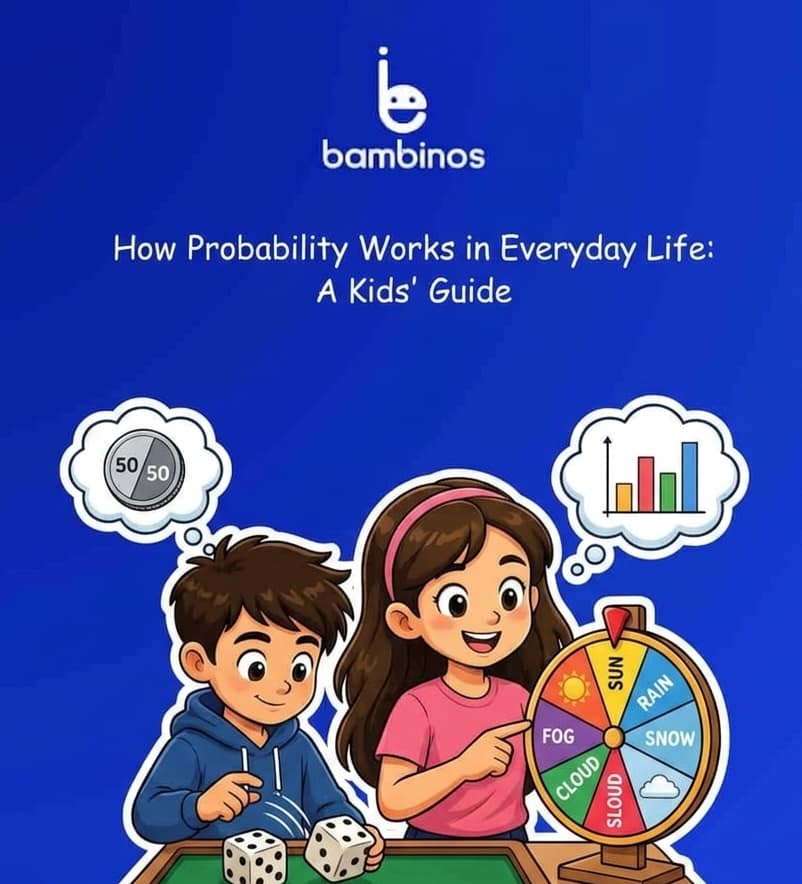
Probability works in everyday life by helping us understand how likely something is to happen. Kids use probability when they predict the weather, play games, roll dice, flip coins, choose objects, and make simple predictions. It helps them understand that some events are more likely to happen than others, while some may be impossible or certain.
For children, probability can seem confusing when they only see formulas and numbers in a textbook. They may know how to calculate an answer but not understand what it means in a real situation.
Simple games, experiments, and familiar examples can make the topic easier to learn. Children can make predictions, test their ideas, and observe what happens. This gives them a practical way to understand chance before moving on to more complex calculations.
In this guide, we’ll explore what probability is, how kids can learn it through fun activities, 50 real-life examples, the benefits of learning it, and activities they can try with Bambinos.live.
What is probability?
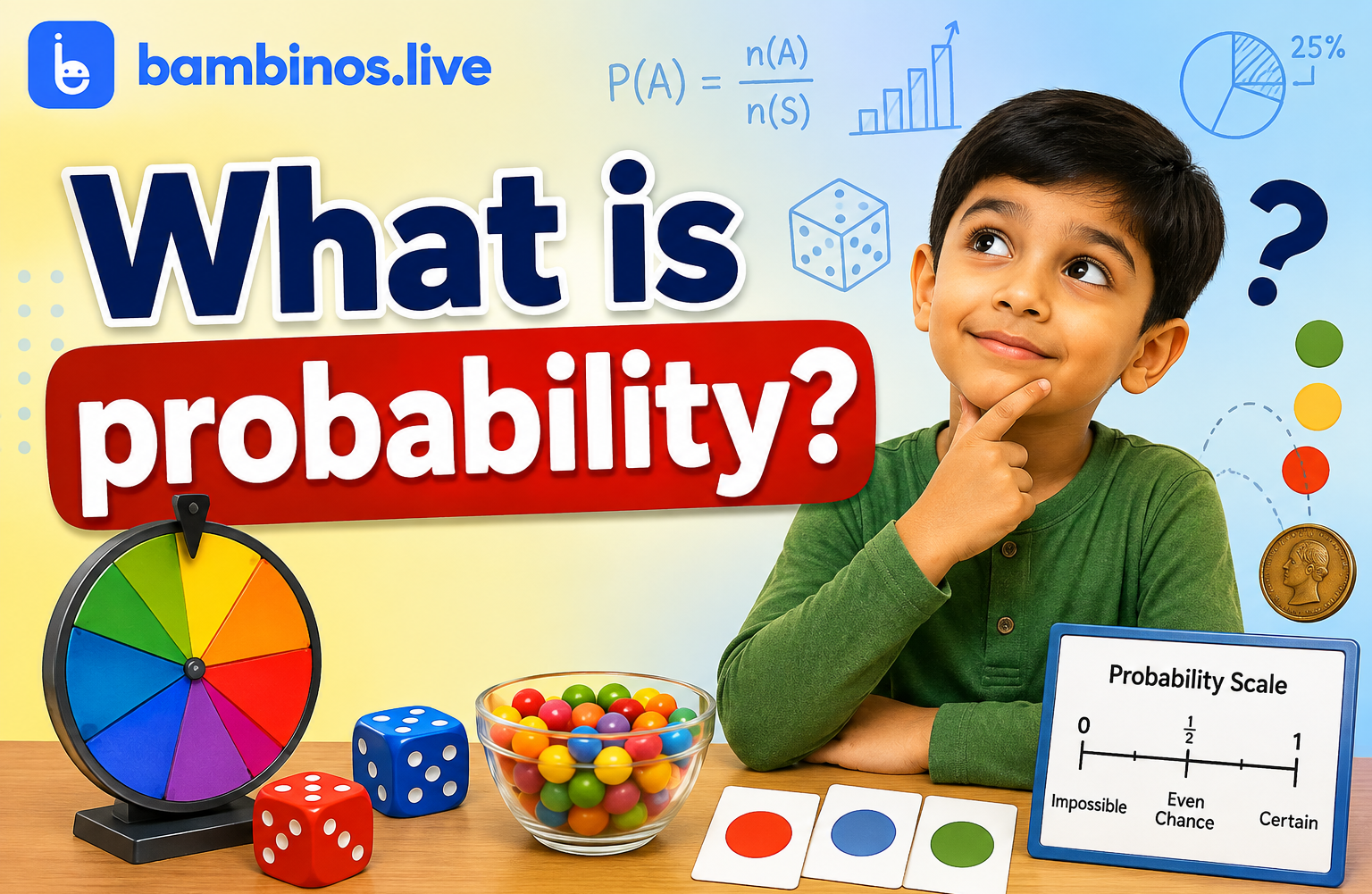
Probability tells us how likely an event is to happen. It can describe n outcome as certain, likely, unlikely, or impossible. We can represent it using words, fractions, decimals, or percentages.
Kids can understand the concept by focusing on
- Outcomes: What could happen?
- Likelihood: Which result has a greater or smaller chance?
- Numbers: How can we show that chance?
For example, a bag contains 3 blue balls and 2 yellow balls. If one ball is picked without looking, blue has a higher chance of being selected because there are more blue balls.
The probability of picking blue is 3/5, or 60%.
This gives children a simple way to connect counting with chance. Now, let's explore fun activities that can help them practice the concept.
How can kids learn probability through fun activities?
Kids can learn probability more easily when they can make predictions, test them, and see what happens. Simple games and hands-on activities can help them understand chance without making the topic feel difficult.
Start with coins
Ask your child which side they think will appear when a coin is tossed. Record the results over several rounds and compare what happened with their prediction.
Try dice experiments
Roll a standard die several times. Ask your child which number they think might appear next. After recording the results, discuss whether any number is guaranteed to appear more often.
Use colored objects
Place different colored buttons, blocks, or balls in a container. If there are more red objects than green ones, ask your child which color is more likely to be picked.
Make a spinner
Create a simple spinner using paper and divide it into sections. Ask your child which section they think has the greatest chance of being selected, then test the spinner several times.
Play prediction games
Before starting a game, ask questions such as:
- Which outcome is more likely?
- Which one is less likely?
- Is this outcome possible?
- Is there an outcome that cannot happen?
These questions encourage children to think about different possibilities before seeing the result.
Keep a record
Use a simple table or tally chart to record the results. Children can compare their predictions with what actually happened and notice patterns in the results.
With these basics in place, let’s explore 50 real-life examples of probability for kids.
50 real-life examples of probability for kids
Real-life examples of probability for kids include weather forecasts, sports results, games, travel plans, school activities, random selections, and everyday predictions. These situations help children see how probability can describe the chance of different outcomes.
Games and play
1. Flipping a coin - A fair coin can land on heads or tails.
2. Rolling a die - A standard die has six possible numbers.
3. Rolling an even number - On a six-sided die, 2, 4, and 6 are even numbers.
4. Drawing a card - The chance of getting a particular card depends on the cards in the deck.
5. Picking a colored ball - A color with more balls has a greater chance of being selected.
6. Spinning a wheel - Larger sections on a fair spinner can have a greater chance of being chosen.
7. Drawing a game card - The number of cards of each type affects the possible results.
8. Moving in a board game - Dice can decide how many spaces a player moves.
9. Choosing a mystery object - If a bag contains more pencils than erasers, a pencil is more likely to be picked.
10. Picking a team member - Drawing names from a box gives each name a chance of being selected.
Weather and nature
11. Checking the chance of rain - Weather forecasts describe how likely rain is.
12. Planning a picnic - A family may check the forecast before choosing a day.
13. Carrying an umbrella - A high chance of rain may influence whether someone takes an umbrella.
14. Choosing outdoor clothes - Temperature forecasts can help people decide what to wear.
15. Predicting snowfall - Weather information can indicate how likely snow may be.
16. Watching for storms - Forecasts can communicate the possibility of severe weather.
17. Observing seasonal patterns - Past weather can help people identify common patterns.
18. Plant growth - Rain, sunlight, and temperature can affect how plants grow.
19. Spotting animals - Some animals may be more likely to appear at certain times.
20. Planning outdoor activities - Families can consider weather conditions before going outside.
Sports
21. Cricket batting - Past scores can help describe a player's performance.
22. Football scoring - Previous match results can be used to discuss possible outcomes.
23. Basketball free throws - A player's successful attempts can be compared with missed attempts.
24. Tennis serves - Match statistics can show how often different results occur.
25. Predicting a match - Team statistics can help people discuss possible results.
26. Selecting players - Coaches may look at previous performances when choosing a team.
27. Comparing statistics - Percentages can show how frequently an event has occurred.
28. Predicting race results - Previous performances can help compare competitors.
29. Penalty kicks - Past success rates can be used when discussing possible results.
30. Scoring chances - Teams can study previous data to identify patterns.
Everyday situations
31. Choosing an outfit - The weather forecast can affect clothing choices.
32. Planning a family outing - Parents may consider the chance of rain before making plans.
33. Choosing a travel route - Traffic information can help people estimate which route may be quicker.
34. Deciding whether to play outside - Weather conditions can affect the plan.
35. Choosing a game - Players can compare the possible results of different games.
36. Picking a snack - If a box contains more of one type of snack, it is more likely to be picked randomly.
37. Choosing a pencil color - A container with more pencils of one color makes that color more likely to be selected.
38. Selecting a book - Choosing a book randomly gives each available book a chance of being picked.
39. Picking a seat - When seats are assigned randomly, each available seat can be selected.
40. Predicting what happens next - Children can use available information to decide which outcome seems more likely.
School activities
41. Choosing a classroom helper - A teacher can randomly select a student's name.
42. Drawing colored cards - Students can predict which color they may pick.
43. Using dice in math games - Dice provide several possible outcomes to explore.
44. Using a spinner - Students can compare the chances of landing on different sections.
45. Conducting a coin experiment - Children can compare actual results with the expected chance.
46. Picking marbles from a bag - Different quantities of colors can show different chances.
47. Guessing answers - Children can discuss how the number of choices affects random guessing.
48. Collecting classroom data - Students can record results and compare them with their predictions.
49. Creating a fair game - Children can decide whether the rules give players equal chances.
50. Making predictions from data - Kids can use collected information to discuss what may happen next.
These examples show that probability is not limited to math lessons. Children can discover it while playing, making predictions, observing patterns, and discussing everyday situations.
What are the benefits of learning probability for kids?
The benefits of learning probability for kids are developing logical thinking, improving problem-solving, building critical thinking, strengthening data skills, encouraging curiosity, supporting decision-making, and connecting math concepts with everyday situations.
How learning probability helps kids
- Builds logical thinking: Kids learn to compare information and identify possible outcomes.
- Improves problem-solving: They practice considering different possibilities before reaching an answer.
- Develops critical thinking: Children learn that an event can be possible without being certain.
- Strengthens data skills: Probability introduces fractions, percentages, numbers, and recorded results.
- Encourages curiosity: Making predictions and testing them encourages children to explore different results.
- Supports decision-making: Understanding chance helps kids compare possible outcomes before making choices.
- Connects math with everyday life: Children can spot probability in games, sports, weather, and daily activities.
These skills give kids a better understanding of how probability works and where they can use it. To give your child the right hands-on practice, let’s see how Bambinos.live can help them explore probability through fun activities.
Try fun probability activities with Bambinos.live
Learning probability does not have to stop at worksheets. Children can explore the concept through questions, games, and simple experiments.
Bambinos.live can help children approach math through interactive learning and activities that encourage them to think through problems instead of only memorizing steps.
Try probability questions
- Ask children to predict which outcome is more likely.
- Compare different possible results.
- Discuss why one outcome has a greater chance.
Explore probability with everyday examples
- Use coins, dice, objects, weather, or sports as examples.
- Ask children to identify possible outcomes.
- Connect classroom learning with situations they already know.
Practice probability problems
- Work through simple probability questions.
- Identify favourable and possible outcomes.
- Use fractions and percentages to represent the chance.
Discuss different outcomes
- Talk about events that are certain or impossible.
- Compare likely and unlikely results.
- Encourage children to explain how they reached an answer.
Learn probability through online maths classes
- Learn concepts with teacher guidance.
- Ask questions when a topic is difficult.
- Practice applying concepts to different problems.
- Build confidence through regular maths practice.
Bambinos.live helps children learn maths through online classes for kids and teens where they can ask questions, practice problems, and develop their understanding with teacher guidance.
FAQs
What is probability for kids?
Probability is the chance that an event will happen. It helps children understand how likely different outcomes are. An event can be certain, likely, unlikely, or impossible. Probability can also be shown as a fraction, decimal, or percentage.
Why is probability important for kids?
Probability is important for kids because it helps them compare different possible outcomes. It can help them make predictions and understand simple data. Children can also use it to think carefully when a result is not certain. These skills can support their maths learning.
How can I teach probability to my child?
You can teach probability using simple activities such as flipping coins and rolling dice. Children can pick coloured objects and predict which result is more likely. They can record what happens and compare it with their prediction. This can make the concept easier to understand.
What are some examples of probability in everyday life?
Examples of probability in everyday life are weather forecasts, sports results, and board games. Coin tosses, dice rolls, and random selections are also common examples. Children can observe probability when different outcomes are possible. These situations can help connect maths with daily activities.
What are the basic types of probability?
The basic types of probability are theoretical, experimental, and axiomatic probability. Theoretical probability is based on possible outcomes before an experiment. Experimental probability is based on results collected from an actual experiment. Axiomatic probability uses a set of mathematical rules to describe events.
How can Bambinos.live help kids learn probability?
Bambinos.live can help kids learn maths through online classes and guided practice. Children can work through probability questions and solve problems with teacher support. They can ask questions and discuss concepts during lessons. This can help them apply what they learn to different problems.
What can kids practice in Bambinos.live online maths classes?
Kids can practice maths questions and solve problems with teacher guidance. They can ask questions and discuss concepts during online classes. They can practice applying concepts to different types of maths problems. This gives them regular opportunities to use what they have learned.
About the Author

Bambinos Learning Solutions
AuthorBambinos is India’s #1 online learning platform for kids built by a team of IIM & IIT graduates.
LinkedIn Profile ↗