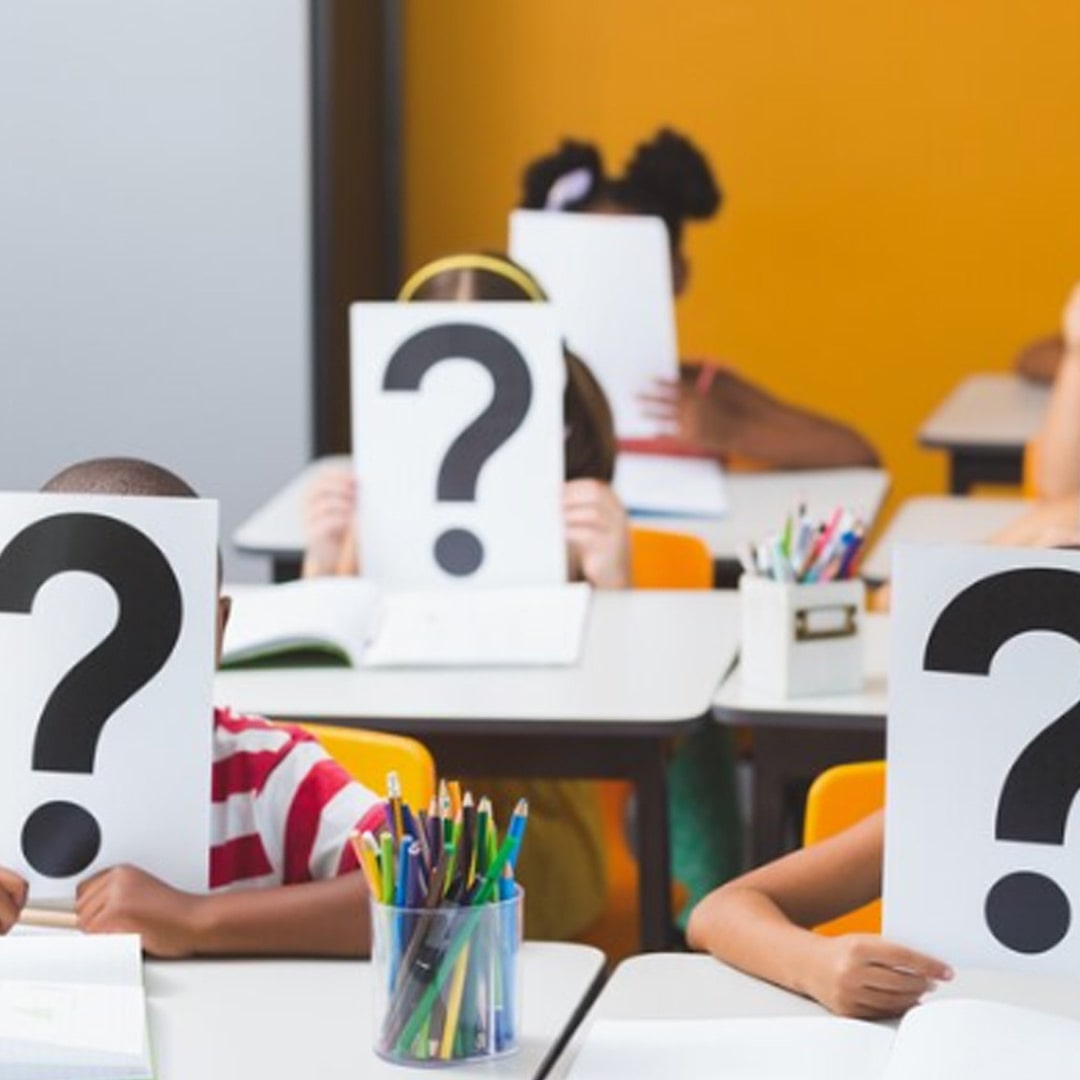
These questions follow a Class 2 kid through an ordinary day: brushing teeth, breakfast, the road to school, the classroom, the evening sky and a bedtime chat about India. Each answer has a short line explaining why it’s true. A seven-year-old who knows that a spider isn’t an insect, and the reason, will remember it far longer than one who only knows the number eight.
Waking up: your body
1. How many teeth does a grown-up have? 32. Kids start with 20 milk teeth. These begin falling out at about six to make space for the bigger adult set.
2. Which organ pumps blood around the body? The heart. It’s roughly as big as your fist, and in a kid it beats roughly 70 to 110 times a minute.
3. Does a newborn baby have more bones than a grown-up? Yes. Babies have about 300 bones. As they grow, some join together, so adults end up with 206.
4. Why do we have eyebrows? To keep sweat and rain out of our eyes. The arch shape sends drops off to the sides.
5. Which sense organ do we use to smell, and which to taste? The nose smells, and the tongue tastes. The two work together, which is why food tastes dull when your nose is blocked with a cold.
Breakfast: food and plants
6. Which fruit carries its seeds on the outside? The strawberry. Each of those tiny dots on the skin is a seed, and one strawberry has about 200.
7. What do bees collect from flowers to make honey? Nectar. It’s a sugary juice inside flowers. Bees carry it back to the hive, where it slowly thickens into honey.
8. Which part of a plant makes its food? The leaves. They use sunlight, water and air to make food. A green substance inside the leaves called chlorophyll catches the light, and it’s also what makes leaves green.
9. What does a plant need to grow? Light, water, air and nutrients. Soil holds water and nutrients for most plants, but some don’t need it at all. A money plant can grow in a bottle of water on a windowsill.
10. What is India’s national fruit? The mango. India grows more mangoes than any other country in the world.
11. Sugar is made from the stem of which plant? Sugarcane. The stem is crushed to squeeze out the sweet juice, which is boiled until sugar crystals form.
On the way to school: animals and roads
12. What is India’s national animal? The tiger. Its stripes aren’t only on the fur. A tiger’s skin underneath is striped too.
13. Which peacocks have the long, colourful tail feathers, the males or the females? The males. Peahens are brown and plainer, which helps them hide while they sit on their eggs.
14. How many legs does a spider have? Eight. That’s why a spider isn’t an insect. Insects, like ants and bees, have six legs.
15. What is a baby kangaroo called? A joey. At birth it’s only about the size of a jellybean. It crawls into its mother’s pouch and grows there for months.
16. Which is the tallest animal? The giraffe. Its long neck has just seven bones, the same number as in a human neck. Each bone is simply much longer.
17. What does a caterpillar turn into? A butterfly or a moth. First it wraps itself in a case called a chrysalis or cocoon, and changes shape completely inside.
18. What do we call a group of birds? And a group of lions? A flock of birds, and a pride of lions.
19. What do the three colours of a traffic light mean? Red means stop, amber means get ready, and green means go. Red sits at the top so drivers can see it even when the light is partly blocked.
In class: numbers and shapes
20. What is the biggest three-digit number? 999. Add one more and you need a fourth digit: 1,000.
21. Is 35 odd or even? Odd. Every odd number ends in 1, 3, 5, 7 or 9.
22. How many grams make one kilogram? 1,000. Kilo means thousand, so a kilogram is a thousand grams.
23. Which is heavier: a kilo of cotton or a kilo of iron? Neither. They both weigh one kilogram. The cotton just takes up much more space. Questions like this reward careful reading over quick guessing, and that habit pays off in maths more than in any other subject. Bambinos’ online maths classes are a good place to build it.
24. How many sides does a triangle have? Three. Tri means three, as in tricycle.
25. What shape is a ball? A sphere. A circle is flat, like a drawing. A sphere is round in every direction.
26. How many colours are there in a rainbow? Seven, which we remember as VIBGYOR. A real rainbow is a smooth band with no hard lines between colours. The scientist Isaac Newton chose to name seven of them.
27. How many days does February have? 28 in most years and 29 in a leap year. A leap year comes once every four years.
28. Why does a day have 24 hours? Because that’s how long the Earth takes to spin around once. The side facing the sun has day, and the side facing away has night.
Evening: the sky
29. Is the sun a star? Yes. It’s the closest star to Earth. The others look tiny only because they’re so much further away.
30. Why do we see lightning before we hear thunder? Because light travels much faster than sound. Both happen at the same moment, but the light reaches you first.
31. Does the Moon make its own light? No. It reflects light from the sun, the way a mirror does.
32. Which is the biggest ocean? The Pacific Ocean. It’s bigger than all the land on Earth put together.
33. Which is the tallest mountain in the world? Mount Everest. It stands on the border of Nepal and China and is about 8,849 metres high.
34. Which is the largest animal on Earth? The blue whale. It’s even bigger than the largest dinosaurs, and its heart alone is about the size of a small car.
35. Which season brings the most rain in India? The monsoon, which usually lasts from about June to September.
36. Do sunflowers follow the sun? Young ones do. Growing sunflowers turn to face the sun as it moves across the sky. Once the flowers open fully, they stop turning and mostly face east.
Bedtime: India
37. What is the capital of India? New Delhi
38. How many spokes does the wheel on our flag have? 24. The wheel is the Ashoka Chakra, and it’s navy blue.
39. Why do we celebrate Independence Day on 15 August? Because India became free from British rule on 15 August 1947.
40. What happened on 26 January 1950? India’s Constitution came into force, which is why we celebrate Republic Day on that date.
41. How many states does India have? 28, plus 8 union territories. Union territories are run more directly by the central government.
42. Who was India’s first President? Dr Rajendra Prasad
43. Who is India’s President now? Droupadi Murmu (as of November 2026). She is the first President from a tribal community.
44. What is India’s national flower? The lotus. It grows in muddy ponds, but its petals stay clean. Water rolls straight off them.
45. Which is the tallest statue in the world? The Statue of Unity in Gujarat. It shows Sardar Vallabhbhai Patel and is 182 metres tall. Patel is also called the Iron Man of India, which is one of the questions in this Class 4 GK set.
46. Who wrote India’s national anthem? Rabindranath Tagore
47. Which is India’s longest river? The Ganga
48. In which city is the Taj Mahal? Agra
49. How many lions are there on India’s national emblem? Four, standing back to back. Only three can be seen from the front.
50. What is India’s national aquatic animal? The Ganges river dolphin. It’s almost blind and finds its way by sending out sounds and listening for the echoes.
Getting more out of these questions
Reading out the answers is the quick part. The useful part is asking your kid to explain one back to you in their own words: “So why is a spider not an insect?” Putting a reason into a full sentence is harder than remembering a fact, and it’s a skill they’ll need in every subject.
That’s also the skill Bambinos works on in its live English and public speaking classes, where kids practise explaining their ideas clearly to a small group. If you’d like to see one, you can book a trial class for your kid at no cost.
About the Author

Madhur Churiwala
AuthorMadhur Churiwala is an accomplished English and communicative skills educator with 15 years of experience. She holds a degree of B. ED in English. She started her career as a Fashion Designer but her passion for teaching and interacting with children turned her into a highly skilled educator. Initially she taught in school and then moved onto online teaching platform where she showcased her skills in education. Her way of teaching in fun and playful environment always inspires children to develop a love for learning. Over the years she has developed her passion for writing. As an author, Madhur brings her dedicated educational background to her blogs offering the valuable insights for educators, parents and students alike.
LinkedIn Profile ↗