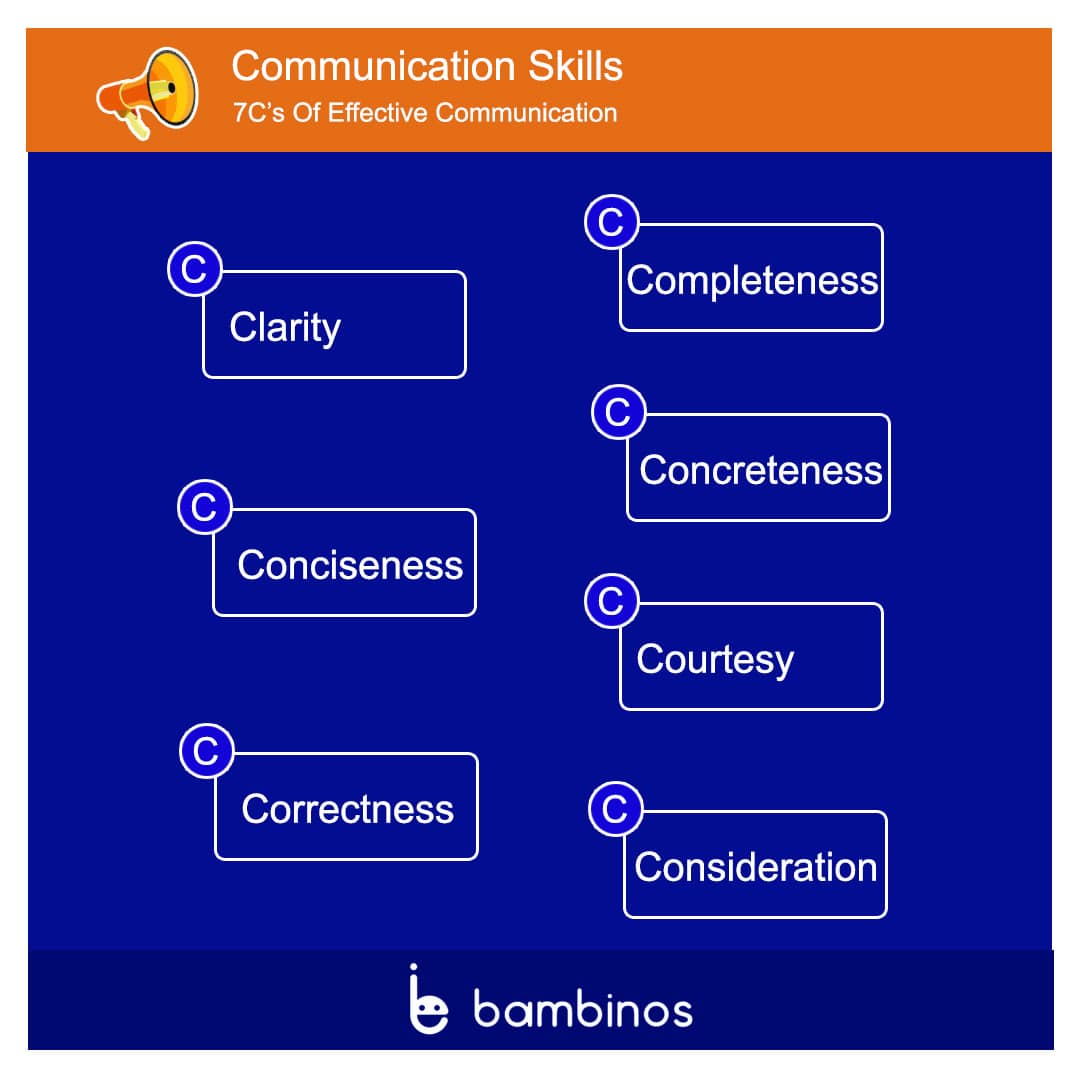
The 7 Cs of communication are Clear, Concise, Concrete, Correct, Complete, Courteous and Considerate. These principles help kids express their ideas, share accurate information and respond respectfully to others.
For example, during a group discussion, a student might say, “We should do something about pollution.” A clearer response would be, “Our school could reduce plastic waste by encouraging everyone to bring reusable water bottles.”
The second statement presents a specific suggestion that classmates can understand and discuss.
From self-introductions to classroom debates and English drama, the seven principles help students organise their thoughts and speak with purpose.
What Are the 7 Cs of Communication?
The 7 Cs are seven qualities of effective communication. They guide how people express ideas, provide relevant information and consider their audience.
| Principle | Meaning | School Example |
|---|---|---|
| Clear | Express ideas that others can understand. | Introduce yourself with your name, class and interests. |
| Concise | Avoid unnecessary words. | Share your opinion in two focused sentences. |
| Concrete | Support ideas with specific details. | Explain how your school could reduce plastic waste. |
| Correct | Use accurate facts and suitable language. | Verify information before a science presentation. |
| Complete | Include essential information. | Explain your role and responsibilities in a drama. |
| Courteous | Communicate politely and respectfully. | Wait for your turn during a discussion. |
| Considerate | Think about the listener's feelings and needs. | Respond thoughtfully when classmates disagree. |
These principles work together. A student may give an accurate answer but fail to explain it clearly, or speak politely without providing enough information.
Easy way to remember: Be clear, stay brief, give details, check facts, include what's needed, show respect and consider the listener.
How Can Students Use the 7 Cs in School?
The seven principles become easier to understand through real classroom situations. They apply to group discussions, introductions, presentations and performances.
| Principle | Situation | Before | Better Response |
|---|---|---|---|
| Clear | Self-introduction | “I like many things.” | “I'm Aarav, and I enjoy chess and adventure stories.” |
| Concise | Group discussion | “There are many reasons, and I think we should do something.” | “We should plant more trees because they provide shade and support wildlife.” |
| Concrete | Classroom debate | “Reading is useful.” | “Reading stories helps me discover new words and understand different characters.” |
| Correct | Science presentation | “The Earth takes 24 days to rotate once.” | “The Earth takes about 24 hours to complete one rotation.” |
| Complete | Drama rehearsal | “I'll be the narrator.” | “I'll introduce the characters and describe the opening scene.” |
| Courteous | Bookshop role-play | “Give me that book.” | “Excuse me, could you please show me that book?” |
| Considerate | Group project | “Your idea is wrong.” | “I understand your point. Could we consider another approach?” |
Example: A classroom group discussion
Imagine students discussing whether schools should assign homework through mobile apps.
One student says, “I don't like it. It's bad.”
After being asked to explain, the student responds:
“I prefer written homework because I already use screens for school projects. Writing in my notebook also helps me concentrate.”
The improved answer presents a clear opinion with a supporting reason. Classmates now have something specific to discuss.
These habits also help with school presentations, teamwork and everyday conversations.
What Activities Can Help Kids Develop the 7 Cs?
Interactive activities help students understand the principles through actual conversations rather than memorising definitions.
1. The 30-Second Self-Introduction
Ask your kid to introduce themselves to a new classmate. Include their name, school class, one interest and a favourite subject.
Example:
“Hello! I'm Maya from Class 5. I enjoy drawing comic characters, and my favourite subject is Science because I like discovering how things work.”
Focus: Clear, Concise and Complete.
Afterwards, ask whether the introduction gave enough information without becoming too long.
2. The Group Discussion Challenge
Choose a topic such as “Should schools have a reading period every day?”
Give each participant one minute to share an opinion, followed by an opportunity to respond to someone else.
Example:
“I support a daily reading period because it gives everyone time to enjoy books. Even ten minutes could help students discover stories they might not read at home.”
Focus: Concrete, Courteous and Considerate.
Encourage students to support their opinions with reasons while respecting different viewpoints.
3. Role-Playing at a Bookshop
One person plays the shopkeeper, while another acts as a customer looking for a mystery book.
Instead of saying, “I want a book,” the customer could ask:
“Good afternoon. Could you recommend a mystery book that I can finish in a week? I need it for my school reading project.”
Focus: Clear, Complete and Courteous.
Switch roles and let the shopkeeper ask follow-up questions.
4. English Drama: The Missing Trophy
Create a short play in which a school trophy disappears before the annual celebration.
Assign four roles: teacher, student, sports captain and school helper. Each character must share useful information and help solve the mystery.
Example:
“I last saw the trophy in the sports room after yesterday's rehearsal. Let's check there before asking the other classes.”
Focus: Correct, Concrete, Complete and Considerate.
After the performance, ask whether the audience understood what happened and how the characters solved the problem.
For more ideas, explore these communication games and activities for kids.
How Can Kids Practice the 7 Cs Every Day?
Kids can develop these habits by concentrating on one principle each day. Simple exercises during family conversations, homework or school activities are enough to get started.
| Day | Principle | Daily Challenge |
|---|---|---|
| Monday | Clear | Give a 30-second self-introduction. |
| Tuesday | Concise | Summarise a favourite movie in three sentences. |
| Wednesday | Concrete | Support an opinion with a specific example. |
| Thursday | Correct | Present three accurate facts about a science topic. |
| Friday | Complete | Explain the beginning, problem and ending of a drama scene. |
| Saturday | Courteous | Role-play a polite conversation at a shop or library. |
| Sunday | Considerate | Respond respectfully to someone with a different opinion. |
A useful self-check before speaking or writing is:
-
Is my main idea easy to understand?
-
Have I included the details that matter?
-
Are my facts correct?
-
Is my response polite and suitable for the listener?
Parents can encourage kids to review their own responses rather than correcting every sentence for them.
Unbox English by Bambinos.live offers teacher-guided activities involving storytelling, group discussions, presentations and creative expression for kids from LKG to Class 8. Families interested in structured communication development can learn more about the online english classes for kids.
How Can Parents Help Kids Communicate More Effectively?
Parents can help by giving kids opportunities to explain ideas, ask questions and listen to different opinions.
A family discussion, pretend interview or short English drama at home can make these skills easier to apply.
Rather than focusing on every small mistake, choose one improvement at a time. A student who finds it difficult to explain an idea can begin with clarity, while someone who frequently interrupts others can work on courtesy and consideration.
Start with one activity this week. Ask your kid to explain an opinion in two sentences, include one supporting example and listen to another person's response.
With consistent opportunities to participate, students can become more comfortable expressing themselves in school and everyday situations.
Want to see how guided English communication activities work? Book a Free Unbox English Demo.
|
Turn one messy note into a clear one In a free Unbox English demo, kids aged 4 to 14 work live with a teacher in a small group, on speaking and writing pitched at their age band. Book a free Unbox English demo |
About the Author

Nimrah Rafiq
AuthorNimrah Rafiq is a passionate educator hailing from Srinagar, holding a degree of MA in English literature. She has worked on various Ed-tech platforms and now she has joined as an educator in bambinos.live. She is enthusiastic about teaching and will move forward with zest and zeal.
LinkedIn Profile ↗