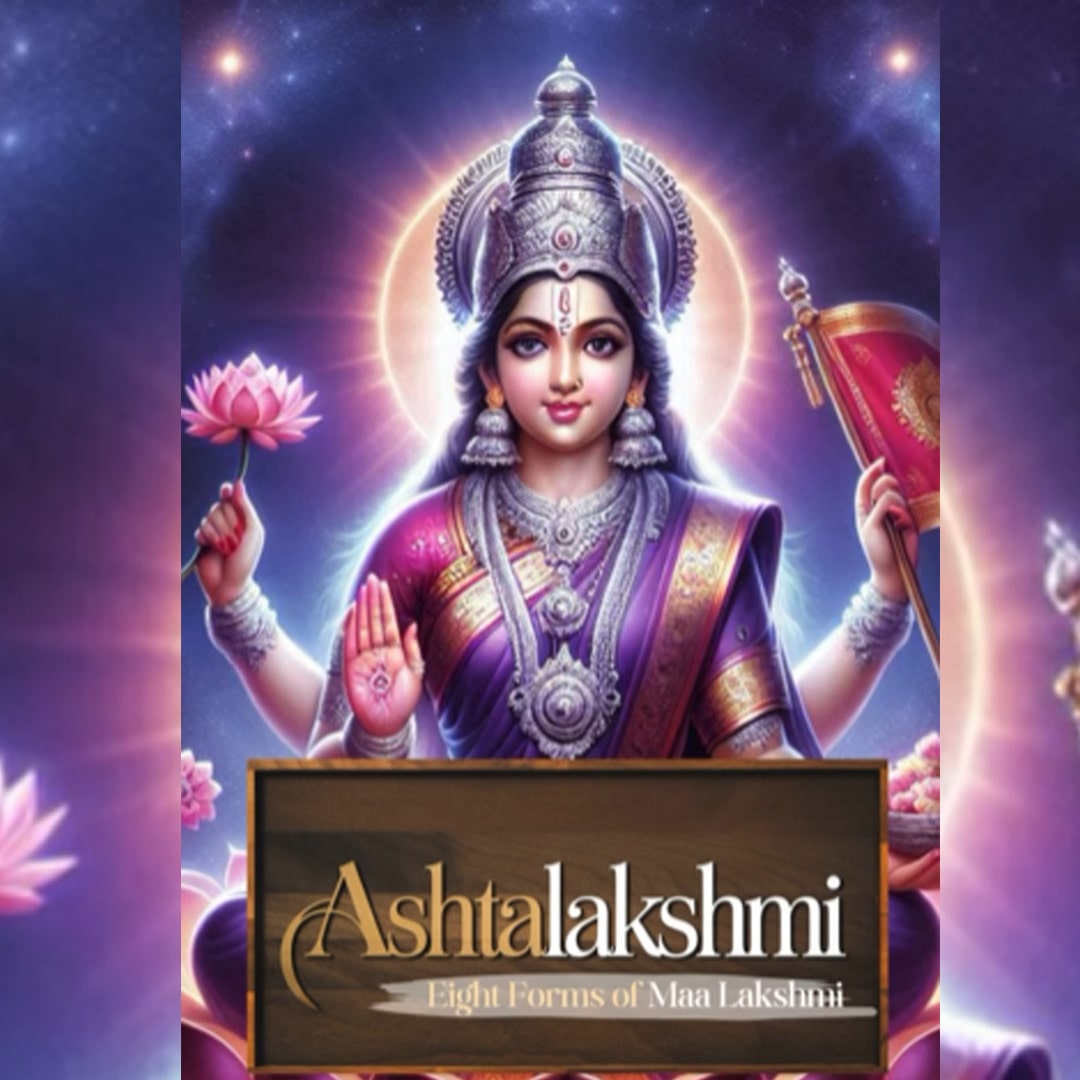
Goddess Lakshmi has eight forms, together called Ashta Lakshmi. “Ashta” means eight in Sanskrit. Each form stands for a different kind of treasure, such as food, courage or learning, which helps kids understand that being “rich” means much more than having money.
This guide has the 8 forms of Lakshmi explained for kids, with a story or example for each form, a line you can say to your kid and a small task they can try the same day.
Who is Goddess Lakshmi?
Goddess Lakshmi is the Hindu goddess of wealth and good fortune, and the wife of Lord Vishnu. She is usually shown sitting on a pink lotus, with gold coins falling from her hand.
Kids love the story of how she appeared. Long ago, the gods and the asuras churned a giant ocean of milk to find a hidden treasure. As they churned, wonderful things rose out of the ocean, and one of them was Lakshmi, sitting on a lotus. Because she came after so much hard work, many families say Lakshmi blesses people who work hard and stay kind.
You can read more about the eight forms on Wikipedia’s page on Ashtalakshmi.
What are the 8 forms of Lakshmi?
The 8 forms of Lakshmi are Adi Lakshmi, Dhanya Lakshmi, Dhairya Lakshmi, Gaja Lakshmi, Santana Lakshmi, Vijaya Lakshmi, Vidya Lakshmi and Dhana Lakshmi. Kids can learn all eight names with this short chant:
Adi Lakshmi, Dhanya Lakshmi, Dhairya Lakshmi, Gaja Lakshmi, Santana Lakshmi, Vijaya Lakshmi, Vidya Lakshmi, Dhana Lakshmi, Namostute, Namostute!
| Form | The treasure she stands for | How she is shown | What kids can learn |
|---|---|---|---|
| Adi Lakshmi | Calm | Seated on a lotus, holding a lotus | Stay calm before you react |
| Dhanya Lakshmi | Food | Holding sheaves of grain | Respect food and don’t waste it |
| Dhairya Lakshmi | Courage | Holding a sword and shield | Keep trying when something is hard |
| Gaja Lakshmi | Gentle strength | Two elephants pouring water over her | Use your strength to help, not to hurt |
| Santana Lakshmi | Family | Holding a child | Show love and care at home |
| Vijaya Lakshmi | Success | Holding a victory flag | Success comes from steady practice |
| Vidya Lakshmi | Learning | Holding a book | Learning is a treasure no one can take away |
| Dhana Lakshmi | Money | Holding a pot of gold coins | Save a little and spend wisely |
Some temples use slightly different names, such as Veera Lakshmi in place of Dhairya Lakshmi, but the idea of eight treasures stays the same.
What does each form of Lakshmi teach kids?
Each form of Lakshmi teaches kids one everyday value they can practise at home or at school. Here is a simple way to share them, one form at a time.
1. Adi Lakshmi: the treasure of calm
A legend says that when Lord Vishnu took the fierce lion-faced form of Narasimha, his anger was so strong that everyone was afraid. Lakshmi’s calm presence helped soothe him.
- Say this to your kid: “Even the strongest people need someone calm beside them.”
- Try this today: The next time your kid feels angry, practise three slow breaths together before talking.
2. Dhanya Lakshmi: the treasure of food
Dhanya means grain. This form reminds us that every chapati and every spoon of rice comes from a farmer’s hard work in the fields.
- Say this to your kid: “Food is a treasure, so we take only what we can finish.”
- Try this today: Ask your kid to finish their plate and thank the person who cooked the meal.
3. Dhairya Lakshmi: the treasure of courage
Dhairya means courage and patience. She carries a sword and shield, but her real gift is the courage to keep going when things feel difficult.
- Say this to your kid: “Being brave doesn’t mean you’re never scared. It means you try anyway.”
- Try this today: Let your kid choose one small brave thing, such as asking a question in class or reading aloud to the family.
4. Gaja Lakshmi: the treasure of gentle strength
Gaja means elephant. Gaja Lakshmi is shown with two elephants pouring water over her. Elephants are very strong, but they are gentle with their young and protect their herd.
- Say this to your kid: “Strong people use their strength to help others.”
- Try this today: Your kid can help a younger sibling or a friend with something they find hard.
5. Santana Lakshmi: the treasure of family
Santana Lakshmi is shown holding a child, and she stands for a happy, caring family.
- Say this to your kid: “A family that helps each other is one of the richest families of all.”
- Try this today: Your kid can do one helpful job at home without being asked, such as setting the table.
6. Vijaya Lakshmi: the treasure of success
Vijaya means victory. She holds a victory flag, which reminds us of the joy of reaching a goal.
- Say this to your kid: “Every big win starts with small practice, day after day.”
- Try this today: Help your kid pick one skill, such as cycling or a times table, and practise it for 10 minutes.
7. Vidya Lakshmi: the treasure of learning
Vidya means learning. She holds a book, which makes her a special form for students.
- Say this to your kid: “Toys can break and money can be spent, but what you learn stays with you forever.”
- Try this today: Ask your kid to teach you one new thing they learnt at school this week.
8. Dhana Lakshmi: the treasure of money
Dhana means money. She holds a pot of gold coins and reminds us to use money wisely.
- Say this to your kid: “Saving a little each week helps you buy something special later.”
- Try this today: Start a small savings jar and decide together what your kid is saving for.
How can you explain the 8 forms of Lakshmi to kids of different ages?
You can explain the 8 forms of Lakshmi to kids of different ages by matching the idea to what they can follow:
| Age | What to focus on | What you can say |
|---|---|---|
| 3–5 years | Lakshmi as a kind goddess who brings good things | “Lakshmi Maa sits on a pink lotus and loves happy, clean homes.” |
| 6–8 years | The eight forms as eight kinds of treasure | “Food is a treasure, and so is learning. Which treasure do you have today?” |
| 9–12 years | How each value shows up in daily life | “Which treasure do you want to build this year: courage, learning or savings?” |
Why do families pray to Lakshmi on Diwali?
Families pray to Lakshmi on Diwali to welcome good fortune into their homes for the year ahead. Homes are cleaned, lamps are lit and rangoli is drawn at the doorway, and many families hold Lakshmi Puja on the main night of the festival.
Diwali is a good time to talk about the 8 forms of Lakshmi, because kids already see the preparations around them. For more on the festival, read why Diwali is celebrated.
What activities can kids do to learn the 8 forms of Lakshmi?
Kids can learn the 8 forms of Lakshmi through short, hands-on activities that take 15 to 20 minutes:
- Eight treasures jar. Write the eight treasures on slips of paper. Each day for a week, your kid picks one and does the “Try this today” task for that form.
- Savings jar for Dhana Lakshmi. Decorate a jar with a lotus drawing and agree on a small amount to save every week.
- Grain sorting for Dhanya Lakshmi. Mix rice, dal and chana in a bowl and let your kid sort them while you talk about where each one grows.
- Draw Gaja Lakshmi. Draw Lakshmi on a lotus with two elephants beside her. Your kid can write one way they will use their strength to help someone.
- Treasure chart. Make a chart with eight boxes. Each time your kid practises one value, such as finishing their food or being brave, they colour a box.
What questions can parents ask kids about the 8 forms of Lakshmi?
Parents can ask open questions that help kids think about the eight treasures:
- Which form of Lakshmi do you like the most, and why?
- Which treasure do you already have a lot of?
- Why do you think learning is called a treasure?
- What would you like to save your money for?
What can kids take away from the 8 forms of Lakshmi?
Kids can take away the idea that real wealth comes in many forms. Good food, a caring family, the courage to try new things and the knowledge they gain at school are all treasures worth valuing. When these stories are shared at home, Lakshmi becomes more than a goddess of money; she becomes a friendly reminder to value every good thing in life.
If your kid enjoys stories like these and wants to explore them further, Little Yogi by Bambinos.live shares stories from Indian traditions, shlokas and their meaning in live classes for kids. Book a Free 50-Min Class
FAQs
What does Ashta Lakshmi mean?
Ashta Lakshmi means “eight forms of Lakshmi.” “Ashta” is the Sanskrit word for eight. Each form stands for a different kind of treasure, such as food, courage or learning.
Is Lakshmi the goddess of money?
Lakshmi is the goddess of wealth, and money is one part of that wealth. Her eight forms also stand for food, family, courage, success, learning, gentle strength and calm. Together they show kids that a happy life needs many kinds of treasure.
Which form of Lakshmi is linked to learning?
Vidya Lakshmi is the form linked to learning and knowledge. “Vidya” means learning in Sanskrit. She is often shown holding a book, which makes her a meaningful form for students.
When do families pray to Lakshmi?
Families pray to Lakshmi throughout the year, and especially on Diwali. Many homes hold Lakshmi Puja on the main night of Diwali to welcome good fortune. In some traditions, Lakshmi is also honoured during the middle three nights of Navratri.
Are the names of the 8 forms of Lakshmi the same everywhere?
The names of the 8 forms of Lakshmi are mostly the same, but a few lists use different names. Some temples include Veera Lakshmi or Aishwarya Lakshmi in place of another form. The idea of eight treasures stays the same in every list.
About the Author

Jyotsna Krishnadev
AuthorJyotsna Krishnadev is a passionate educator, a design aficionado, an ardent reader, a passionate writer and a storyteller at heart. She is the author of Hot Air Balloon, a book that takes readers on a journey of discovery and adventure, much like the one her words often embark on. With a sharp eye for detail and an insatiable curiosity about the world, she has made her mark as a thought leader in the realms of design, art, culture, and the intricacies of life. Her voice resonates through the pages of esteemed architectural magazines, local publications, and newspapers, where she pens articles and opinion pieces that challenge perspectives and spark dialogue. A firm believer that words can shape the world, Jyotsna finds inspiration in every corner of life. She uses her writing to explore the intersection of creativity and life, weaving together her love for literature, her passion for design and her reflections on culture.
LinkedIn Profile ↗