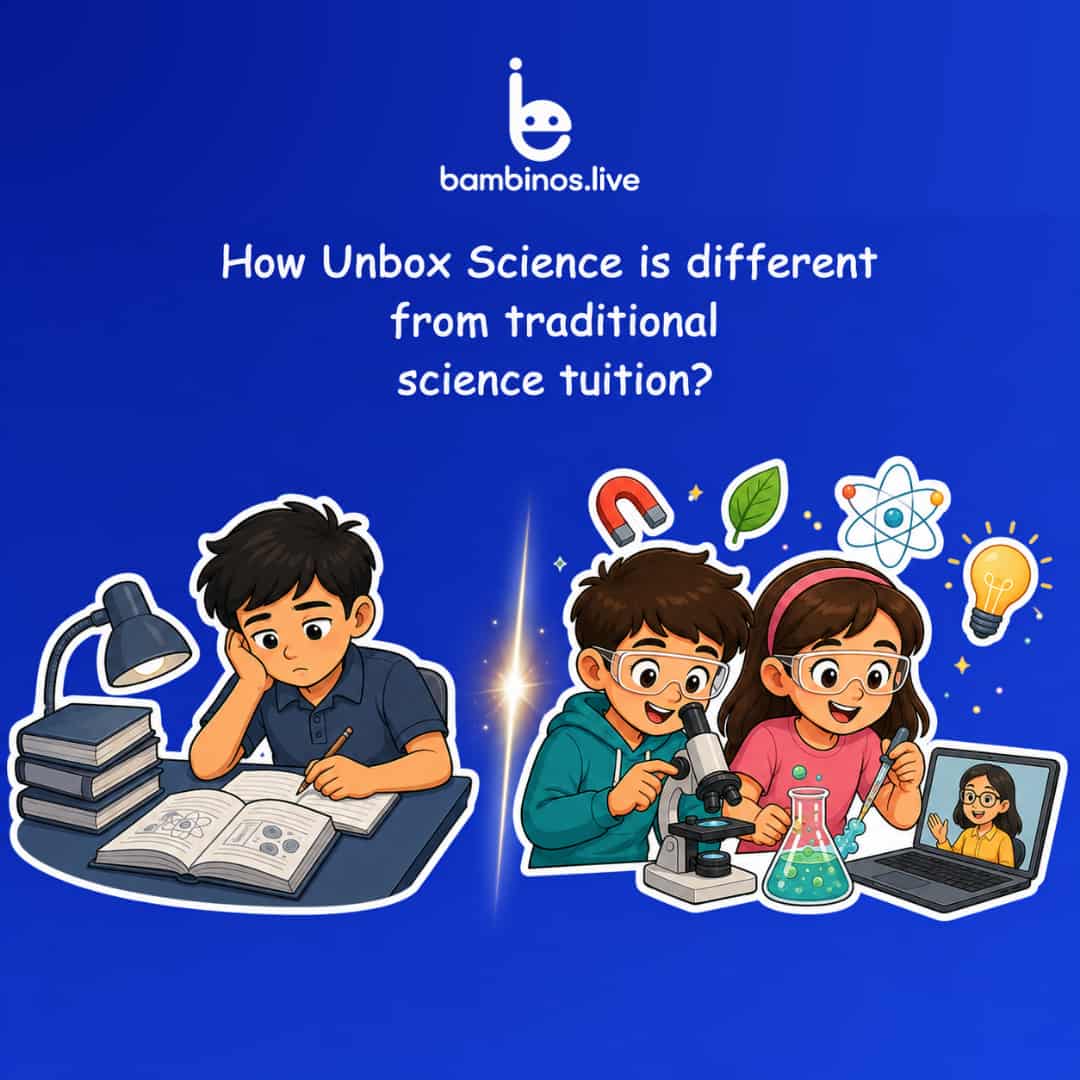
Imagine your child returning home from science tuition with a notebook full of notes and a chapter marked as complete. They may have memorised the definitions, solved a few questions, and prepared for the next test. But when you ask, “Can you explain why this happens?” they pause.
This is a concern many parents can relate to.
Science is not only about remembering formulas, definitions, or textbook answers. It is also about asking questions, observing the world, testing ideas, and understanding why things happen. While traditional science tuition can help children revise school topics, parents today may also be looking for science learning experiences that encourage deeper understanding.
This is where Unbox Science takes a different approach. Instead of focusing only on completing chapters, Unbox Science encourages children to explore concepts through questions, experiments, discussions, and real-world connections.
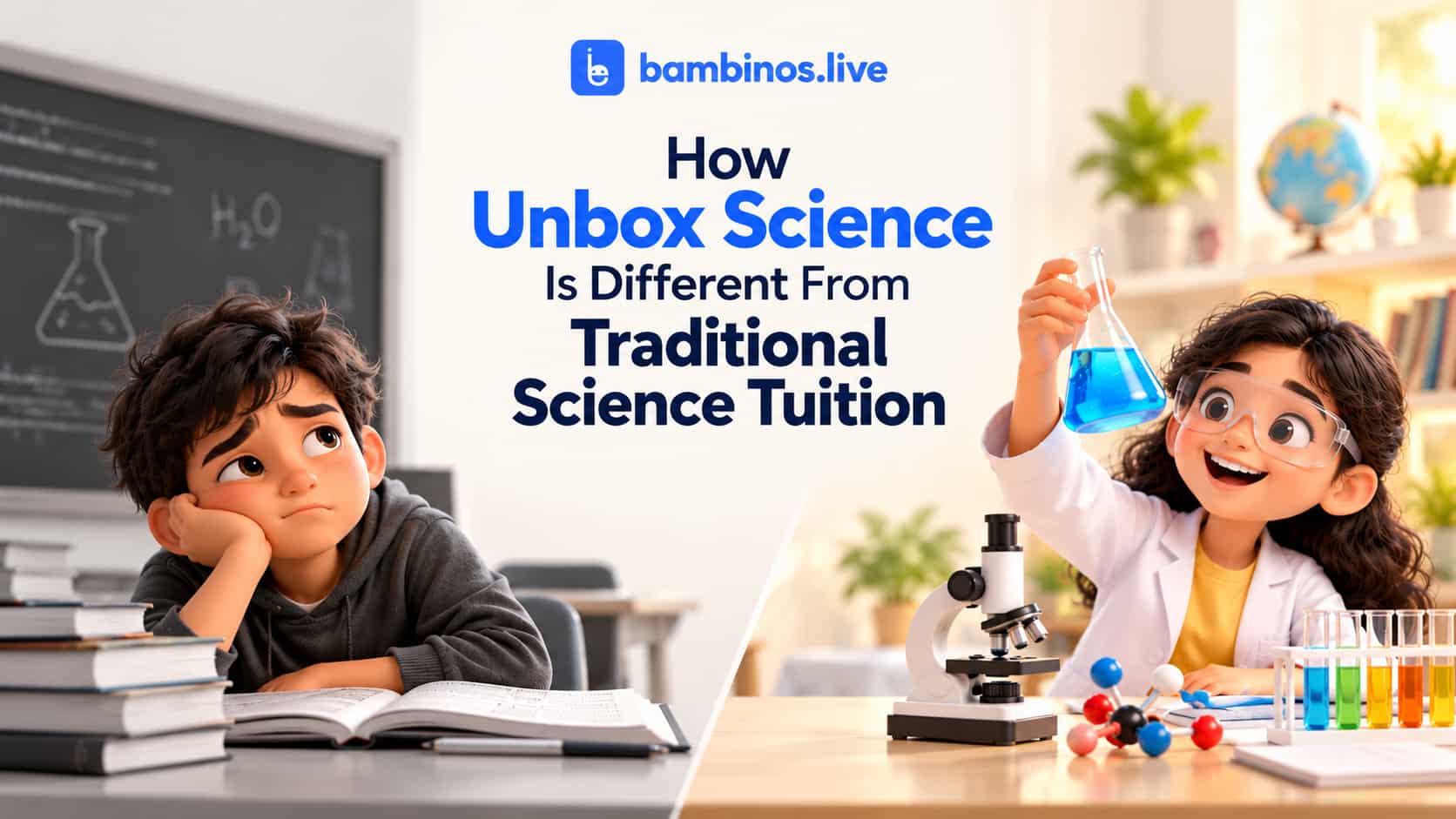
Traditional Science Tuition Often Follows the Textbook
Traditional science tuition usually follows the child's school syllabus closely. A tutor may explain a chapter, go through important definitions, solve questions, and help the child prepare for tests.
This approach can be useful when a child needs support with schoolwork. However, science can sometimes begin to feel like another subject where the main goal is to memorise the right answer.
For example, a child may remember the definition of force but may not always understand how force appears in everyday situations. They might know the answer in a worksheet but struggle to explain the concept in their own words.
Unbox Science, the best online science classes for kids, focuses on helping children go beyond simply knowing an answer. It encourages them to understand the idea behind it and think about how it works in the real world.
Learning Begins With Curiosity
Children are naturally curious.
They ask why the sky changes colour, how plants grow, why objects fall, and what makes some things float while others sink. These questions are an important part of learning science.
In many traditional science tuition classes, there may be limited time to explore these questions because the focus is often on completing the syllabus.
With Unbox Science, curiosity becomes part of the learning process. Children are encouraged to observe, ask questions, make predictions, and think about possible explanations.
This can make science classes for kids feel more engaging because learning starts with something children genuinely want to understand.
Instead of simply being told how something works, they get opportunities to explore the “why” behind it.
Book a demo for free and let your kid be one of 50,000+ learners discovering science through curiosity with Unbox Science.
From Memorising Concepts to Understanding Them
A child can memorise that plants need sunlight, water, and air. But understanding how these factors support plant growth requires a deeper level of learning.
Concept-based science learning focuses on helping children connect information rather than remembering isolated facts.
This is one of the important differences between traditional science tuition and an approach like Unbox Science. The focus is not only on whether a child can repeat information but also on whether they can explain, connect, and apply what they have learned.
When children understand a concept clearly, they can approach unfamiliar questions with greater confidence.
This can be especially useful as science becomes more advanced in higher grades, where simply memorising answers may not always be enough.
Hands-On Learning Makes Science Feel Real
Reading about an experiment and actually taking part in one can feel very different.
Hands-on science learning gives children opportunities to observe what happens when they test an idea. They can make predictions, notice changes, discuss results, and think about why the outcome occurred.
Science experiments for kids can make learning more memorable because children are actively involved in the process.
Imagine learning about floating and sinking only by reading a paragraph. Now imagine placing different objects in water, predicting what will happen, and then discussing why the results were different.
The second experience gives children something to think about.
This is why interactive science classes can help make scientific concepts feel less abstract and more connected to real life.
Live Learning Encourages Participation
Another difference is the way children participate during class.
In a traditional setting, the teacher or tutor may spend most of the session explaining while students listen and take notes. In online science classes, participation can also vary depending on how the sessions are designed.
Unbox Science uses live science classes for kids and encourages active involvement through questions, discussions, activities, and opportunities to explain ideas.
When children are invited to participate, they are less likely to remain passive learners.
They get chances to share their thinking, ask questions when something is unclear, and listen to different perspectives. This can make online science learning feel more interactive and personal.
For parents searching for science online classes for students, the level of participation can be just as important as the topics being taught.
Science Beyond the Classroom
One of the biggest advantages of meaningful science learning is that children begin noticing science everywhere.
They can see it while riding a bicycle, cooking food, watching rain, switching on a light, or observing a plant grow. Simple fun science activities to spark curiosity in kids can also help them connect what they learn with everyday experiences.
Unbox Science connects scientific concepts with everyday experiences so children can understand that science does not exist only inside a textbook.
A child who begins asking, “Why did that happen?” is developing an important habit of scientific thinking.
Over time, this habit can encourage curiosity, reasoning, and problem-solving.
Learning That Grows With the Child
Children in different age groups need different learning experiences.
A Grade 1 child may learn science best through observation, simple questions, and familiar examples. An older child may be ready to explore more detailed concepts, experiments, and scientific reasoning.
Unbox Science is designed as science classes for Grade 1 to 8, allowing the learning experience to progress as children grow.
This gives children an opportunity to build their understanding step by step rather than being introduced to concepts in exactly the same way at every age.
For parents looking at science learning programs for children, it is important to consider whether the learning approach matches the child's stage of development and encourages them to stay curious.
So, Which Approach Is Better?
The answer depends on what your child needs.
Traditional science tuition can provide useful support for school chapters, revision, and exam preparation. But if parents want their children to explore concepts more deeply, ask questions, take part in experiments, and understand how science connects with everyday life, they may want to look beyond a tuition-focused approach.
The difference is not simply science tuition vs online classes. It is also about how children experience learning.
Do they only listen and memorise, or do they get opportunities to question, test, discuss, and explain?
That experience can shape the way children feel about science.
Give Your Child a More Interactive Way to Learn Science
For parents looking for the best online science classes for kids, it can help to choose a learning experience that goes beyond completing lessons.
Bambinos.live's Unbox Science brings together live learning, hands-on activities, experiments, discussions, and concept-based science learning. Children get opportunities to explore scientific ideas, ask questions, make predictions, and explain what they discover.
Rather than seeing science as a list of facts to remember, children can begin seeing it as a way to understand the world around them.
With the right guidance and an engaging learning environment, Unbox Science can help children build curiosity and develop a stronger connection with science as they learn and grow.
Frequently Asked Questions
1. How is Unbox Science different from traditional science tuition?
Traditional science tuition often focuses on school chapters, revision, and exam preparation. Unbox Science takes a broader approach by encouraging children to explore concepts through questions, experiments, discussions, real-world connections, and active participation.
2. Are Unbox Science classes suitable for children in different grades?
Yes. Unbox Science is designed for children in Grades 1 to 8, with science concepts and learning experiences progressing according to the child's level.
3. Do children get hands-on learning opportunities in Unbox Science?
The learning approach includes hands-on activities and experiments that encourage children to observe, make predictions, test ideas, and discuss what they discover.
4. Can online science classes be interactive for kids?
Yes. Live, interactive sessions can give children opportunities to ask questions, participate in activities, share their ideas, and explain concepts instead of only watching or listening.
5. How can parents get started with Unbox Science?
- Book a demo with Bambinos.live to get a clear idea of how Unbox Science works and how your kid can learn through questions, activities, experiments, and discussions.
- See how your kid responds to the learning experience. Notice whether they enjoy asking questions, participating in activities, and exploring scientific concepts.
- Give your kid time to learn. Understanding science takes time. Regular participation, activities, experiments, and discussions can help them become more comfortable exploring and explaining scientific ideas.
Every young learner starts with a question. The right learning environment can give your kid the space and support to explore those questions and understand the science behind them.
About the Author

Rita Gupta
AuthorRita is an experienced educator specializing in Gita, and English, known for her engaging teaching style and supportive classroom environment. Along with her passion for teaching, she actively writes articles and stories that reflect her creativity and love for learning. Rita focuses on understanding every student’s individual needs, helping them gain confidence, stay motivated, and build a strong academic foundation. Through her guidance, learners develop essential skills and unlock their highest potential. For her, every student is a unique story waiting to be written, and she feels grateful to play even a small part in helping them discover their brightest chapter.