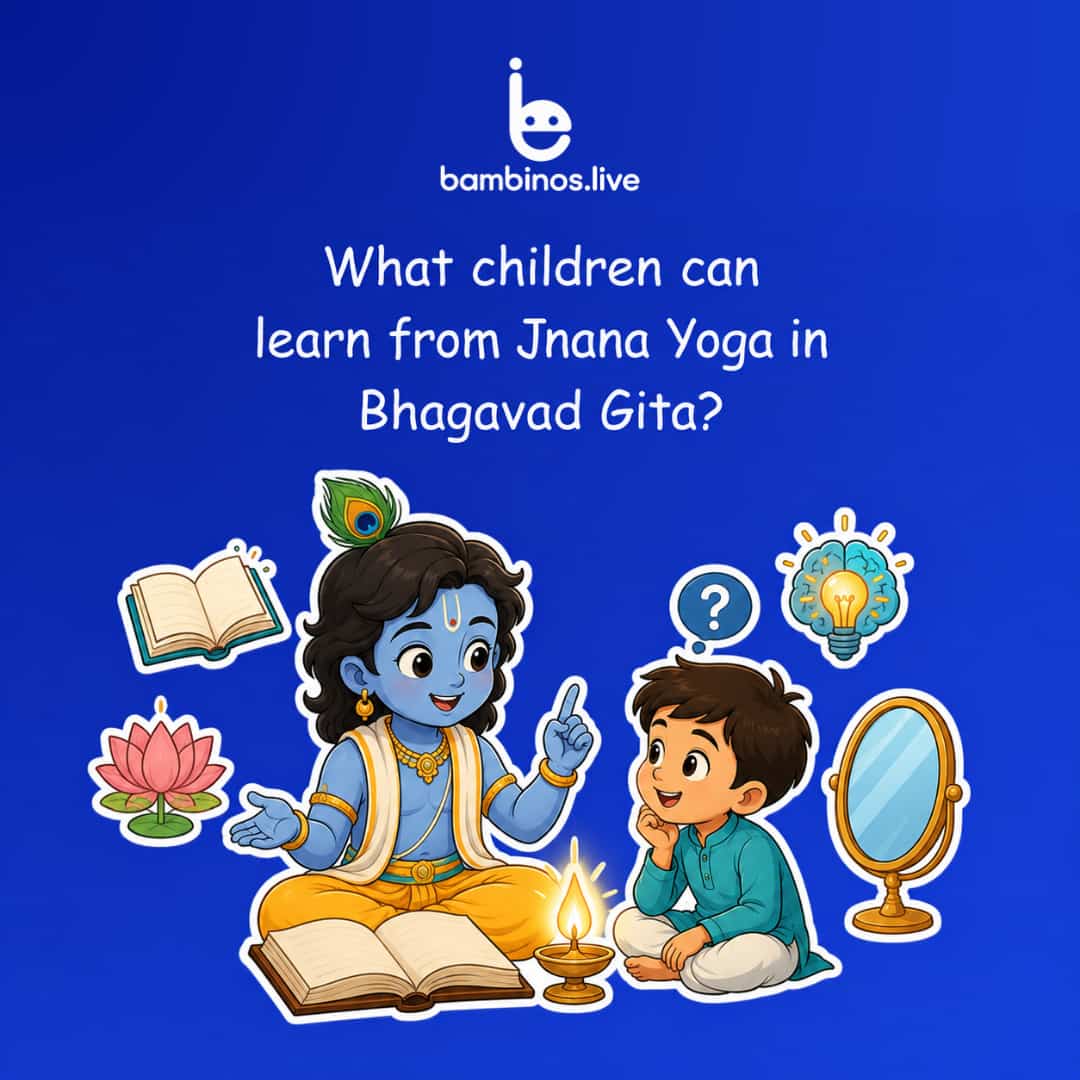
Jnana Yoga teaches children how to think clearly, ask meaningful questions, understand themselves, and make wise decisions. Through simple lessons from the Bhagavad Gita, children can develop critical thinking, self-awareness, emotional balance, and strong values.
Jnana Yoga, also known as the path of knowledge or wisdom, encourages children to look beyond information and understand the deeper meaning behind their thoughts and actions.
In the current era of technology, children are exposed to an enormous amount of information every day. They may be good at using technology, performing well in academics, and remembering facts, but information alone does not always lead to wisdom.
Children also need to learn how to think independently, understand their emotions, make thoughtful decisions, and recognize what truly matters in life. This is where the teachings of Jnana Yoga in the Bhagavad Gita can offer valuable lessons.
“सच्चा ज्ञान केवल जानकारी प्राप्त करने तक सीमित नहीं है, बल्कि स्वयं को समझने और सही निर्णय लेने की क्षमता भी है।”
Jnana Yoga encourages children to develop the habit of questioning, reflecting, and seeking a deeper understanding of themselves and the world around them. It teaches that true knowledge is not simply about collecting information but about developing wisdom and self-awareness.
Let us explore what children can learn from Jnana Yoga in the Bhagavad Gita and how parents can introduce these ideas through simple everyday activities.
What does Jnana Yoga mean?
Jnana Yoga means the path of knowledge and wisdom. The word Jnana comes from Sanskrit and refers to knowledge, understanding, or wisdom.
However, the knowledge associated with Jnana Yoga goes beyond what children learn from textbooks or classrooms. It encourages them to understand themselves, reflect on their actions, question what they observe, and seek deeper understanding.
In the Bhagavad Gita, Lord Krishna explains the importance of self-knowledge and understanding the difference between what is temporary and what is eternal. These ideas can be introduced to children through simple and practical examples.
“ज्ञान योग का उद्देश्य केवल ज्ञान प्राप्त करना नहीं, बल्कि उस ज्ञान को समझकर जीवन में सही तरीके से अपनाना है।”
Whether it is called Jnana Yoga, Gyan Yoga, Gyana Yoga, or Gnana Yoga, the underlying idea remains the pursuit of knowledge, wisdom, and self-understanding.
These lessons remain relevant today because children need more than academic knowledge to navigate friendships, challenges, emotions, technology, and everyday decisions.
Easy Jnana Yoga Activities for Children
Easy Jnana Yoga activities for children include reflective activities, story-based activities, asking “Why?”, keeping a gratitude journal, and learning one verse from the Bhagavad Gita per week. These activities help children learn Jnana Yoga in a fun and engaging way.
Parents often feel that spiritual learning cannot be easily accomplished by children. However, some Jnana Yoga practices can easily be taught to kids using fun and engaging activities.
Some easy Jnana Yoga activities are as follows:
1. Reflective Activity
Ask the child to reflect upon the following questions:
- What have I learned today?
- Have I helped somebody?
- How can I improve myself tomorrow?
2. Story-based activity
Children can learn courage, honesty, responsibility, and kindness from stories of the Bhagavad Gita Jnana Yoga.
3. Asking Why?
Teach your children to ask the question "Why?" Instead of simply knowing things.
4. Keeping a Gratitude Journal
Write three things to be grateful about daily.
5. One verse from Bhagavad Gita per week.
Jnana Yoga Meditation for Kids
Jnana Yoga meditation for kids can begin with simple practices such as silent sitting, concentrating on deep breathing, hearing soothing music, thinking about one positive thing, and seeing their heart full of light. Parents wanting more calming techniques can explore these Best Calm-Down Strategies for Kids at home.
One nice thing about education is Jnana Yoga meditation.
In contrast to complicated forms of meditation, kids can start from simple forms like:
- Silent sitting for five minutes.
- Concentrating on deep breathing.
- Hearing soothing music.
- Thinking about one positive thing.
- Seeing their heart full of light.
Regular meditation will help them to concentrate, control their emotions and become patient.
Karma, Bhakti, and Jnana Yoga
Karma Yoga, Bhakti Yoga, and Jnana Yoga are three spiritual paths which are complementary and are outlined in the Bhagavad Gita as follows:
- Karma Yoga - The path of selfless actions.
- Bhakti Yoga - The path of devotion and love.
- Jnana Yoga - The path of wisdom and knowledge.
Thus, Karma Bhakti Jnana Yoga aids in bringing up a well-balanced individual.
If the children:
- perform good deeds (Karma);
- grow loving and grateful (Bhakti); and
- are seeking wisdom (Jnana);
then they will become emotionally and mentally sound, moral and spiritual individuals.
Four Yoga Paths in Bhagavad Gita
The Four Yoga Paths in Bhagavad Gita provide various methods to develop spiritually:
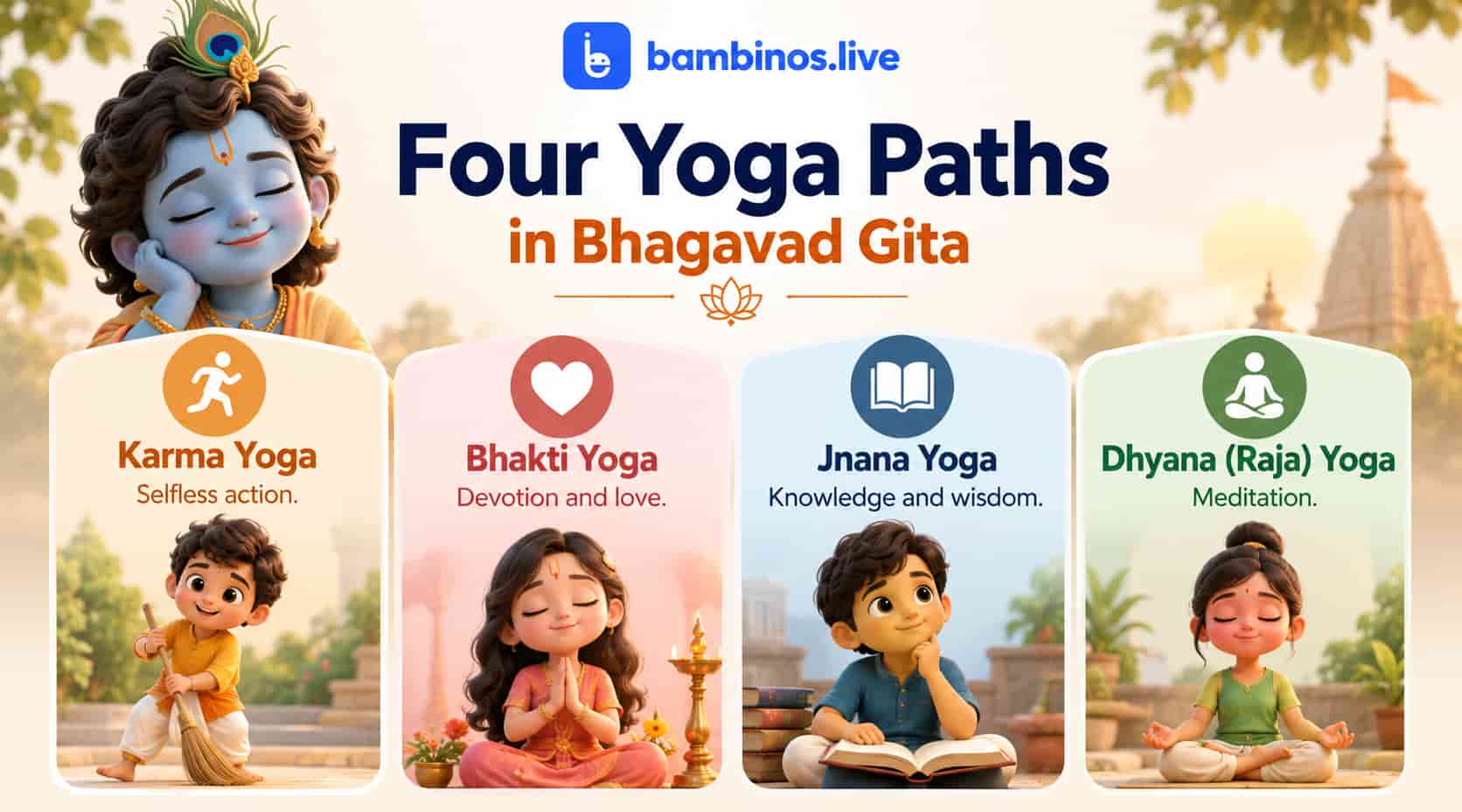
- Karma Yoga - Selfless action.
- Bhakti Yoga - Devotion and love.
- Jnana Yoga - Knowledge and wisdom.
- Dhyana (Raja) Yoga - Meditation.
Each child has his/her own individual personality. Some children learn through acts of service, some through devotion, some through meditation, and others by asking questions and contemplating on various issues.
Benefits of Jnana Yoga for Kids
The benefits of practicing Jnana Yoga for kids go far beyond spiritual development.
Critical Thinking Skills: Critical thinking skills help kids before taking action.
Good Judgement: They understand consequences and make good judgement calls.
Increases Emotional Intelligence: They become aware of their emotions and control them.
Grows Self-Confidence: Self-confidence comes from self-awareness, not comparing oneself to others.
Teaches Kids Values: They learn values such as honesty, compassion, patience, and responsibility.
Teaches Kids to Love Learning: They understand why learning is important.
Reduces Stress Levels: They won’t be stressed anymore because knowledge takes away all fears.
Character Development: Resilience, humility, gratitude, and kindness are developed.
Why should parents introduce Jnana Yoga to their kids?
Parents should introduce Jnana Yoga to children at a young age because early exposure to Bhagavad Gita Gyan Yoga can help children develop positive thoughts, good behavior, self-awareness, and strong values. Parents can also consider Bhagavad Gita classes online to introduce these teachings to children in a simple and engaging way.
Children who are exposed to Bhagavad Gita Gyan Yoga at a young age can gradually learn to reflect on their actions and understand the importance of making thoughtful choices.
“बच्चों को कम उम्र से ही अच्छे विचार और अच्छे संस्कार सिखाने से उनके व्यक्तित्व के विकास के लिए एक मजबूत आधार तैयार हो सकता है।”
The current education system emphasizes academic excellence, while Jnana Yoga can complement academic learning by emphasizing emotional intelligence, ethics, self-awareness, and other important virtues.
These qualities can make it easier for children to handle peer pressure and other challenges they may face in their lives.
Jnana Yoga can also help children understand that intelligence and wisdom are both important for success. Intelligence can help children acquire and understand knowledge, while wisdom can help them use that knowledge thoughtfully in real-life situations.
“बुद्धिमत्ता केवल अधिक जानने में नहीं, बल्कि सही समय पर सही ज्ञान का उपयोग करने में भी है।”
By introducing Jnana Yoga through stories, discussions, reflection, and simple everyday activities, parents can help children develop thoughtful minds, good values, and kind hearts.
Want to introduce Jnana Yoga to your child? Book a demo with Bambinos.live to discover our engaging learning programs for children.
About the Author

Pratakshi Ashwani Narang
AuthorPratakshi, a seasoned English tutor with over 10 years of experience, has not only excelled in the field of teaching but also made significant contributions as a writer. Her passion for education and love for children are evident in her published works. With a keen eye for detail and a creative flair, Pratakshi's writing style captivates readers of all ages. Her articles on various educational topics have been widely acclaimed for their insightful content and engaging narrative. As an online tutor, Pratakshi seamlessly blends her teaching expertise with her writing skills to create informative and engaging resources for students worldwide. Her dedication to empowering learners shines through in every piece she produces.
LinkedIn Profile ↗