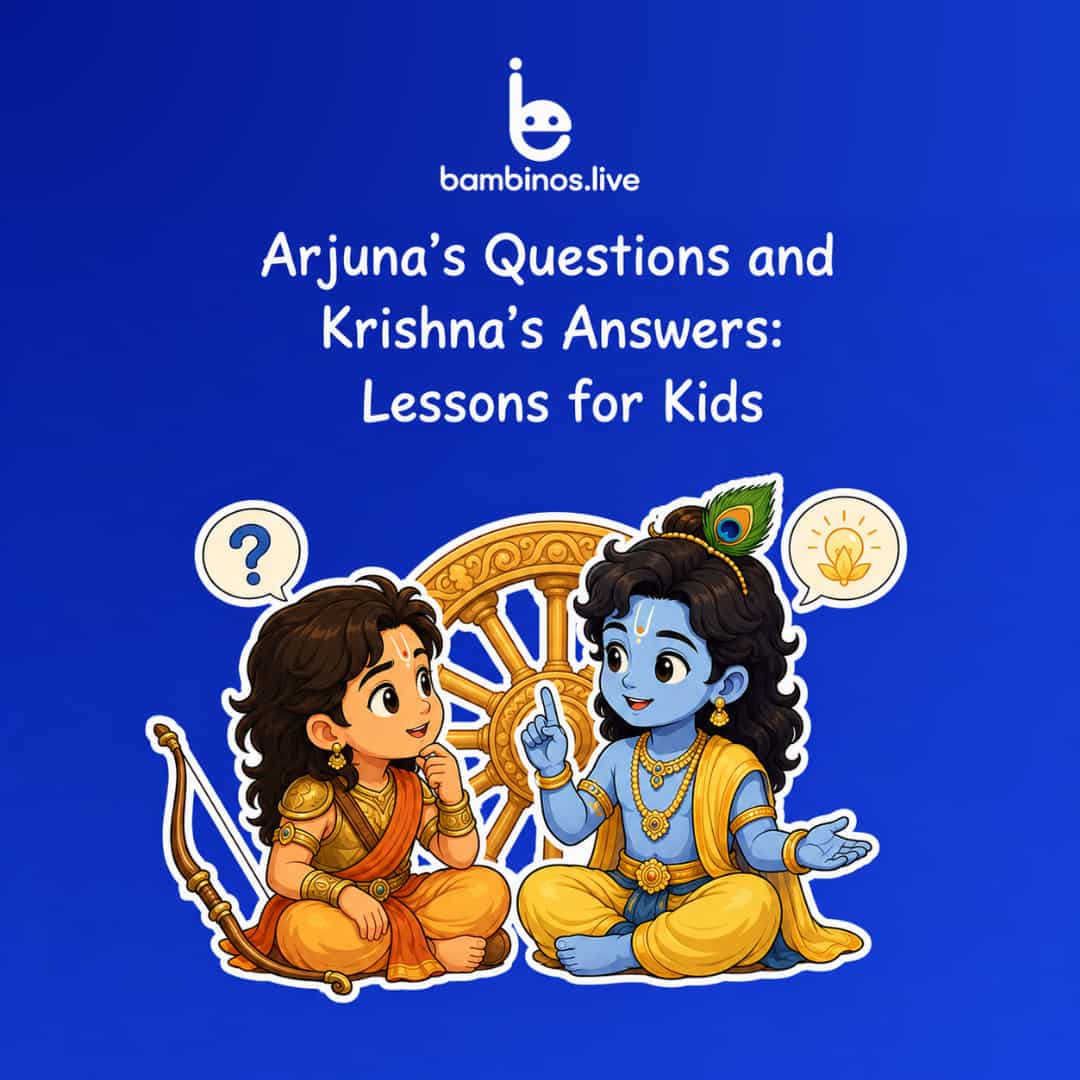
Lord Krishna is one of the most respected figures in India. His life is full of stories about bravery, wisdom, friendship, kindness, responsibility, and devotion. Besides being engaging, stories about Krishna provide valuable information and important life lessons for children.
Being brave and wise, while also playful at times, Lord Krishna teaches people how to handle difficult situations calmly and bravely, make the right decisions, and behave rationally. The life lessons of Lord Krishna are timeless and can help children become responsible, brave, compassionate, and confident individuals.
Who Is Lord Krishna?
Lord Krishna is considered one of the incarnations of Lord Vishnu according to Hindu tradition. His early life includes many stories about his playful deeds, his life in Gokul and Vrindavan, his devotion to his friends, and his bravery in fighting for justice.
Later, he becomes a diplomatic and wise leader and teacher. One of the most important events in the life of Lord Krishna is his conversation with Arjuna on the battlefield of Kurukshetra.
Before the war, Arjuna becomes confused and afraid. He does not know what to do or whether he should fight. He asks Lord Krishna many questions about duty, fear, sorrow, action, and the right way to live. Krishna answers his questions and guides him.
The life lessons from the conversation between Krishna and Arjuna are among the most important lessons that children can learn.
1. Work Hard and Do Not Think About the Results
The first lesson from the Bhagavad Gita that can be explained to children is to carry out their duties honestly without constantly worrying about the results.
Children may feel anxious before an exam, competition, presentation, or game. The teachings of Krishna encourage them to focus on their preparation and actions instead of worrying about the outcome.
A child can think:
“I will work hard, try my best, and learn from whatever happens.”
This approach can help reduce unnecessary stress and make learning more enjoyable.
2. Be Brave in Difficulties
Even though Arjuna was a skilled warrior, he experienced fear and uncertainty. Krishna did not simply tell him that his problems would disappear. Instead, he showed Arjuna how to face his duties with courage and wisdom.
This is an important moral lesson from the Bhagavad Gita for children.
Children may face difficult situations when making new friends, performing on stage, trying something challenging, or admitting their mistakes. These experiences can teach them to face challenges and not give up easily.
Bravery does not mean the absence of fear. It means having the courage to overcome fear.
3. Ask Questions and Keep Learning
The conversation between Arjuna and Lord Krishna is an excellent example of the importance of asking questions.
Arjuna did not pretend to know everything. He openly asked Krishna questions because he wanted to understand difficult situations and make the right decisions.
This teaches children that asking questions shows curiosity and a willingness to learn.
Whether a child has questions about mathematics, nature, relationships, values, or life, they should feel comfortable asking “Why?” and “How?”
Learning from the teachings of Krishna encourages children to remain curious and open-minded.
4. Choose What Is Right Instead of What Is Easy
While guiding Arjuna, Krishna explains that the right choice is not always the easiest one.
Children make many small decisions every day. They may have to decide whether to tell the truth, help a friend, complete their homework, share something, or apologise.
The important lesson is to understand the difference between choosing what is easy and choosing what is right.
Doing the right thing may not always be easy, but it can help children develop self-respect and strong values.
5. Stay Steady When Things Are Difficult
Another important lesson from Krishna is the value of maintaining balance during difficult situations.
Life includes both good and challenging periods. Winning can make people happy, while losing can make them disappointed. Krishna's teachings encourage people to remain steady rather than allowing their emotions to control their actions.
For children, this can mean saying:
“I am disappointed, but I can try again.”
6. Be a Good Friend
Krishna's friendship with Sudama is one of the most touching stories associated with Lord Krishna. Despite becoming a powerful king, Krishna did not forget his childhood friend and continued to treat him with love and respect.
This story teaches children that true friendship does not depend on wealth, popularity, appearance, or social status.
Good friends:
- Help each other.
- Listen to each other carefully.
- Share with each other.
- Do not laugh at others.
- Support their friends during difficult times.
- Celebrate each other's successes.
One of the most beautiful lessons from Lord Krishna's example is to treat everyone with love and respect, regardless of their social status.
7. Use Your Talents in the Right Way
Lord Krishna was known for his intelligence, courage, wit, leadership skills, and empathy. He used his abilities to help people and stand up for what was right.
Children also have different talents. Some may be good at painting, mathematics, music, running, storytelling, or helping others.
The lesson is not to compare different talents but to use them in a positive way.
Instead of asking:
“Am I better than others?”
Children can ask:
“How can I use my talent to do something good?”
8. Remember That It Is Alright to Ask Questions
There is another important lesson that children can learn from Arjuna.
Arjuna's questions in the Bhagavad Gita show that even a capable person can experience uncertainty. What matters is how we respond to that uncertainty.
Children may sometimes believe that they must know everything. Arjuna's example shows that it is perfectly acceptable to say:
“I don't understand this. Can you explain it to me?”
Asking questions can help children develop humility, curiosity, and a willingness to learn.
The lessons children can learn from Arjuna include asking questions, listening to guidance, overcoming doubts, and facing challenges with courage.
9. Control Anger and Negative Emotions
The Bhagavad Gita teaches about the effects of uncontrolled desires and emotions. For children, this can be explained simply: when anger takes control, a person may act in a way they later regret.
The teachings of Krishna encourage people to control their actions and remain calm.
When a child becomes very angry, they can follow these simple steps:
Stop → Breathe → Think → Act
Taking a moment before reacting can help children make better choices.
10. Respect Everyone
Krishna's teachings highlight the importance of seeing the true value of every person.
Children learn that people may differ in appearance, language, abilities, background, or experiences. However, everyone deserves respect and kindness.
This lesson is especially important in schools and other settings where children meet people from different backgrounds.
Respect, friendship, cooperation, and kindness can help create a more harmonious environment.
11. Do Not Lose Hope After Failure
The lessons associated with Krishna encourage people to make an effort and persevere.
A child who fails an exam may feel disappointed in their abilities. A child who loses a game may want to give up. However, failure does not mean that it is the end.
“Failure is feedback, not a verdict.”
Children can identify what went wrong, learn from their mistakes, practise, and try again.
12. Choose Your Friends Carefully
The teachings from Krishna's life also highlight the importance of good relationships and values.
The people we spend time with can influence our thoughts, behaviour, and habits.
Children should learn to choose friends who set a positive example and encourage them to become better people.
The Teachings of Krishna in Daily Life
The teachings of the Bhagavad Gita are not limited to the classroom or the study of religion. Children can apply these lessons in their everyday lives.
- Before a test: Do your best and do not be afraid of the result.
- After making a mistake: Learn from it and try to improve.
- During an argument: Stay calm before saying or doing anything.
- When a friend needs help: Be kind and supportive.
- When something seems difficult: Be brave and keep going.
- When you are uncertain: Ask questions and learn more.
- When you succeed: Stay humble.
- When you fail: Try again.
Why Is It Beneficial for Children to Learn About Krishna?
Krishna's stories contain wisdom that can interest and engage children. While stories about Krishna's childhood can entertain children, the teachings associated with the Bhagavad Gita can introduce important ideas about responsibility, bravery, self-control, wisdom, and action.
Through suitable Krishna lessons for kids, children can develop useful qualities such as:
- Confidence
- Emotional stability
- Responsibility
- Curiosity
- Perseverance
- Empathy
- Self-discipline
- Respect
- Problem-solving skills
- Optimism
Above all, children can understand that spirituality is not only about stories and verses. It can also involve values and lessons that can be applied in everyday life.
Conclusion
The lessons associated with Krishna can remain valuable for children because they address challenges that people may face throughout life, including fear, uncertainty, friendship, failure, responsibility, anger, and the search for wisdom.
The conversation between Krishna and Arjuna shows that seeking guidance and asking questions can be a natural part of dealing with uncertainty. Krishna's teachings encourage people to be wise, brave, calm, and responsible.
The life and teachings of Krishna offer many lessons that children can apply in their everyday lives.
Perhaps the most valuable lessons for children are:
“Do your duty, keep learning, be peaceful, be kind, and follow the righteous path.”
These moral lessons can help children develop into kind, brave, responsible, and confident individuals.
About the Author

Pratakshi Ashwani Narang
AuthorPratakshi, a seasoned English tutor with over 10 years of experience, has not only excelled in the field of teaching but also made significant contributions as a writer. Her passion for education and love for children are evident in her published works. With a keen eye for detail and a creative flair, Pratakshi's writing style captivates readers of all ages. Her articles on various educational topics have been widely acclaimed for their insightful content and engaging narrative. As an online tutor, Pratakshi seamlessly blends her teaching expertise with her writing skills to create informative and engaging resources for students worldwide. Her dedication to empowering learners shines through in every piece she produces.
LinkedIn Profile ↗