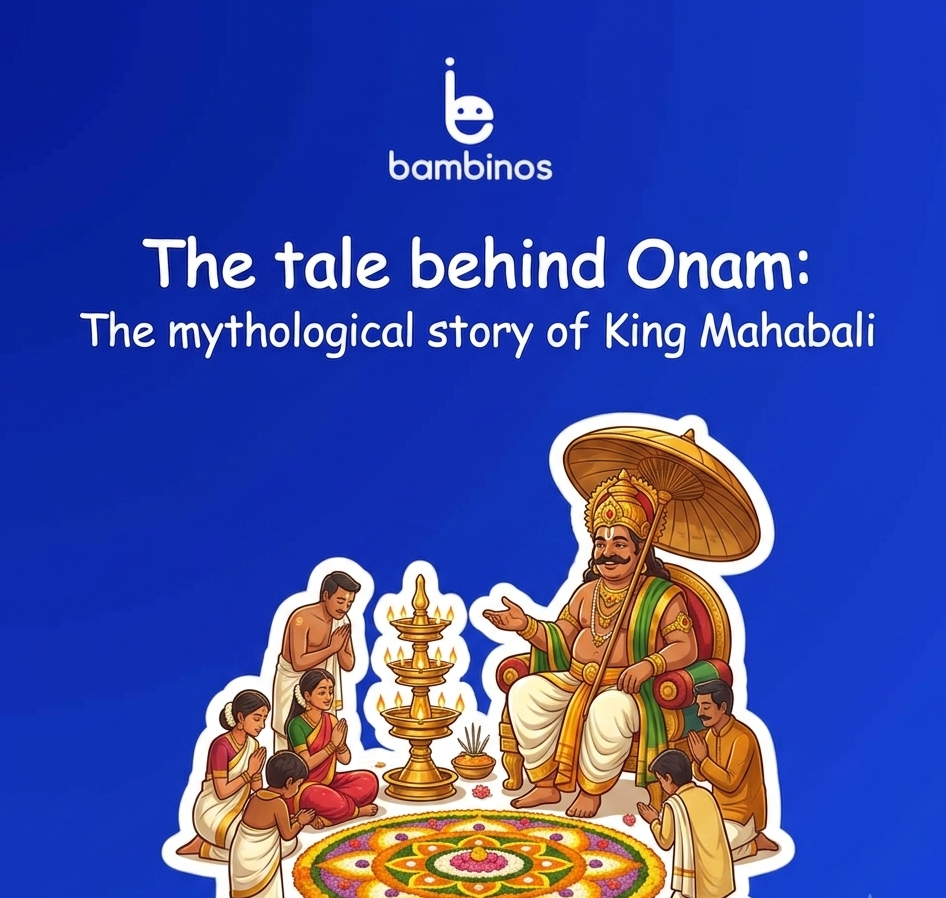
The story of Onam is about King Mahabali, Lord Vishnu and Vamana. According to Hindu mythology, Mahabali was a generous king who loved his people. Lord Vishnu appeared as Vamana and asked the king for three paces of land. Onam marks Mahabali's yearly return to his kingdom.
Many kids know Onam through colourful Pookalam, Onam Sadya, traditional clothes and family celebrations. But do children know why people welcome King Mahabali every year? Do teens know the story behind the traditions they see during the festival?
In this blog, kids, children and teens can explore the story of Mahabali and Vamana in simple English. They can also discover the meaning behind popular Onam traditions and try a few fun activities with their families.
What is the story of Onam?
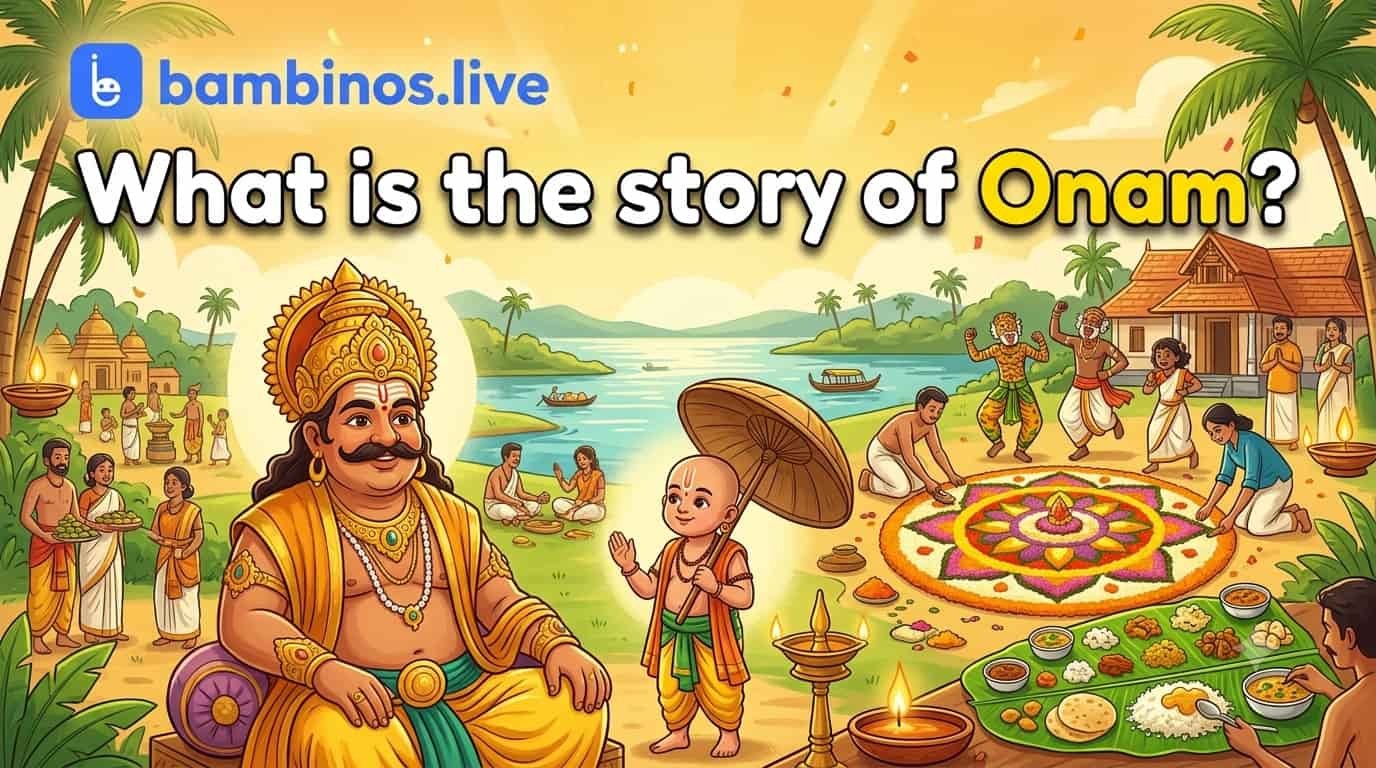
The story of Onam is about King Mahabali's promise to Vamana and his return to his people once a year. The story can be understood through three important events:
1. King Mahabali's rule
Mahabali was a kind and generous king. His people were happy with his rule, and his kingdom was known for peace and prosperity.
2. Vamana's request
Lord Vishnu came to Mahabali as Vamana, a young Brahmin. Vamana asked the king for three paces of land, and Mahabali agreed to the request.
3. Mahabali's return
Vamana used his first two steps to cover the Earth and the heavens. Mahabali offered his head for the third step. Lord Vishnu later allowed him to visit his people once every year.
This annual return of Mahabali is traditionally linked with Onam. Families celebrate by making Pookalam, preparing food and spending time together.
Who was King Mahabali?
King Mahabali was a powerful and generous ruler who was loved by his people. According to Hindu mythology, he belonged to the Asura lineage and ruled a prosperous kingdom.
Children can understand Mahabali's character through a few simple qualities:
- Generous: He gave to people who came to him for help.
- Kind: He cared about the people in his kingdom.
- Devoted: He followed his religious duties with faith.
- Honest: He kept the promises he made.
- Caring: He valued the people he ruled.
Mahabali was remembered not only as a king but also as someone who cared for his people. His character is one reason he remains an important part of Onam traditions.
For kids, his story can also be a simple lesson about sharing, helping others and keeping their word.
Why did Lord Vishnu visit King Mahabali?
Lord Vishnu visited King Mahabali as Vamana to test the king's generosity and devotion. At that time, Mahabali was performing a ritual and giving gifts to people who approached him.
The visit can be understood through three simple events:
- Vamana arrived: Vamana came before Mahabali in the form of a young Brahmin. He looked small and asked the king for a gift.
- Vamana made a request: Vamana asked Mahabali for three paces of land. The request seemed small compared with the size of Mahabali's kingdom.
- Mahabali agreed: Mahabali agreed to Vamana's request. He did not take back his word after making the promise.
This decision leads to the most important part of the story.
What did Vamana ask King Mahabali for?
Vamana asked King Mahabali for three paces of land. Mahabali agreed because he believed the request was small.
The conversation can be imagined like this:
- Vamana: “King Mahabali, I have come to ask you for a gift.”
- Mahabali: “Tell me what you need. I will give it to you.”
- Vamana: “I need only three paces of land.”
- Mahabali: “You have asked for very little. I agree to your request.”
Mahabali then gave his word.
After receiving the king's promise, Vamana began to grow. His form became so large that his first step covered the Earth and his second step covered the heavens.
Mahabali then realised that there was no space left for Vamana's third step.
What happened when Vamana took three steps?
Vamana covered the Earth and the heavens with his first two steps and asked Mahabali where he should place his third step. Mahabali then offered his own head.
The three steps happened like this:
- First step: Vamana took his first step and covered the Earth.
- Second step: Vamana took his second step and covered the heavens.
- Third step: Vamana had no place left for his third step. Mahabali bowed before him and offered his own head.
Vamana placed his third step on Mahabali's head.
Mahabali then had to leave his kingdom. However, Lord Vishnu was pleased with his devotion and his willingness to keep his promise.
According to the traditional story, Vishnu allowed Mahabali to return to his people once every year.
This annual return is traditionally associated with Onam.
What can children learn from the story of Onam?
Children can learn about generosity, honesty, humility and keeping promises from the story of Onam. The story of King Mahabali also helps children understand the importance of helping others, keeping their word and treating people with kindness.
Kids can understand these values through simple actions:
- Sharing something with a friend teaches generosity.
- Helping someone teaches kindness.
- Keeping a promise teaches responsibility.
- Accepting a difficult situation calmly teaches humility.
Parents and teachers can use the story to start simple conversations with children about how these values can be followed at home and school.
How do people celebrate Onam?
People celebrate Onam with traditional food, flowers, clothes, games and cultural events.
Pookalam
People make Pookalam, a floral design, at the entrance of their homes. Families use flowers to create different shapes and patterns.
Onam Sadya
Onam Sadya is a traditional vegetarian meal served on a banana leaf. It includes several dishes and is enjoyed with family and friends.
Vallam Kali
Vallam Kali, or traditional boat racing, is an important part of Onam celebrations in parts of Kerala. Large groups gather to watch the races.
Traditional clothes
People wear traditional Kerala clothes during the festival. Kids and teens often enjoy dressing up for family gatherings and celebrations.
Family celebrations
Families come together to eat, play games and take part in cultural programmes. These gatherings give children an opportunity to enjoy the festival with their loved ones.
Onam activities for kids
Onam activities for kids can help children learn about the festival while enjoying creative and traditional games. Parents and teachers can choose activities based on the child's age and interests.
Make a Pookalam
Give kids different flowers and let them create their own Pookalam. Younger children can make simple patterns, while older children and teens can try more detailed designs.
Draw King Mahabali
Ask children to draw King Mahabali and show his return to his kingdom. They can add flowers, homes and people waiting to welcome him.
Retell the Mahabali story
Parents can tell the story of Mahabali and Vamana and ask children to retell it in their own words. Teens can write a short version or create a small dialogue between the characters.
Make an Onam greeting card
Kids can create a handmade Onam card for their parents, grandparents, teachers or friends. They can add flowers, traditional patterns and a simple Onam message.
Learn about Onam Sadya
Parents can introduce children to the different dishes served during Onam Sadya. Kids can learn the names of the dishes and understand why families share the meal during the festival.
Try traditional games
Families can introduce children to simple traditional Onam games. Playing together can help kids learn about Kerala's festival traditions while spending time with family.
Explore more Indian mythological stories with Bambinos.live
The story of Onam introduces kids, children and teens to King Mahabali, Vamana and the traditions connected with the festival. It also gives families a simple way to talk about generosity, honesty, humility and keeping promises.
Want to introduce children to more stories from Indian mythology? Explore more mythological stories with Bambinos.live and discover engaging stories about Indian traditions, festivals and mythology.
FAQs
1. Why is Onam celebrated?
Onam is celebrated to welcome the return of King Mahabali, according to the traditional legend. The festival is also celebrated through Pookalam, Onam Sadya, traditional games, cultural events and family gatherings. The legend of Mahabali and Vamana is an important part of Onam and helps children understand the cultural and mythological meaning behind the festival.
2. Who was King Mahabali?
King Mahabali was a powerful ruler who was known for his generosity and care for his people. According to Hindu mythology, he belonged to the Asura lineage and ruled a prosperous kingdom. His people respected him for his kindness and good rule. His story remains an important part of Onam and helps children learn about generosity and keeping promises.
3. Who was Vamana?
Vamana was the fifth avatar of Lord Vishnu according to Hindu mythology. He appeared before King Mahabali as a young Brahmin and asked for three paces of land. Mahabali accepted the request. Vamana then grew into a huge form and covered the Earth and heavens with his first two steps, leading Mahabali to offer his head for the final step.
4. Why did Vamana ask Mahabali for three paces of land?
Vamana asked Mahabali for three paces of land as part of the traditional story of Onam. Mahabali was known for giving gifts to people who approached him, so he accepted the request. Vamana then grew in size and used his first two steps to cover the Earth and heavens. Mahabali offered his head when there was no space left for the final step.
5. What does the story of Onam teach children?
The story of Onam teaches children about generosity, honesty, humility and keeping promises. Mahabali gives freely to others and keeps his word even when the situation changes. Parents and teachers can use the story to explain these values through simple examples, such as sharing with friends, helping others and completing something they promised to do.
6. What is Pookalam?
Pookalam is a floral design made during Onam. People arrange flowers in different patterns at the entrance of their homes. Families often create the design together during the festival. Younger kids can make simple patterns, while older children and teens can try detailed designs. The activity gives families a chance to celebrate together while learning about an Onam tradition.
7. What is Onam Sadya?
Onam Sadya is a traditional vegetarian feast prepared during the Onam festival. The meal contains several dishes and is usually served on a banana leaf. Families and friends sit together and enjoy the food. For children, learning about Sadya can be a simple way to discover Kerala's food traditions and understand how shared meals bring families together.
8. What are some Onam activities for kids?
Some Onam activities for kids include making Pookalam, drawing King Mahabali, retelling the Mahabali story, creating greeting cards and learning about Onam Sadya. Younger children can take part in simple craft activities, while older children and teens can write stories, create dialogues or help prepare decorations. These activities can make learning about Onam more enjoyable.
About the Author

Bambinos Learning Solutions
AuthorBambinos is India’s #1 online learning platform for kids built by a team of IIM & IIT graduates.
LinkedIn Profile ↗