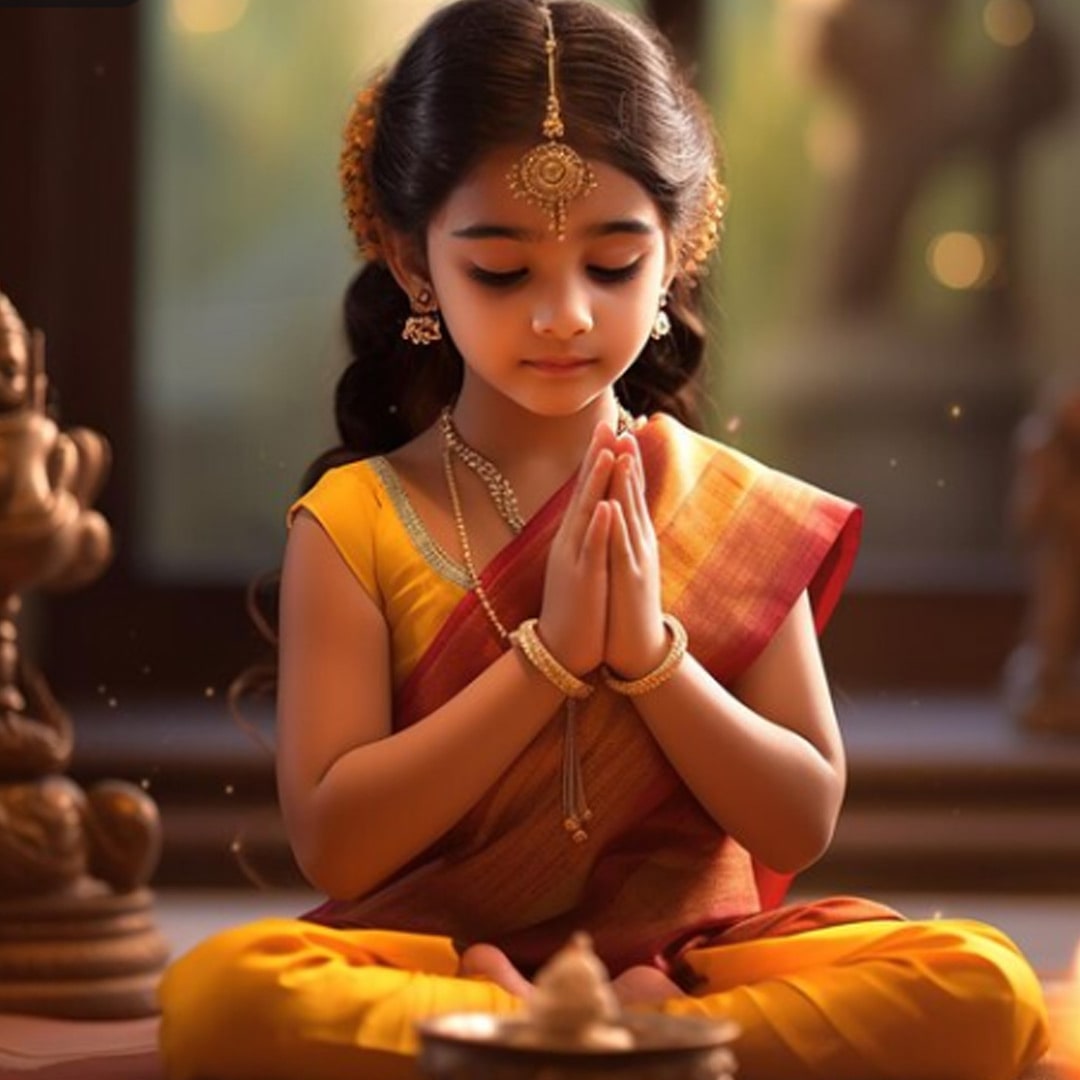
Many Indian kids hear the Gayatri Mantra long before they know what it means. It plays in the background during morning prayers, at a grandparent’s house, at the start of a school assembly. Then one day a kid asks, “What are we actually saying?”
This guide answers that question in simple terms: the words, what each one means, where the mantra comes from, what families traditionally believe it offers, and the customs people follow when chanting it. It also includes a gentle way to teach it to kids, one line at a time.
The mantra
ॐ भूर्भुवः स्वः। तत्सवितुर्वरेण्यं भर्गो देवस्य धीमहि। धियो यो नः प्रचोदयात्॥
Om bhūr bhuvaḥ svaḥ
tat savitur vareṇyaṁ bhargo devasya dhīmahi
dhiyo yo naḥ pracodayāt
A simple meaning: We meditate on the glorious light of the divine Savitr. May that light inspire and guide our minds.
For a young kid, you can shorten it further: “We think about the bright light of God, and we ask it to help us think well.”
What each word means
| Word | Meaning |
|---|---|
| Om | The sacred sound that begins most prayers |
| Bhūr | The earth |
| Bhuvaḥ | The space between earth and sky |
| Svaḥ | The heavens |
| Tat | That |
| Savitur | Of Savitr, the divine light of the sun that wakes and moves all life |
| Vareṇyam | Most excellent, worthy of choosing |
| Bhargo | Radiance, the light that removes darkness |
| Devasya | Of the divine |
| Dhīmahi | We meditate on |
| Dhiyo | Our thoughts, our understanding |
| Yo | Who |
| Naḥ | Our |
| Pracodayāt | May inspire, may guide |
Notice that the mantra does not ask for money, marks or success. It asks for one thing: a clearer mind. That is a lovely idea to share with kids, because it is something they can actually work on.
Where the mantra comes from
The Gayatri Mantra is found in the Rigveda, one of the oldest texts in the Hindu tradition, in Book 3, Hymn 62, Verse 10. Tradition credits it to Sage Vishwamitra, the same sage kids may know from Ramayana stories as Rama’s teacher.
“Gayatri” is also the name of the poetic metre the verse is written in, which has three lines of eight syllables each. Over time, the mantra itself came to be honoured as Goddess Gayatri, also called Vedmata, the Mother of the Vedas.
The opening words, Om bhūr bhuvaḥ svaḥ, are a short invocation that is traditionally added before the Rigveda verse when it is chanted.
The mantra also has a link to the Bhagavad Gita. In Chapter 10, Verse 35, Krishna lists the best of many things and says, “Among metres, I am Gayatri.” Older kids often enjoy finding this connection between two texts they thought were separate.
Gayatri Jayanti
Gayatri Jayanti is the day set aside to honour Goddess Gayatri and the mantra. Many families observe it on Shukla Ekadashi in the month of Jyeshtha, while others mark it on the full moon of Shravan, so the date depends on your region and calendar.
Families observe it in different ways: chanting the mantra together, a small puja with flowers, a havan, or simply learning the meaning. For kids, it is a good day to learn one new line of the mantra or hear the story of Sage Vishwamitra. If a havan is part of your family’s observance, younger kids should take part only with an adult close by.
Benefits families traditionally associate with it
In Hindu tradition, the Gayatri Mantra is chanted for wisdom, clarity and good understanding, sometimes called sadbuddhi. These are spiritual beliefs, held with deep respect by many families, and they are not medical claims.
For kids, regular chanting can also bring some practical learning benefits:
-
Listening and memory. Learning three lines in a fixed rhythm is a good memory exercise.
-
Sanskrit sounds. Kids practise sounds like bh, ṁ and ḥ that are rare in English.
-
A calm routine. Two minutes of chanting before school can become a quiet, steady start to the day.
-
Cultural connection. Kids understand a prayer they hear at family events, instead of just mouthing along.
Every kid responds differently, so focus on understanding and enjoyment rather than expecting a particular result. If your kid enjoys this, Bambinos.live also has a guide to simple Krishna mantras for kids that work well as a next step.
Traditional rules and customs
Customs around the Gayatri Mantra vary between families, regions and communities. Some traditions have specific rules about who chants it and when it is first taught. If your family follows a particular tradition, it is best to ask an elder or a priest you trust. Commonly followed customs include:
-
Time of day. Traditionally it is chanted at sunrise, noon and sunset, known as the three sandhyas. Many families simply chant it in the morning.
-
A clean, quiet place. Chanting usually happens after a bath, sitting on a mat facing east in the morning.
-
Posture. Sitting comfortably with a straight back, eyes closed or looking down.
-
Counting. Some people chant 108 times using a japa mala of 108 beads. Others chant 3, 11 or 27 times. Kids do not need to chant 108 times.
-
Pronunciation. Saying each word slowly and clearly is considered more important than speed.
-
Respect. The mantra is treated with reverence, so it is usually chanted with attention rather than casually.
Teaching it to kids, one line a week
Trying to learn all three lines in one sitting can frustrate a young kid. A slower plan works better:
Week 1: Om bhūr bhuvaḥ svaḥ. Point to the ground, then the air, then the sky as you say each word. Kids remember the actions first and the words follow.
Week 2: tat savitur vareṇyaṁ. Chant it while watching the morning sun from a window. Talk about how sunlight wakes up plants, birds and people.
Week 3: bhargo devasya dhīmahi. Light a diya and talk about how even a small light removes darkness from a room.
Week 4: dhiyo yo naḥ pracodayāt. Ask your kid when they needed good thinking this week. Sharing a toy, solving a sum, saying sorry to a friend all count.
By the end of the month, many kids can chant the whole mantra and explain it in their own words. If you would like a teacher to help with pronunciation, the Little Yogi course teaches prayers, mantras and Gita shlokas in live groups of up to six kids, with feedback on each kid’s chanting.
FAQs
Can kids chant the Gayatri Mantra?
Many families teach it to kids from a young age, while some traditions introduce it at a particular ceremony. Follow your family’s custom, and focus on correct pronunciation and meaning.
What is the best time to chant the Gayatri Mantra?
Traditionally, sunrise is considered the best time, along with noon and sunset. For kids, a regular morning slot works well.
Why is it chanted 108 times?
The number 108 is considered sacred in many Indian traditions, and a japa mala has 108 beads. Kids can start with three repetitions.
Is the Gayatri Mantra from the Bhagavad Gita?
No. It is from the Rigveda. The Gita mentions Gayatri once, in Chapter 10, Verse 35.
When is Gayatri Jayanti?
It falls in Jyeshtha or Shravan depending on regional tradition. Check your local Hindu calendar for the date each year.
Want to watch a teacher take a class through it first? Try a free class at Bambinos.live.
About the Author

Swati Prasad
AuthorSwati Prasad is a seasoned educator and Communication Trainer with 13 years of teaching experience. She holds a Bachelor of Hotel Management and has completed coursework for a Master's in Tourism. Specializing in remote training, Swati has developed strong skills in independent and efficient work, with a focus on communication and organization. Swati's journey in education includes eight years as a Pre-primary teacher, where she honed her ability to connect with young learners. Her passion for teaching and communication extends beyond the classroom, as she is also the published author of two successful children's books: "You Can Be a Whizz Kid Too!" and "Choose Your Path to Happiness.
LinkedIn Profile ↗