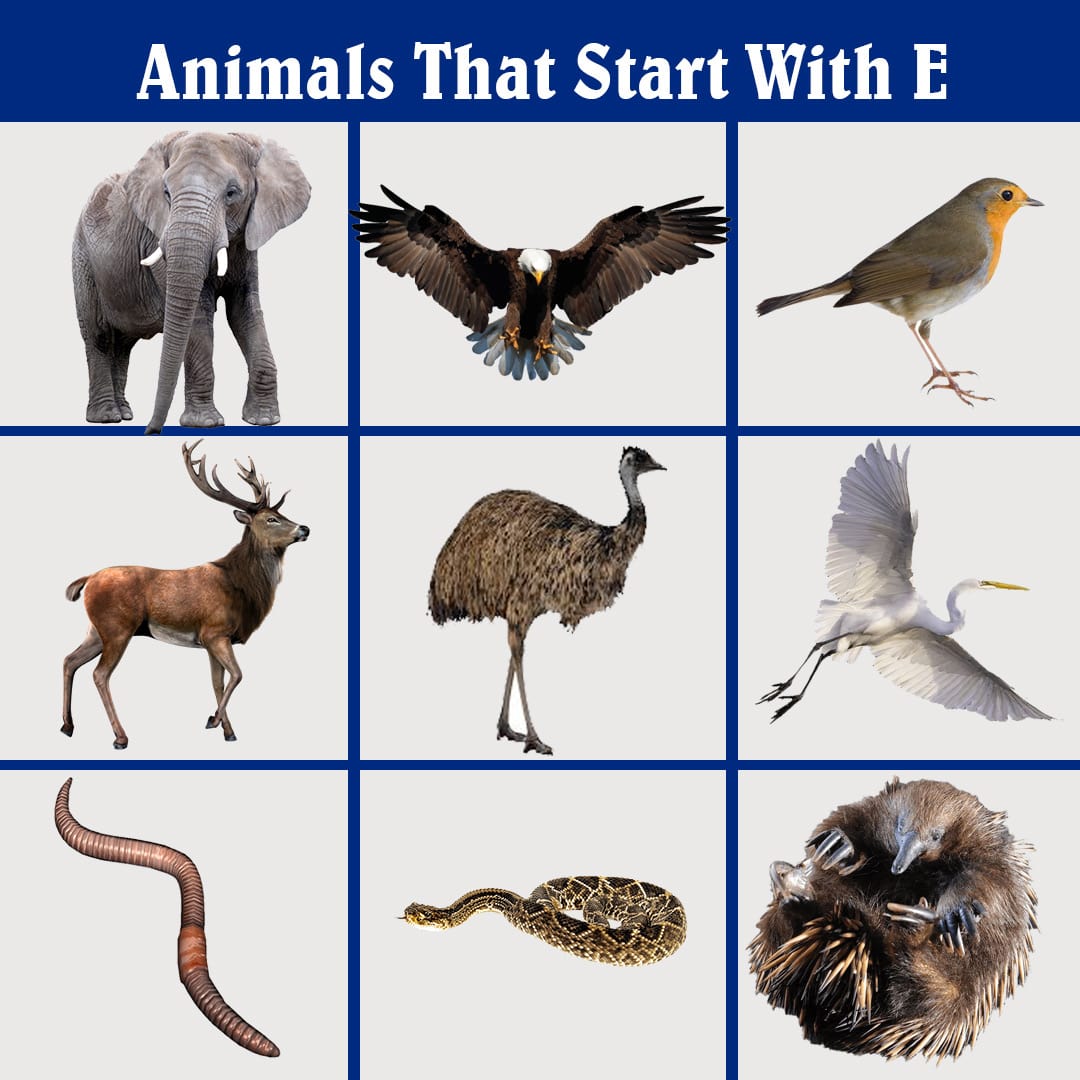
Two animals on this list are easy to see in India. Elephants live wild in forests from Kerala to Assam. Egrets are the white birds standing in rice fields or riding on the backs of buffaloes. The others take us to Australia, North America and Europe.
One thing to notice as you read the names aloud: they don’t all start with the same E sound. Elephant and elk begin with the short e, as in egg, while eagle, eel and emu begin with the long e. If your kid is still learning the letter, these letter E activities stick to short-e words, which are easier to start with.
Here they are at a glance, before we look at each one.
| Animal | Where it lives | What it eats | What makes it unusual |
|---|---|---|---|
| Elephant | Africa and Asia, including India | Grass, leaves, bark, fruit | The largest land animal |
| Egret | Wetlands and fields on every continent except Antarctica | Fish, frogs, insects | Cattle egrets follow grazing animals |
| Eagle | Every continent except Antarctica | Fish, small mammals, birds | Eyesight several times sharper than ours |
| Eel | Rivers and oceans | Fish, crabs, worms | Some swim thousands of km to breed |
| Elk | North America and parts of Asia | Grass, bark, leaves | One of the largest members of the deer family |
| Emu | Australia | Plants, seeds, insects | Can’t fly, but runs at about 50 km/h |
| Earthworm | Soil almost everywhere | Rotting leaves and plant matter | Has five pairs of heart-like organs |
| Echidna | Australia and New Guinea | Ants and termites | A mammal that lays eggs |
| Eastern diamondback rattlesnake | South-eastern USA | Rabbits, rats and other small animals | Gives birth to live young |
| European robin | Europe, North Africa and western Asia | Insects, worms, berries | Sings through the winter |
Elephant
Elephants are often called the largest animals on Earth. They’re actually the largest land animals. The blue whale, which lives in the sea, is much bigger.
An elephant’s trunk is its nose and upper lip joined together. It has tens of thousands of muscle bundles and no bones, so it can pick up a single peanut or tear down a branch. India is home to most of the world’s Asian elephants, and the elephant is India’s national heritage animal.
Egret
If you’ve seen a white bird standing next to a cow or buffalo in an Indian field, it was probably a cattle egret. It follows grazing animals because their hooves stir up insects from the grass. Many other egret species wade in shallow water, standing very still until a fish swims close, then striking with their sharp beaks.
Eagle
Eagles see far better than we do. A soaring eagle can spot small prey from a great height, and some species can see several times more sharply than humans. Their diving speed is impressive too. A golden eagle swooping on prey has been clocked at well over 200 km/h, though it flies much more slowly the rest of the time. Many eagle pairs stay together for years and return to the same nest.
Eel
There are hundreds of eel species, and they don’t all live the same way. Freshwater eels spend most of their lives in rivers and lakes, then travel long distances out to sea to breed. Some European eels swim thousands of kilometres to the Sargasso Sea in the Atlantic. Moray eels, on the other hand, live their whole lives in the ocean, often hiding in cracks in coral reefs.
Elk
The elk, also called wapiti, is one of the largest members of the deer family. Males grow a huge new set of antlers every year and drop them in late winter. In autumn, males make a loud, high-pitched call known as bugling to attract females and warn off rivals. Elk are strong swimmers and cross rivers easily.
Emu
The emu is the second-tallest bird in the world, after the ostrich. Adults stand up to about 1.9 metres tall. Emus can’t fly, but they can run at around 50 km/h on their long legs, and they swim well too. The father emu sits on the eggs, for about eight weeks, and barely eats the whole time.
Earthworm
Earthworms are small but extremely useful. As they tunnel, they let air and water into the soil, and as they eat dead leaves, they turn them into rich soil. Farmers and gardeners are always glad to find them. You can watch this happen in a glass jar layered with soil and sand, with a few worms and some leaves on top. Within a couple of weeks the layers are mixed. It’s the kind of simple observation kids do in Unbox Science’s live classes.
A common myth says that if you cut an earthworm in half, you get two worms. That isn’t true. Some species can regrow a lost tail section, but the two halves don’t become two new worms.
Echidna
The echidna is one of only a few kinds of mammals that lay eggs. The platypus is the other famous one. A mother echidna lays a single soft-shelled egg and keeps it in a pouch on her belly until it hatches. The baby is called a puggle. Echidnas are covered in spines like a hedgehog and catch ants and termites with a long, sticky tongue.
Eastern diamondback rattlesnake
This snake lives in the south-eastern United States and is the largest venomous snake in North America. It belongs to a group called pit vipers. Between its eyes and nostrils are heat-sensing pits that let it detect warm-blooded prey in the dark. Most snakes lay eggs, but this one gives birth to live young. It usually rattles its tail as a warning long before it would strike.
European robin
The European robin is a small bird with an orange-red face and chest. It’s common in gardens across Europe. Unlike many birds, both males and females sing, and they keep singing through the winter to defend their patch of ground. Gardeners often find a robin following them closely, waiting for worms turned up by the spade.
Talking about the list with kids
A good question to finish with: which of these animals could you actually see near where you live? In most of India, it’s the egret, sometimes an eagle, and, depending on where you are, elephants in a forest reserve. Earthworms are probably under the nearest flowerpot. Spotting one in real life will stay with a kid much longer than reading about all ten.
In phonics classes at Bambinos, letter sounds are practised with words like these, about things kids find genuinely interesting. The first class is a free trial.
About the Author

Nimrah Rafiq
AuthorNimrah Rafiq is a passionate educator hailing from Srinagar, holding a degree of MA in English literature. She has worked on various Ed-tech platforms and now she has joined as an educator in bambinos.live. She is enthusiastic about teaching and will move forward with zest and zeal.
LinkedIn Profile ↗