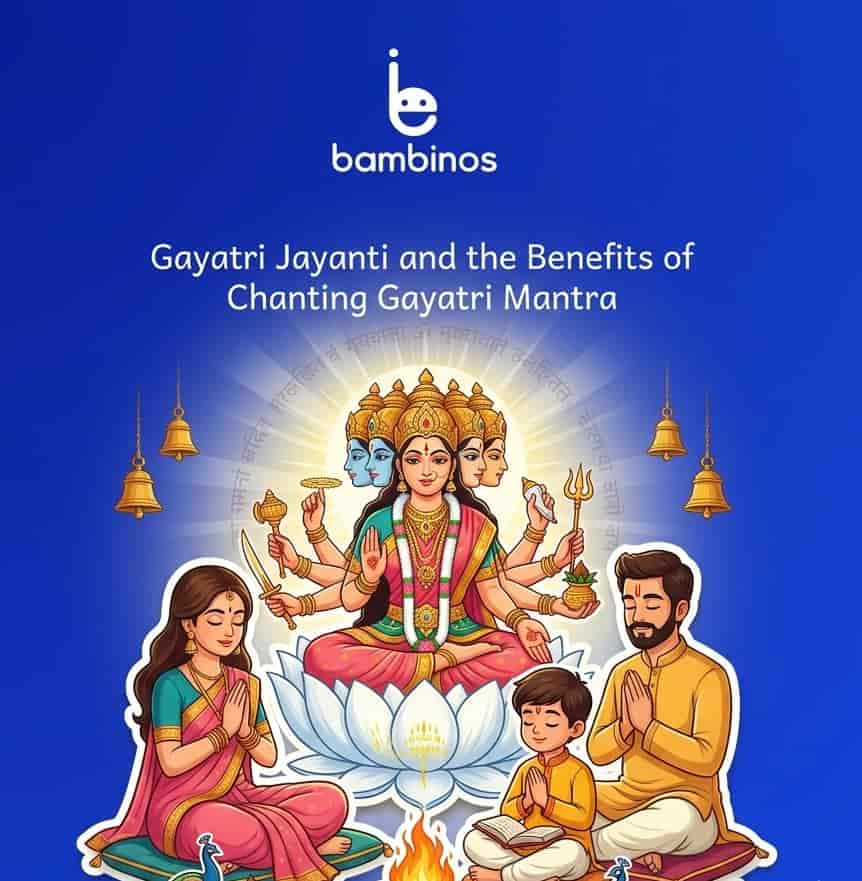
Gayatri Jayanti is traditionally associated with Goddess Gayatri, also known as Ved Mata (वेदमाता) or Vedmata, the Mother of the Vedas. The occasion is closely connected with the Gayatri Mantra, a Vedic mantra found in the Rigveda and traditionally associated with Sage Vishwamitra.
For kids and teens, Gayatri Jayanti can be an opportunity to learn the Gayatri Mantra meaning in English, Sanskrit, Vedic traditions and traditional ideas of wisdom, knowledge and Sadbuddhi. Learning the meaning behind the mantra can help children understand its cultural and spiritual significance.
At Bambinos.live, kids and teens can learn Sanskrit, Indian mythology, the Bhagavad Gita and Indian cultural traditions through age-appropriate lessons and activities.
In this blog, you will learn about Gayatri Jayanti, the Gayatri Mantra, Sanskrit, Vedic traditions and Indian cultural values through simple explanations
What is Gayatri Jayanti?
Gayatri Jayanti is traditionally observed to honour Goddess Gayatri and the significance of the Gayatri Mantra. Goddess Gayatri is revered as Ved Mata or Vedmata, the Mother of the Vedas. The occasion is associated with knowledge, wisdom and illumination of the intellect.
- Goddess Gayatri: Revered as Ved Mata or Vedmata, the Mother of the Vedas.
- Gayatri Mantra: The occasion is closely associated with this revered Vedic mantra.
- Traditional observance: Families may include chanting, Puja, Mantra Jaap, Havan or Yajna.
The way Gayatri Jayanti is observed can differ according to family, regional and community traditions. Some families may follow a detailed religious observance, while others may focus on prayer, chanting or learning about the significance of the mantra.
For children, Gayatri Jayanti can be introduced through stories, Sanskrit vocabulary and simple discussions about wisdom and thoughtful choices. Older kids and teens can explore its connection with the Rigveda, Gayatri Chhanda, Savitr and Sage Vishwamitra.
Who is Goddess Gayatri?
Goddess Gayatri is traditionally revered as Ved Mata or Vedmata, the Mother of the Vedas. She is closely associated with the Gayatri Mantra and traditional ideas of knowledge and wisdom.
- Vedmata: Goddess Gayatri is traditionally known as the Mother of the Vedas.
- Gayatri Mantra: She is closely associated with the revered Vedic mantra.
- Knowledge and wisdom: She represents traditional ideas connected with learning and illumination.
- Savitr: The Gayatri Mantra is traditionally addressed to Savitr, a divine solar figure.
- Cultural learning: Children can explore Goddess Gayatri through stories, Sanskrit and traditional artwork.
Learning about Goddess Gayatri can help children understand the cultural and spiritual context surrounding the Gayatri Mantra. For older children and teens, the topic can also provide an introduction to Vedic literature, Sanskrit and Indian philosophical traditions.
What is the Gayatri Mantra?
The Gayatri Mantra is a revered Vedic mantra from the Rigveda that is traditionally addressed to Savitr. It is associated with Gayatri Chhanda, a traditional Vedic metre.
The commonly recited form is:
Om Bhur Bhuvah Svah Tat Savitur Varenyam Bhargo Devasya Dhimahi Dhiyo Yo Nah Prachodayat
- Vedic origin: The mantra is found in the Rigveda.
- Traditional address: It is addressed to Savitr.
- Gayatri Chhanda: The mantra is associated with a traditional Vedic metre.
The Gayatri Mantra is traditionally understood as a prayer connected with divine light, wisdom and guidance of the intellect. Children can learn it gradually through pronunciation, simple meanings and cultural context.
For younger children, parents can introduce one line at a time. Older kids and teens can explore the Sanskrit vocabulary and understand how the mantra fits into Vedic traditions.
What does Dhiyo Yo Nah Prachodayat mean?
“Dhiyo Yo Nah Prachodayat” traditionally means “May our minds be guided towards wisdom and good understanding.” The phrase expresses a prayer for the divine to guide, inspire and illuminate the intellect. It reflects the traditional idea of seeking clarity, wisdom and सद्बुद्धि through the Gayatri Mantra.
For children, the meaning can be explained through everyday situations where thoughtful judgement matters. Parents can discuss examples such as resolving an argument calmly, helping a friend, thinking before speaking or making a responsible decision. This helps children understand how the idea of wisdom and good judgement can apply to daily life.
What are the benefits of chanting the Gayatri Mantra?
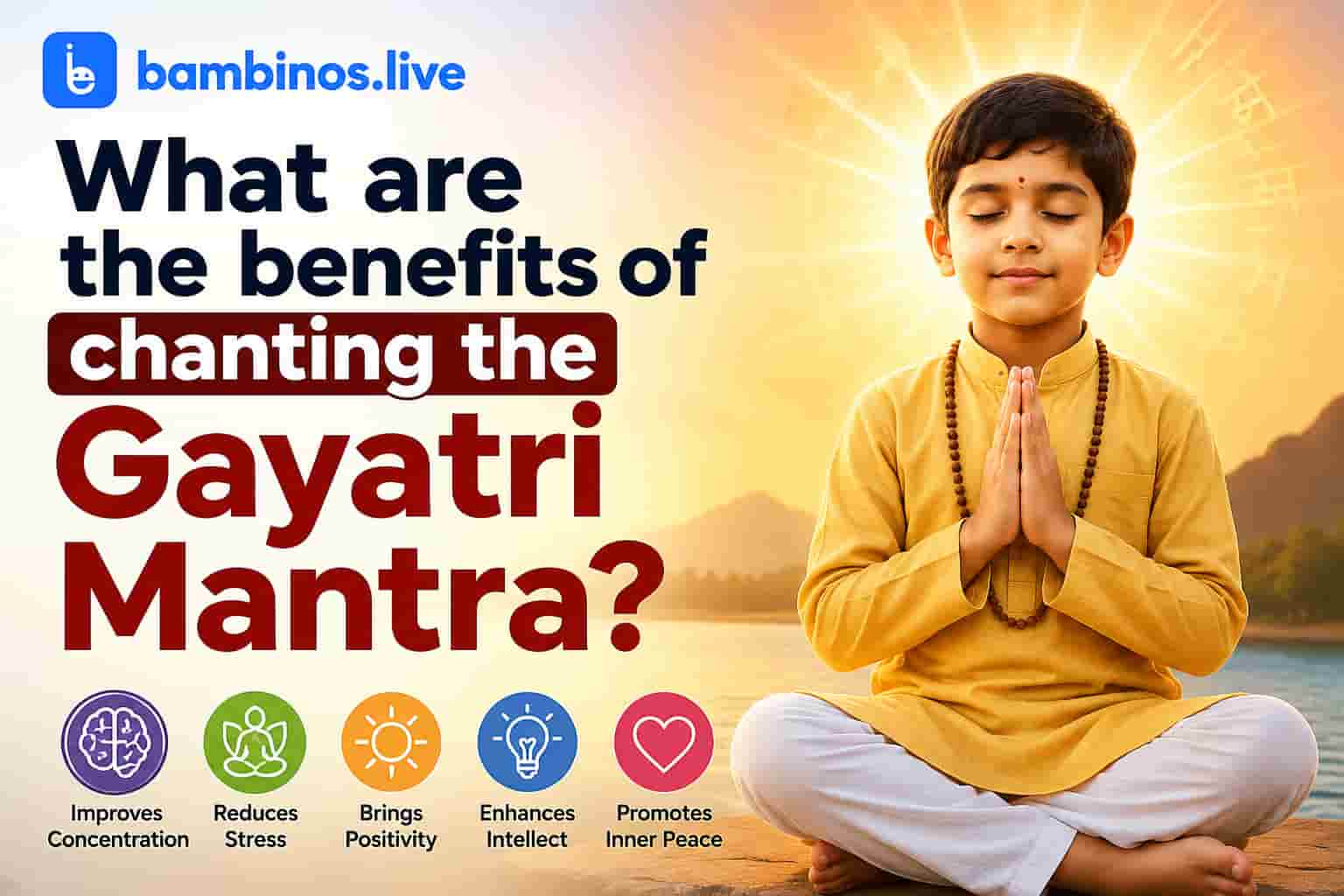
Traditional benefits of chanting the Gayatri Mantra are associated with concentration, wisdom, reflection and guidance of the intellect. These are traditional spiritual beliefs and should not be presented as guaranteed medical or scientific effects.
- Concentration: Chanting involves attention to words, pronunciation and rhythm.
- Reflection: Mantra Jaap can provide time for prayer and quiet reflection.
- Sanskrit learning: Children can become familiar with Sanskrit sounds and vocabulary.
- Vedic learning: Kids can learn about the Rigveda and Gayatri Chhanda.
- Sadbuddhi: The mantra introduces the traditional idea of wise understanding.
For children, chanting can also become an opportunity to practise listening, pronunciation and memory while learning about Indian cultural traditions.
These should be understood as traditional or educational benefits rather than guaranteed health outcomes.
Example: A parent can teach “Dhiyo Yo Nah Prachodayat,” explain its meaning and ask the child to describe a situation where they could make a wise or thoughtful choice.
How is Gayatri Jayanti celebrated?
Gayatri Jayanti can be observed through prayer, Gayatri Mantra chanting, Puja, Mantra Jaap, Havan and Yajna. Practices can differ between families, regions and communities.
- Chanting: Families may recite or listen to the Gayatri Mantra.
- Puja: Some families may perform a traditional Puja dedicated to Goddess Gayatri.
- Mantra Jaap: Devotees may repeat the mantra as part of their spiritual practice.
- Havan: Some observances may include a traditional fire ritual.
- Yajna: Families or communities may include Yajna according to their customs.
Parents can explain the purpose of each activity to children so they understand the cultural context instead of simply following the ritual.
Gayatri Mantra chanting
Gayatri Mantra chanting involves reciting or listening to the revered mantra as part of traditional spiritual practice.
- Listening: Younger children can begin by listening to the mantra.
- Pronunciation: Children can gradually practise individual lines.
- Meaning: Parents can explain simple meanings alongside recitation.
Children do not need to memorise the entire mantra immediately. Learning gradually can make pronunciation and meaning easier to understand.
Gayatri Jayanti Puja Vidhi
Gayatri Jayanti Puja Vidhi can vary according to family and regional customs. A family observance may include preparing a prayer space, offering flowers, praying to Goddess Gayatri and reciting or listening to the mantra.
- Prayer space: Families may prepare a clean and respectful place for prayer.
- Offerings: Flowers or other traditional offerings may be included.
- Mantra: Families may recite or listen to the Gayatri Mantra.
- Family tradition: The exact Puja Vidhi can differ between communities.
Children can observe and learn about the practices with guidance from parents or elders.
Mantra Jaap
Mantra Jaap means repeated recitation of a mantra. Some devotees use a Japa Mala to count repetitions during their practice.
- Repetition: A mantra is recited repeatedly.
- Japa Mala: A traditional mala may be used to count repetitions.
- Focus: Devotees may use Jaap as part of prayer and focused spiritual practice.
Children can be introduced to Jaap gradually, with attention given to pronunciation and understanding rather than completing a fixed number of repetitions.
Havan and Yajna
Havan and Yajna are traditional practices that some families and communities can include in religious observances. Children can observe these practices with adult guidance.
- Havan: A traditional ritual involving offerings into a sacred fire.
- Yajna: A broader Vedic ritual tradition that can involve offerings, mantras and prayers.
- Supervision: Children should participate around fire only with appropriate adult guidance.
What is the connection between Gayatri Mantra and Bhagavad Gita?
The Bhagavad Gita mentions Gayatri in Chapter 10, Verse 35, within Vibhuti Yoga. Lord Krishna describes different manifestations of divine excellence in this chapter.
- Chapter: The reference appears in Chapter 10.
- Section: Chapter 10 is known as Vibhuti Yoga.
- Verse: Gayatri is mentioned in Verse 35.
- Connection: The reference provides a link between the Bhagavad Gita and Vedic traditions.
The Gayatri Mantra is found in the Rigveda, while the Bhagavad Gita is part of the Mahabharata. This distinction can help older children understand that different Hindu texts have different contexts and purposes. For children and teens who want to explore these teachings further, Bhagavad Gita classes online can provide age-appropriate lessons on verses, stories, values and their cultural context.
What does Lord Krishna say about Gayatri?
In Bhagavad Gita Chapter 10 Verse 35, Lord Krishna identifies Gayatri among the Vedic metres. The statement appears as part of his explanation of divine manifestations.
- Vibhuti Yoga: The verse appears in Chapter 10.
- Gayatri: Krishna identifies Gayatri among the Vedic metres.
- Broader context: The reference forms part of Krishna's explanation of divine manifestations.
Older children and teens can explore this verse while learning about the Bhagavad Gita and its connection with broader Vedic traditions.
What is the connection between Sage Vishwamitra and Gayatri Mantra?
The Gayatri Mantra is traditionally associated with Sage Vishwamitra, also known as Brahmarishi Vishwamitra, and is found in the Rigveda.
- Sage Vishwamitra: An important figure in Hindu tradition.
- Traditional association: He is traditionally connected with the Gayatri Mantra.
- Rigveda: The mantra is found in this ancient Vedic text.
Sage Vishwamitra also appears in several traditional stories. Children can learn about him through age-appropriate storytelling and explore themes such as determination, discipline and spiritual pursuit.
For older kids and teens, his connection with the Gayatri Mantra can provide an introduction to Vedic literature and the traditional role of sages in Indian heritage.
Why is the Gayatri Mantra chanted 108 times?
The Gayatri Mantra is traditionally chanted 108 times as a form of Japa, with 108 holding significance in several Indian spiritual traditions. Some devotees use a Japa Mala to count the repetitions. The practice is traditionally associated with focused prayer, reflection and spiritual discipline.
- Traditional Japa: Devotees may recite the mantra 108 times as part of their spiritual practice.
- Japa Mala: A traditional mala can help count each repetition.
- Gradual practice: Beginners can first learn the pronunciation and meaning before following 108 repetitions.
Children do not need to complete 108 repetitions. Parents can introduce Gayatri Mantra Jaap gradually, focusing on correct pronunciation, understanding and respectful learning.
Explore Indian traditions with Bambinos.live
At this point, you have learned about Gayatri Jayanti, Goddess Gayatri, Vedmata, the Gayatri Mantra, Sage Vishwamitra and the Rigveda. These topics introduce children to Sanskrit, Indian mythology and cultural traditions, along with ideas such as ज्ञान, सद्बुद्धि and वैदिक परंपरा.
Kids and teens can learn these subjects through Sanskrit words, stories, Bhagavad Gita verses and cultural activities. They can also learn the meaning of the Gayatri Mantra, Hindu traditions and the role of Sanskrit and Vedic literature.
Bambinos.live offers classes for kids and teens in Sanskrit, Indian mythology, the Bhagavad Gita and Indian cultural traditions. Book a free demo with Bambinos.live to choose a learning program for your child.
FAQs
1. Why is Gayatri Jayanti celebrated?
Gayatri Jayanti is celebrated to honour Goddess Gayatri and the traditional importance of the Gayatri Mantra. The occasion is associated with wisdom, knowledge and guidance of the intellect. Families may observe Gayatri Jayanti according to their customs through Gayatri Mantra chanting, Puja Vidhi, Mantra Jaap, Havan or Yajna.
2. What is the Gayatri Mantra?
The Gayatri Mantra is a revered Vedic mantra found in the Rigveda and traditionally addressed to Savitr. It is associated with Gayatri Chhanda, a traditional Vedic metre. Children can learn the mantra along with its Sanskrit pronunciation, गायत्री मंत्र का अर्थ and its traditional connection with Vedic learning.
3. What is the Gayatri Mantra meaning in English?
The Gayatri Mantra meaning in English is traditionally understood as a prayer for divine light to guide and illuminate the intellect. A simple explanation for children is, “May the divine light guide our minds towards wisdom and understanding.” Its meaning can also be connected with Sadbuddhi (सद्बुद्धि), or wise and good understanding.
4. What does Dhiyo Yo Nah Prachodayat mean?
“Dhiyo Yo Nah Prachodayat” is traditionally understood as a prayer for guidance and illumination of the intellect. The phrase can be connected with wisdom and सद्बुद्धि. For children, it can be explained as a prayer that their minds may be guided towards wisdom and good understanding. Parents can connect this meaning with making thoughtful choices and developing good judgement.
5. What are the benefits of chanting the Gayatri Mantra?
Traditional benefits of chanting the Gayatri Mantra are associated with concentration, wisdom, reflection and spiritual practice. Gayatri Mantra Jaap can also introduce children to Sanskrit pronunciation, Vedic traditions and the idea of Sadbuddhi. These are traditional spiritual beliefs and should not be presented as guaranteed medical or scientific benefits.
6. Can children chant the Gayatri Mantra?
Children can learn and chant the Gayatri Mantra with guidance from parents, teachers or knowledgeable elders. Younger children can begin by listening and gradually learning the words, while older kids and teens can explore the Sanskrit meaning and Vedic background. Parents can focus on correct pronunciation, understanding and respectful learning.
7. Who is Goddess Gayatri?
Goddess Gayatri is traditionally revered as Ved Mata or Vedmata (वेदमाता), the Mother of the Vedas. She is closely associated with the Gayatri Mantra and traditional ideas of knowledge, wisdom and illumination. Children can learn about Goddess Gayatri through stories, Sanskrit activities, traditional artwork and age-appropriate cultural learning.
8. Who is Sage Vishwamitra?
Sage Vishwamitra is an important figure in Hindu tradition and is traditionally associated with the Gayatri Mantra. He is also known as Brahmarishi Vishwamitra (ब्रह्मर्षि विश्वामित्र) and appears in several traditional stories. Children can learn about him through age-appropriate storytelling while exploring his connection with the Rigveda and Vedic heritage.
9. What is Vibhuti Yoga?
Vibhuti Yoga is Chapter 10 of the Bhagavad Gita, where Lord Krishna describes different divine manifestations. Gayatri is mentioned in Chapter 10, Verse 35, where Krishna identifies Gayatri among the Vedic metres. Older children and teens can explore this reference while learning about the Shrimad Bhagavad Gita (श्रीमद्भगवद्गीता), Vibhuti Yoga (विभूति योग) and broader Indian philosophical traditions.
About the Author

Bambinos Learning Solutions
AuthorBambinos is India’s #1 online learning platform for kids built by a team of IIM & IIT graduates.
LinkedIn Profile ↗