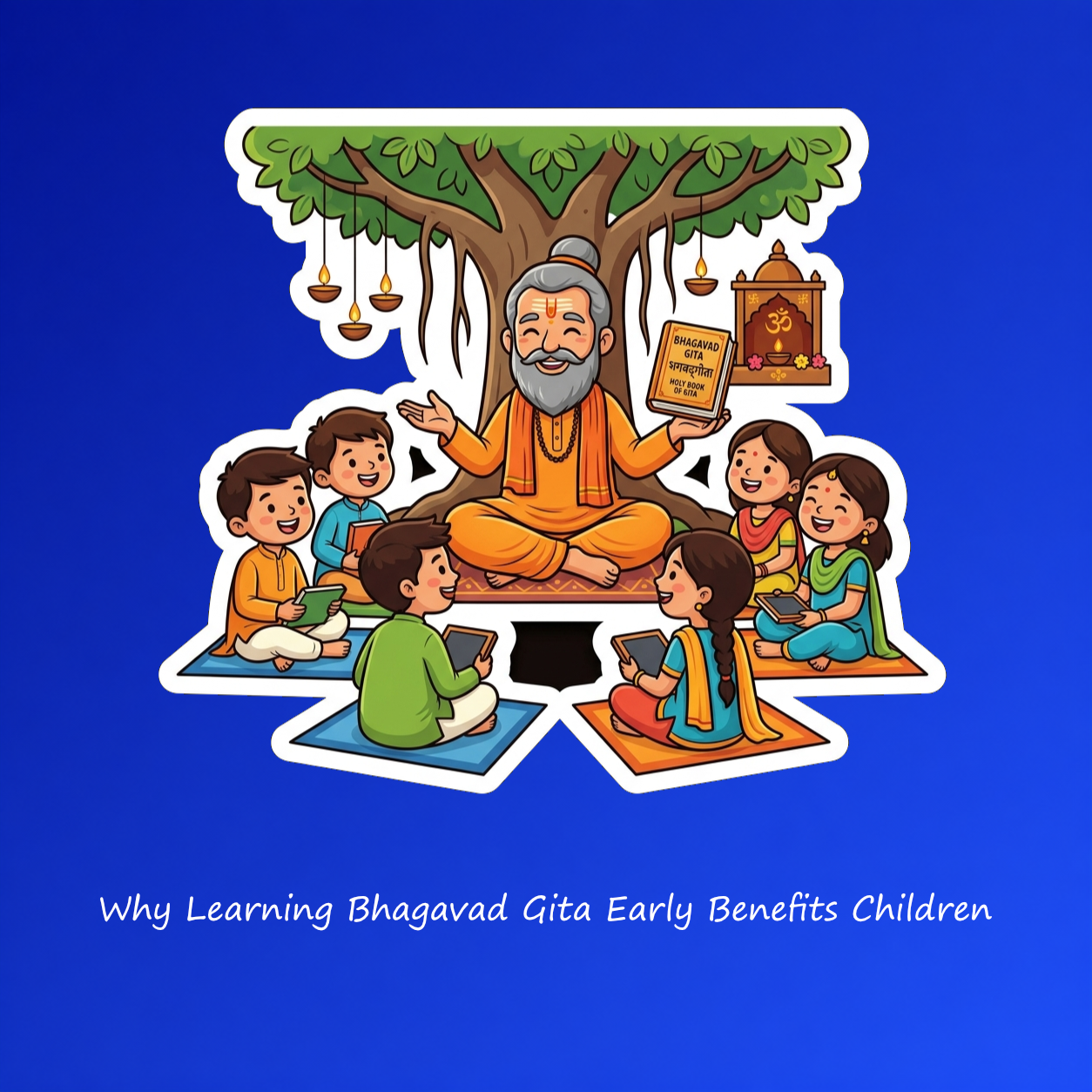
Learning the Bhagavad Gita early benefits children because its ideas get time to grow with them. A verse heard at six can mean something new at ten, and something deeper again at fifteen.
Think of a line your grandmother used to say when you were small. You may not have understood it then. Years later, in a hard moment, it came back to you and suddenly made sense. The Gita is full of lines like that, and childhood is the best time to plant them.
Why Start the Gita Early?
Children should start the Gita early because ideas heard often in childhood tend to stay with them. An early start also lets the meaning unfold slowly, without pressure.
In the Gita, Krishna talks Arjuna through a moment of confusion and fear. Its central questions are about duty, fear and doing the right thing. Children meet these questions long before adulthood, in classrooms, on playgrounds and within families.
Starting early does not mean beginning with the whole text. It means starting with stories, adding a few short verses, and letting the rest follow.
5 Benefits of Learning the Bhagavad Gita Early
1. Verses Grow With the Child
The same verse gains new meaning at each age, because each stage brings a new problem that its words answer.
Take verse 2.47, where Krishna asks Arjuna to care for the work and let go of its fruits:
| Age | What the child hears in 2.47 |
|---|---|
| 6 | "Try your best." |
| 10 | A comfort after a spelling test that went badly |
| 14 | A real question: how much should marks decide how I feel about myself? |
The words stay the same. The child changes, and keeps finding more in them. These Gita shlokas every child should know are good ones to plant early for this reason.
2. Words for Values Children Already Feel
The Gita gives children clear words for values that are hard to explain in everyday language:
- Dharma: right duty
- Karma: action
- Kshama: forgiveness
A child who has a word for an idea can talk about it. "That wasn't fair" becomes a conversation about dharma. "Why should I share first?" becomes a conversation about kindness.
Stories make these words stick. The Mahabharata is full of characters who face these choices, and these Bhagavad Gita stories in English bring them to life for young listeners.
3. Practice in Listening and Speaking Clearly
Reciting shlokas gives children regular practice in listening closely and speaking clearly. Sanskrit verses have a fixed rhythm, and each sound must be repeated with care.
A child first listens to a shloka several times, then repeats it in small parts, paying attention to long and short sounds. Over weeks, this can turn into a habit of careful listening.
Chanting also gives shy children something safe to say aloud. A child who will not speak up in class may happily chant a shloka they know well.
4. A Shared Family Ritual
The Gita gives families a small, regular reason to sit together. A short slot on a Sunday morning is enough to begin.
- Keep a regular slot: The same time each week turns it into a ritual children look forward to.
- Invite grandparents in: Many grandparents know Gita stories and verses from their own childhood.
- Let children lead sometimes: A child who explains a verse to the family understands it better.
Keeping the habit going is what counts, far more than how much is covered. Over a year, a few verses a month add up to a real foundation.
5. A Living Link to Festivals and Culture
Festivals give children a joyful reason to connect with the Gita. Gita Jayanti marks the day the Gita is believed to have been spoken.
This year, the International Gita Jayanti Mahotsav in Kurukshetra runs from 5 to 25 December 2026, with the main events from 14 to 20 December, as reported by DD News. Families who cannot travel can still mark the day at home by reading one chapter together, or by learning one new verse.
What If a Child Shows No Interest?
If a child shows no interest at first, go back to stories and wait. Interest often comes once the Gita feels like a story about real people.
- Avoid turning it into homework: A child who is made to memorise verses as a chore may lose interest for years.
- Lead with a bedtime story: A child who hears a good story at night often comes back asking for the next one.
Some families find that a class helps here, while others prefer to learn at home first. This comparison of online and offline Bhagavad Gita classes for kids can help you decide what suits your child.
Give the Gita Room to Grow
A verse learned at six does not need to be fully understood at six. It only needs a place in your child's memory, where it can wait for the day it makes sense. Start with one story your child enjoys and one verse that fits their life right now, then let the meaning grow year by year.
If you would like a teacher alongside you, Little Yogi at Bambinos.live offers live Bhagavad Gita classes for kids aged 4 to 15 in small groups. You can try a free demo class with Little Yogi before you decide.
FAQs
Is it too early to start the Gita at age 5?
No, age 5 is not too early to start the Gita, as long as you begin with stories. Short verses can follow from about age 7.
Is the Gita only about religion?
The Gita is a sacred text, and it also discusses duty, effort, self-control and kindness. These ideas apply to a child's daily life at school and at home.
How much time should a child spend on the Gita each week?
A child can spend about a quarter of an hour on the Gita, once or twice a week. Short, regular sessions work better than long ones now and then.
About the Author

Rita Gupta
AuthorRita is an experienced educator specializing in Gita, and English, known for her engaging teaching style and supportive classroom environment. Along with her passion for teaching, she actively writes articles and stories that reflect her creativity and love for learning. Rita focuses on understanding every student’s individual needs, helping them gain confidence, stay motivated, and build a strong academic foundation. Through her guidance, learners develop essential skills and unlock their highest potential. For her, every student is a unique story waiting to be written, and she feels grateful to play even a small part in helping them discover their brightest chapter.
LinkedIn Profile ↗